
How to Choose a Reliable Stainless Steel Cookware Manufacturer in China
Choosing a stainless steel cookware manufacturer in China is an evidence exercise, not a brand search — most of what ranks for this query is consumer content that will not take your wholesale order. For importers, category buyers and brand owners: how to build a shortlist, verify the factory and the steel, match compliance paperwork to your markets, and score the terms that predict reorders.
 Potobelo Editorial Team11 min read
Start with the spec, not the search
Search "stainless steel cookware manufacturer" from the US and the first page shows consumer brands — All-Clad, Made In, Heritage Steel, Hestan — plus "best cookware sets" listicles. None of them will take your wholesale order, and none of them tells you anything about production capability. The reliable stainless steel cookware manufacturer for your business is not the one with the loudest brand; it is the one that can be verified against your requirements.
So the shortlist starts before any search: write the spec. What grades do you need — 304 for cooking surfaces as a minimum, 201 only for non-food-contact parts like lids and outer shells? What sizes, capacities and construction — one-piece deep-drawn bodies, composite (impact) bottoms for even heating and induction compatibility? What volumes, and which destination markets, since those decide the compliance paperwork you will need? If grades are new to you, how stainless steel cookware grades are defined is the reference to read first.
Write it down. A spec you can hand to five factories is the difference between comparable quotes and a pile of marketing. A workable one-page version looks like this:
- Materials: grades per part — 304 for cooking surfaces and interiors; 201 acceptable only for parts that never hold food, such as lids and outer shells.
- Construction: one-piece deep-drawn body where the design allows it; composite (impact) bottom for even heating and induction compatibility.
- Range: sizes and capacities, plus which SKUs are catalog items and which are custom.
- Volumes: first order, annual forecast, and the MOQ you can commit to per model.
- Markets: destination countries, because they determine the compliance paperwork in section five.
- Timing: when you need samples and when you need the container, so lead-time promises can be compared against a calendar.
None of this needs to be final. It needs to be written, because every subsequent step — the shortlist, the quotes, the samples, the inspection — is a comparison against this document.
Build a shortlist of factories, not brands
Shortlist candidates come from four places: trade shows where you can handle the product (Canton Fair, Ambiente, regional housewares shows), B2B platforms such as Alibaba and Made-in-China (treat the listing as lead generation, not verification), industry directories, and — most reliable — referrals from importers already buying cookware from China. Our sourcing guides walk through each channel in more detail.
Two things to unlearn before you start. First, "top cookware brands" lists are consumer content: the brands on them usually do not run wholesale or OEM programs, and a brand ranking says nothing about factory capability. Second, country of brand is not country of factory — several "American" and "European" cookware brands manufacture overseas. Made-in-USA discourse is a marketing position, not a verification method.
Then split your shortlist by buyer type, because the requirements differ. If you are buying catalog products for wholesale, you need MOQ flexibility, stable lead times and reorder-grade consistency. If you are running an OEM stainless steel cookware program or a private label stainless steel cookware line, you additionally need engineering depth, sampling discipline and packaging control. A factory that is excellent for one may be mediocre for the other. Decide which you are, and score candidates against that list — not against a generic "good supplier" ideal.
Watch for platform red flags while you shortlist: listings where every product is priced identically, "factories" that cannot name their own production lines, and sales teams that answer technical questions with brochures. None of these disqualify a candidate on its own, but each one is a prompt to move the conversation to documents and a live tour.
Separate stainless steel cookware manufacturers from trading companies
The single most expensive mistake in China sourcing is approving a factory that turns out to be a trading company. Trading companies resell other people's production; the gap between the sample you approve and the container you receive widens with every hand the goods pass through.
A real stainless steel cookware factory can show you evidence that a trader cannot. Ask for four things:
- A business license with manufacturing scope, not a "trade" scope.
- A process line-up — which of these are in-house: deep drawing, composite-bottom bonding, welding, polishing, packaging. In-house is not a purity test; the point is that you know what is outsourced.
- Live footage of the floor — a video call walkthrough, unannounced, works fine. A trader books a tour of someone else's factory; a manufacturer walks you through their own.
- Audit reports and audit willingness — BSCI or equivalent social-compliance audits, and acceptance of a third-party audit as part of your qualification.
A factory that hesitates on any of these is telling you something. The full audit playbook — certificates and the three inspection points — is covered in our guide to sourcing cookware from China, which this article builds on.
One calibration note: this is also the bar we hold ourselves to. Potobelo is the export brand of a Guangdong cookware manufacturer with three decades of production behind it, and the evidence list above is what a buyer receives from us before the first quote — a reference point to compare other candidates against.
Check the stainless steel story: grades, materials, process
Every quotation names a grade. The verification question is whether the metal in the container is the metal on the invoice. Both 201 and 304 are austenitic grades; the chemistry bands are standard AISI ranges, as referenced in this stainless steel grades overview: 304 carries 18–20% chromium and 8–10.5% nickel, while 201 substitutes manganese for part of the nickel (16–18% chromium, 3.5–5.5% nickel) — which is why it costs less and why its corrosion resistance is lower in practice. For a cooking surface that meets food acids and standing water, 304 is the recognized food-contact choice; 201 is typically used where contact is not the issue — lids, outer shells, value lines. What the price gap between 201 and 304 buys is a separate article, and worth reading before you compare quotes.
Verifying the grade takes paperwork, not trust:
- Mill certificate per batch. Ask for it with every quotation and every shipment. It states grade, gauge and heat number. No mill certificate, no grade claim — that simple.
- Grade written into the purchase order. If "304" appears on the PO and the inspection clause, a factory has a contractual reason to keep the substitution honest.
- Optional PMI spot check. At inspection, a handheld spectrometer confirms the alloy on a finished piece. It is cheap, and it is the only test that sees the actual pot.
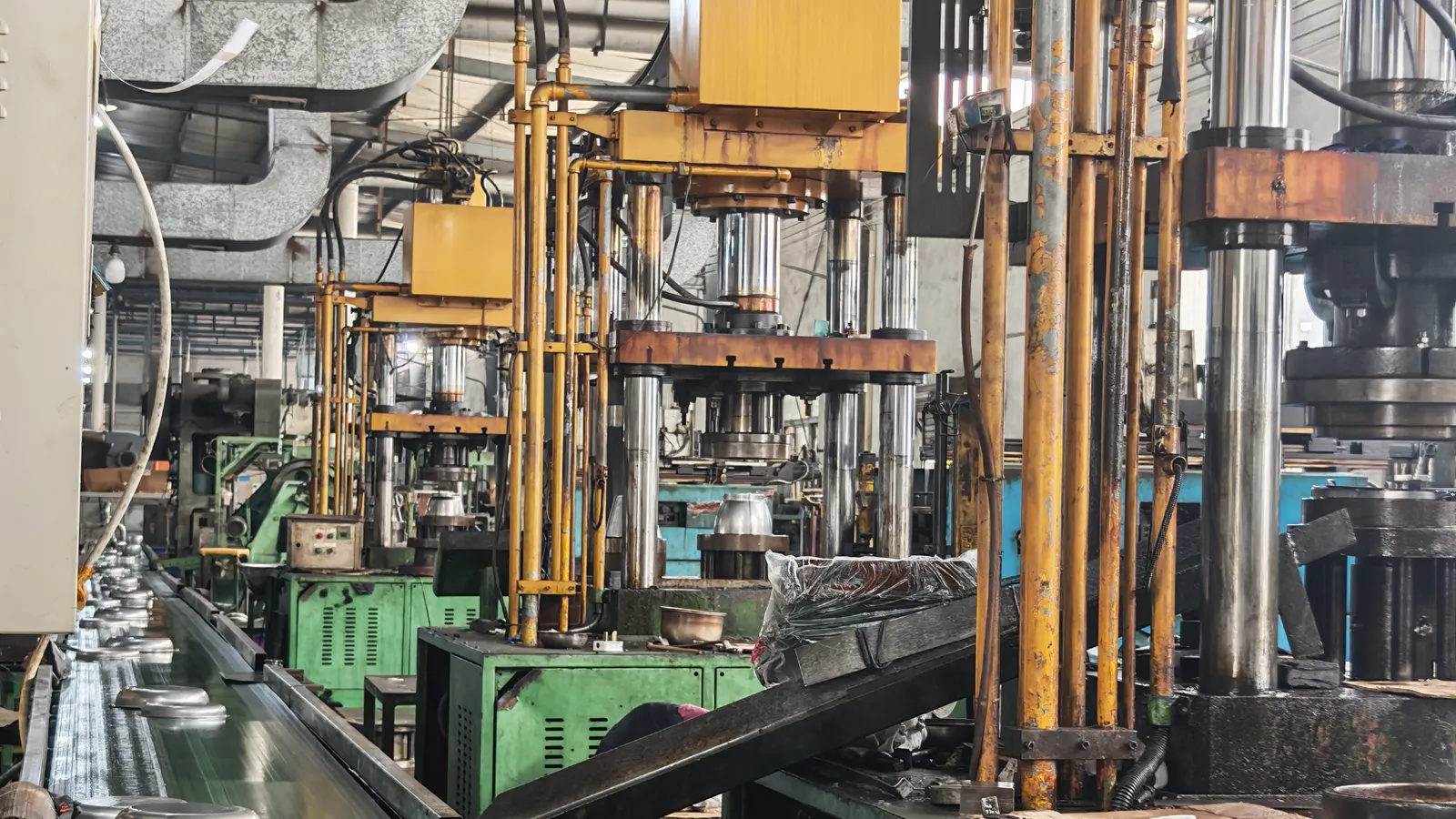
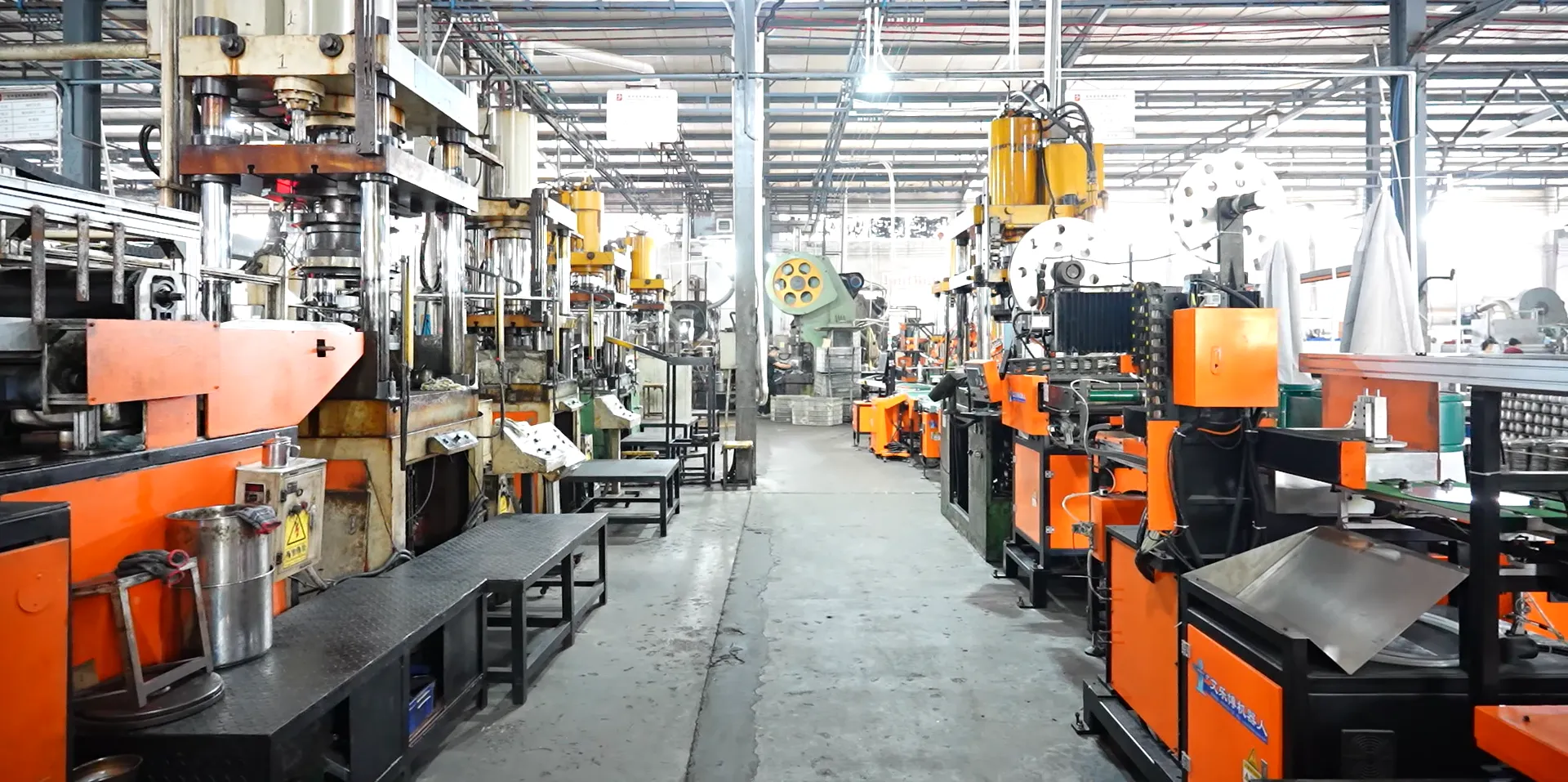
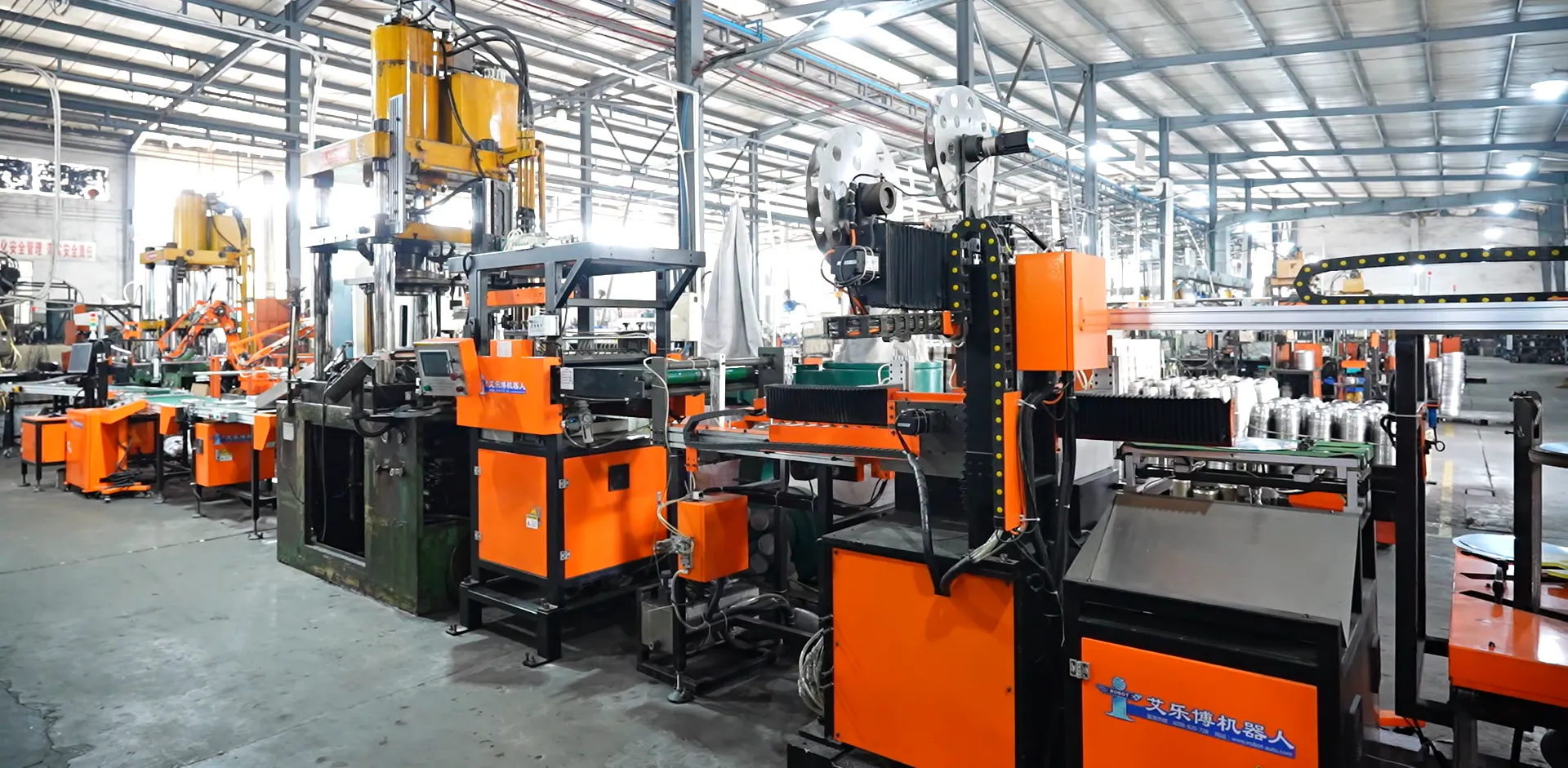
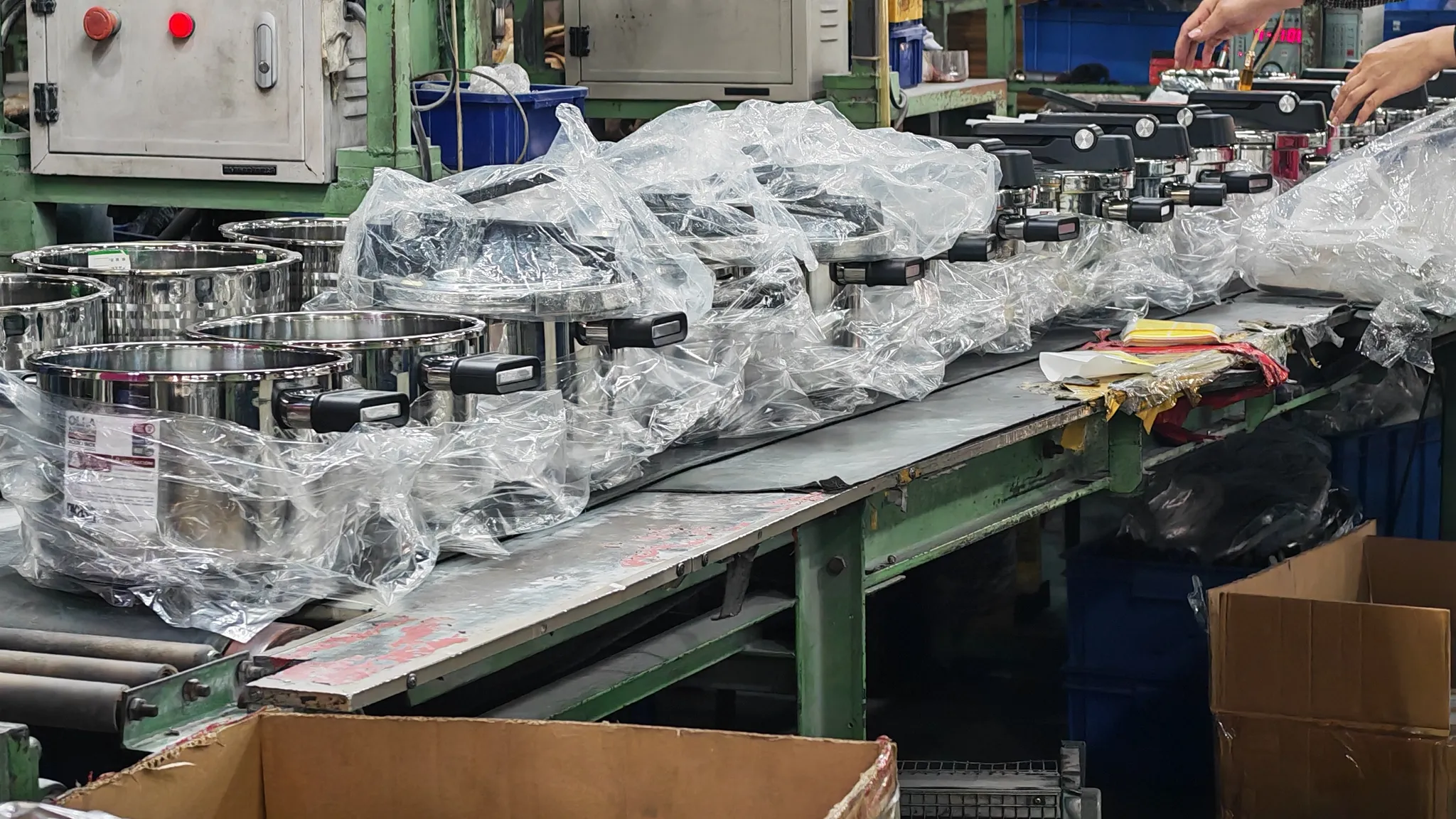
Then look at the process behind the sample. A one-piece body drawn from sheet, a composite bottom bonded for even heating, clean welds, consistent polishing — these are the capabilities that decide whether a nice sample can be repeated at 10,000 pieces. Deep drawing in particular separates cookware specialists from assemblers: it is why a factory invests in multi-station press lines and dies of their own. The line below is what that investment looks like on a real floor.
Ask directly which of these steps are in-house: coil slitting and blanking, deep drawing, composite-bottom bonding, welding, polishing, packaging. There is no shame in outsourcing a step — many good factories buy lids or handles in. The point of the question is that you know where the chain breaks, so you can inspect the right step. A factory that answers with a process list and a floor tour has a process story; one that answers with a brochure has a sales story. And when the process story includes welding, ask about the method and the seam treatment: visible weld lines on a pot body are a finish defect, not a design feature.
Match compliance evidence to your destination markets
Compliance is not a logo wall; it is a set of test reports that match your market and your exact article. This is the part where vague claims cost the most, because a failed market compliance check can hold a container at customs or pull a product from shelves.
- United States. Food-contact regulation is assessed by behaviour, not by a list of approved brands. FDA accepts stainless steel on the basis of composition — the recognized series carry chromium of at least 16% — and the working reference is the inventory of food-contact substances listed in 21 CFR. Ask for FDA-relevant test reports for the article you are importing.
- European Union. Regulation (EC) 1935/2004 is the framework for all food-contact materials: it sets an overall migration regime, not a whitelist of grades. Germany applies LFGB testing on top. Request a migration test report — report number, lab, date, the exact article — not a generic "EU compliant" line.
- China domestic. If the product will also be sold in China, GB 4806.9-2016 applies specific release limits (SRL) for metal food-contact materials. A factory selling domestically will know this standard; the test reports are evidence.
- Middle East. Saudi-bound shipments require SABER certificates issued through the SASO platform; Gulf importers commonly add SASO testing. Ask whether the factory has shipped this category to your destination country before — repeat shipping is its own evidence.
The table below is the summary version:
Destination market | Framework | What to request from the factory |
|---|---|---|
US | FDA food-contact (composition-based; recognized series ≥16% chromium) | FDA-relevant test report for the article, per batch |
EU (incl. Germany) | Regulation (EC) 1935/2004 migration regime; LFGB in Germany | Migration test report (lab + report no. + article), LFGB where applicable |
China (domestic) | GB 4806.9-2016 specific release limits (SRL) | GB 4806.9 test report for the article |
Saudi Arabia / Gulf | SASO platform, SABER certificates | SABER certificate + category shipping history |
One rule covers all of them: if a factory shows you a certificate wall but cannot produce the underlying report for your article, treat the claim as unverified. And check the report's date and tested article — a five-year-old FDA report for a different pot is evidence of history, not of your product.
Test the sample like a buyer, then seal it
The sample is where reliable factories and fast-talking ones diverge. Test it like the goods will be tested — because they will be.
Check the sample against your spec point by point: grade (mill certificate again), gauge and dimensions, surface finish, lid fit, composite-bottom performance on an induction hob, and the food-contact report if your market requires one. On the composite bottom specifically, put the sample on an induction hob and watch for even heating across the base — a bottom that hot-spots in the sample will hot-spot in every unit of the batch. Order samples from your top two or three shortlisted stainless steel cookware manufacturers against the same written spec, so you are comparing product, not marketing. Then seal the winner: both sides sign and date the approved piece, and the purchase order states that production is compared against the sealed reference at the final inspection. Add a third-party AQL inspection before shipment if the order size justifies it — at container volumes it almost always does. The inspection points themselves (incoming material, in-process, final) are covered in the sourcing guide linked above; the principle here is that the sealed sample is the contract.
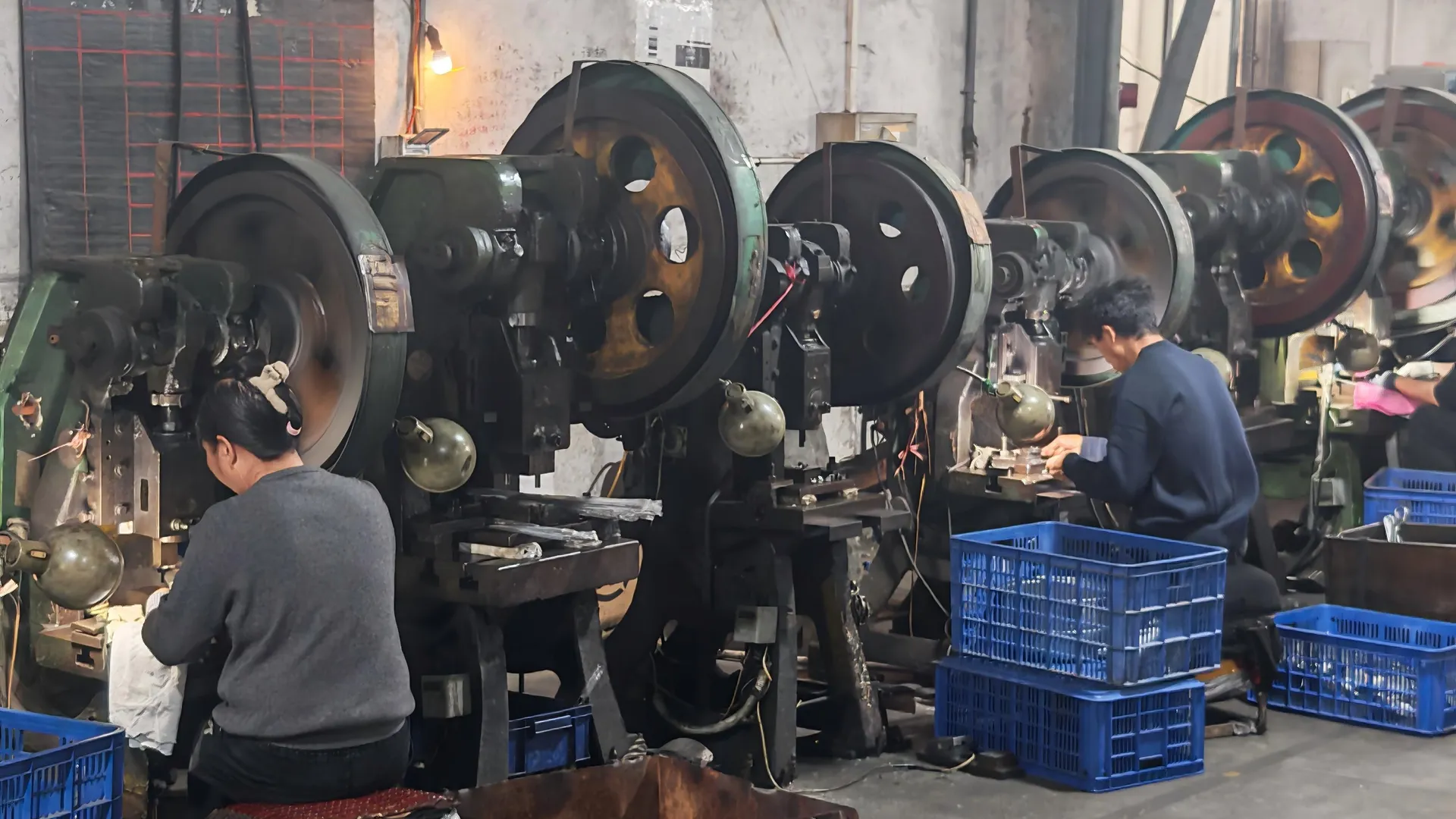
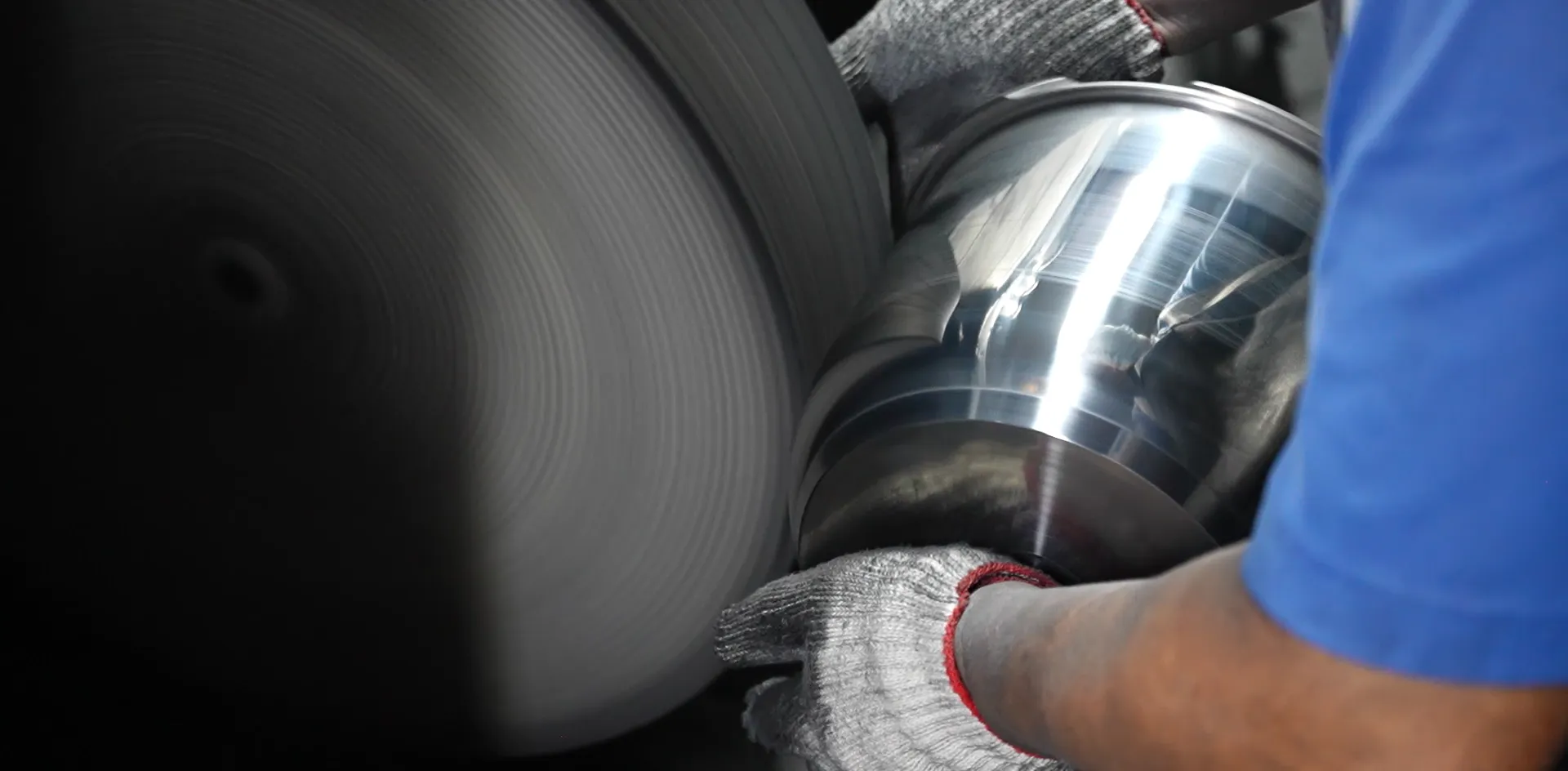
The photo below is the step most buyers never see: the hand-finishing that decides how a sample actually feels — and whether it can be repeated on a production batch.
Score the shortlist on terms that predict reorders
The final filter is commercial, and it predicts the relationship better than any sales pitch. Score every shortlisted factory on the same ten dimensions, then compare totals:
Dimension | What good looks like | Weight |
|---|---|---|
Factory evidence | License, in-house lines, live floor tour, audit willingness | 10 |
Grade verification | Mill certificates per batch, grade on the PO, PMI available | 10 |
Compliance paperwork | Test reports matching your markets and article | 10 |
Sample discipline | Sealed-sample process, production-vs-reference inspection | 10 |
MOQ fit | MOQ quoted per model and category, not one magic number | 10 |
Lead time | Committed working days, and a history of meeting them | 10 |
Payment terms | Standard T/T with deposit balance; L/C where needed | 10 |
Response quality | Document requests answered completely, quickly | 10 |
Inspection access | Third-party and buyer inspections welcomed | 10 |
Track record | Repeat buyers, export history to your region | 10 |
The photo below is the end of the chain that predicts reorders: finished pots being bagged on the packing line — the point where a factory's discipline shows, and where your inspection happens before the container is sealed.
Two commercial realities are worth knowing before you score. First, stainless quotes move with raw-material prices: nickel is the cost driver in stainless steel, and the LME nickel contract is the reference most mills price against — ask for a quote validity period so a quote does not quietly expire mid-negotiation. Second, MOQ is a per-model and per-category number, not a universal figure; a factory that answers "what is your MOQ" with a single number for everything is usually quoting you a sales line, not a production reality.
Run the scorecard, keep the two or three factories above 80, and take the shortlist to a conversation — not the other way around. When you bring a spec, a target market and a volume, you can see how a factory documents its capability in minutes, and whether the person across the table answers like a partner or a sales script. That is the last test, and the one that starts with a conversation.
Common questions
How do I find a reliable stainless steel cookware manufacturer in China?
Start from your spec, not from search rankings. Define grades (304 for cooking surfaces), sizes, volumes and destination markets first, then build a shortlist from trade shows, verified directories and importer referrals. Filter on evidence: a manufacturing business license, in-house process lines, real factory footage and audit reports. Verify the steel per batch with mill certificates, match compliance reports to your markets, then compare MOQs and lead times. The supplier that answers document requests quickly and completely is usually the one that survives a reorder.
Is 304 stainless steel cookware food safe?
In practice, 304 (18/8 or 18/10) is the stainless grade with established food-contact recognition in the US and EU. Food-contact rules are behaviour-based, not a whitelist of grades: the EU's Regulation (EC) 1935/2004 sets a migration framework, and the US FDA accepts stainless steel by composition, with recognized series carrying at least 16 percent chromium. For a buyer the paperwork matters: request a migration test report for the specific article plus a mill certificate for the batch. Grade 201 has no such established recognition and is generally used for lids or outer shells.
What certifications should a stainless steel cookware manufacturer have?
The useful answer is market-specific. For the US, request FDA food-contact test reports for the article you import; for the EU, a migration test under the Regulation (EC) 1935/2004 framework, with LFGB testing common for Germany. Saudi-bound shipments need SABER certificates issued through the SASO platform. System certifications such as ISO 9001, ISO 14001 and BSCI audit reports indicate managed processes and audited social compliance. Ask for the underlying test reports — lab name, report number, date and the exact article tested — rather than accepting a wall of certificate logos.
How do I verify a stainless steel cookware manufacturer before ordering?
Verify in five layers. One: confirm the manufacturer — a manufacturing business license, in-house lines and a live floor walkthrough. Two: verify the steel — a mill certificate per batch, grade written into the purchase order. Three: verify compliance — migration test reports matching your markets and article. Four: seal a sample — production is compared against the sealed reference, with a third-party AQL inspection before shipment. Five: verify terms — MOQ per model, lead time, payment and defect-replacement commitments that survive a reorder.
Written by
Potobelo Editorial Team
Sourcing and engineering staff at Potobelo, a stainless steel cookware brand built on 30 years of Zoombo manufacturing in Guangdong, China. We write from inside the plant that makes the product, not from reviewing it.