
Retail Ready Packaging for Cookware: Wholesale and Bulk Formats
Packaging is the line of a cookware order that is decided last and complained about first. This guide is for importers, distributors and private-label owners choosing between bulk and retail-ready formats: what each format costs, how carton dimensions drive your freight, which inner-packing details decide your damage rate, and what to write into the PO so the bulk run matches the approved sample.
 Potobelo Editorial Team13 min read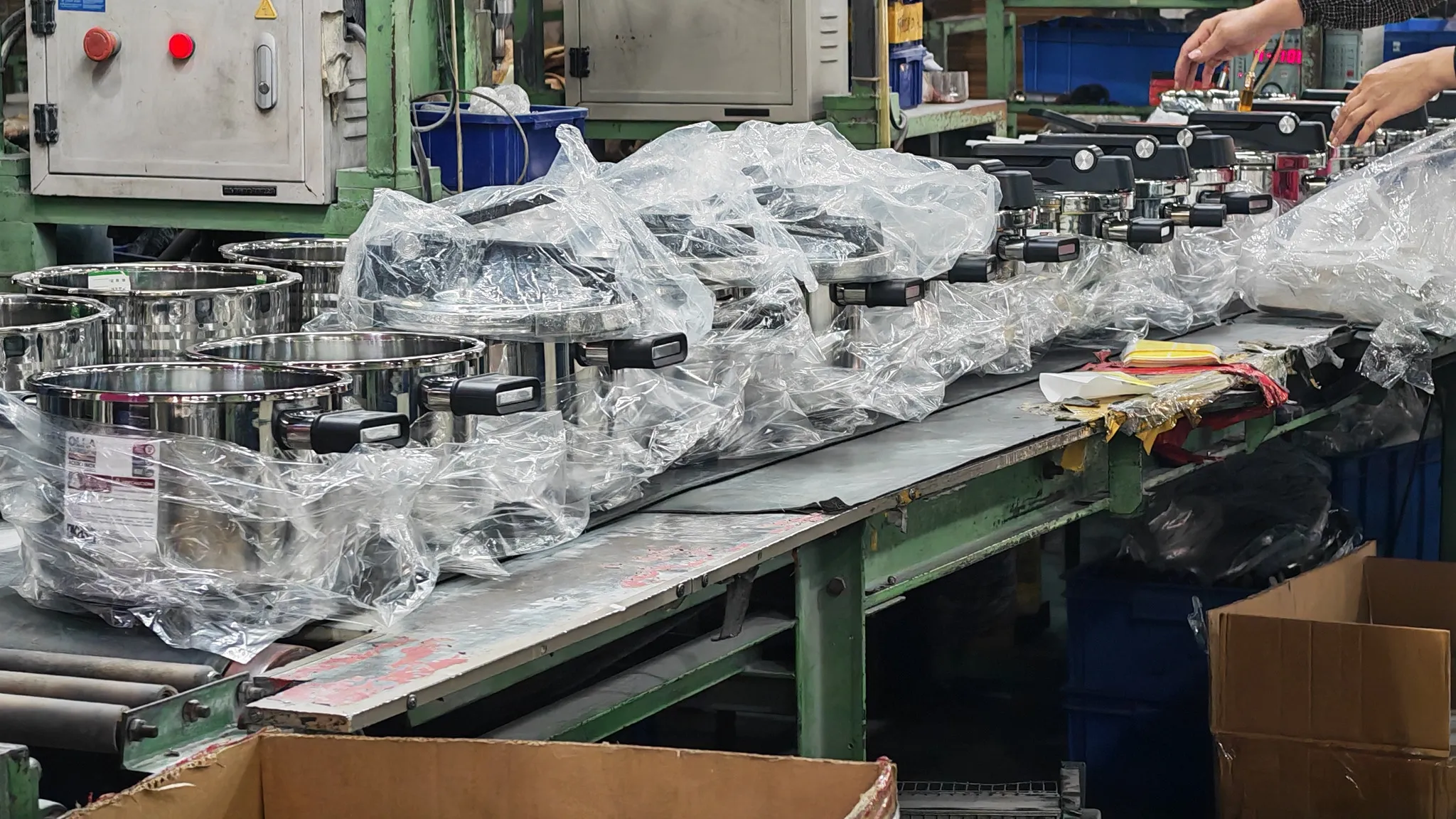
What retail ready packaging means for a cookware programme
Retail ready packaging (RRP) — also called shelf ready packaging or SRP — is the outer case or tray a store can put on the shelf exactly as it arrives. Nobody unpacks it or rebuilds a display: the case is the display, the tray is the shelf unit, and the empty board is recycled. That is why the phrase reads as a packaging-supply term rather than a sourcing one: the pages ranking for it are written for brands selling fast-moving goods into grocery, not for importers.
For an import programme the same words mean something narrower and more financial. Your retail ready packaging is the layer between your supplier's carton and your customer's shelf — the tray, sleeve or shelf-ready case that decides whether a retail buyer can accept a pallet at a distribution centre instead of paying staff to handle it twice. Retailers adopted the format for two reasons. The first is labour: a case that reaches the shelf intact in one movement saves store time on every replenishment cycle. The second is availability — a case that can be replenished in a single movement is a shelf that spends less time out of stock, which is the half of the argument a retail buyer will raise first.
The industry guideline behind the format frames it as a functional set — a case that is easy to identify, easy to open, easy to replenish, easy to shop, and easy to dispose of or recycle. That work was published by ECR Europe, now part of The Consumer Goods Forum, and the original report is still the clearest statement of what the format is meant to do. Importers read that list as a style guide. It is a specification. "Easy to open" means a defined perforation or tear tape at a defined height, not a nicer-looking box. "Easy to replenish" means the case fits the shelf depth and stays standing when the front units are taken. "Easy to identify" means the case carries the barcode and the case count a stockroom scanner needs. Those are dimensions, not adjectives.
Retail-ready or bulk: the trade-off in your landed cost
Every packaging conversation opens with a false choice. Retail-ready is not automatically the modern answer; it is one of three options, each moving a different cost line.
Bulk (export) packing is the cheapest way to move volume. Plain board, no print, the tightest cube you can build, and your customer repacks on arrival. You pay the least per unit and the least freight, and the retail presentation becomes someone else's problem.
Retail ready packing costs more per unit — printed board, a tray or a shelf-ready case, often a master carton around it, sometimes a fitment — and it is only worth the difference when the retail customer requires it — the requirement is theirs, the unit cost is yours. Walmart popularised the display-ready case; Costco, Target and the discounters each run their own version of the same idea, similar but not identical. The differences are exactly the things that get a pallet refused at a distribution centre: case height, case count, barcode placement, pallet pattern and the marking on the case.
Hybrid formats sit in between: a plain master carton with a printed sleeve, or a colour box inside a bulk outer, so one run serves a retail customer and a repacking distributor.
Two questions decide it, and neither is about appearance. First, does your customer operate a distribution centre that will break your pallet? If so, their vendor guide — not your supplier — defines the packaging, and non-compliance is settled by a chargeback. Second, what does the repack cost your buyer? On a first order that labour can be a larger number than the packaging difference. Printed boxes and trays also carry print tooling and a minimum run that sits on the packaging line rather than the product, which is the fastest way to lose margin on a first shipment — the first-order arithmetic is worked through in how to start a cookware wholesale business.
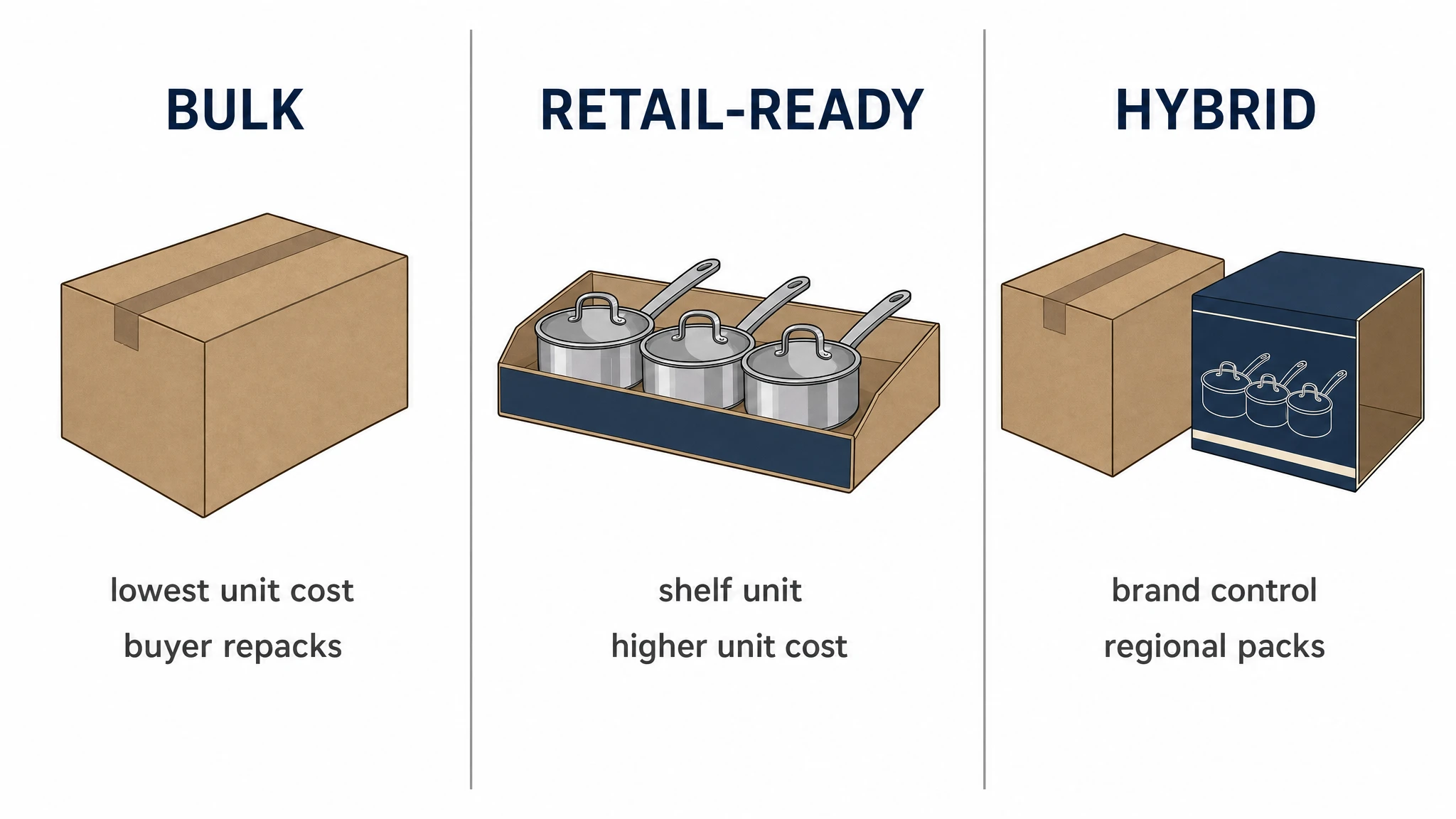
Illustrative render — how the three formats trade unit cost against shelf readiness and buyer repack.
Why cookware breaks the standard RRP playbook
The standard retail-ready case was designed for products that stack. Cookware does not.
Weight. A stainless set is heavy per unit, so case count is capped by manual handling limits before cube becomes the constraint. A case too heavy to lift safely is a case the distribution centre will split. On our own line the case count for a heavy set is set by what one person can lift safely, so ask your supplier to propose it against your customer's handling limit rather than against the carton size.
Round bodies and sets. Deep-drawn round shapes waste carton cube, and nesting is the main lever: how the pans sit inside each other sets the carton interior, which sets the carton outside, which sets everything downstream. A nested set is heavier per cubic metre than the same pans sold singly, so the pallet maths moves with it.
Surfaces. Polished and mirror-finished bodies scratch against each other and against board. Separation is not cosmetic: a case arriving with scuffed bodies goes back to you, not onto the shelf.
Lids and handles. Glass lids break, and projecting handles create void space and puncture risk. Most programmes pack lids separately or protect them with a fitment, and handles must sit inside the carton footprint or be protected where they point.
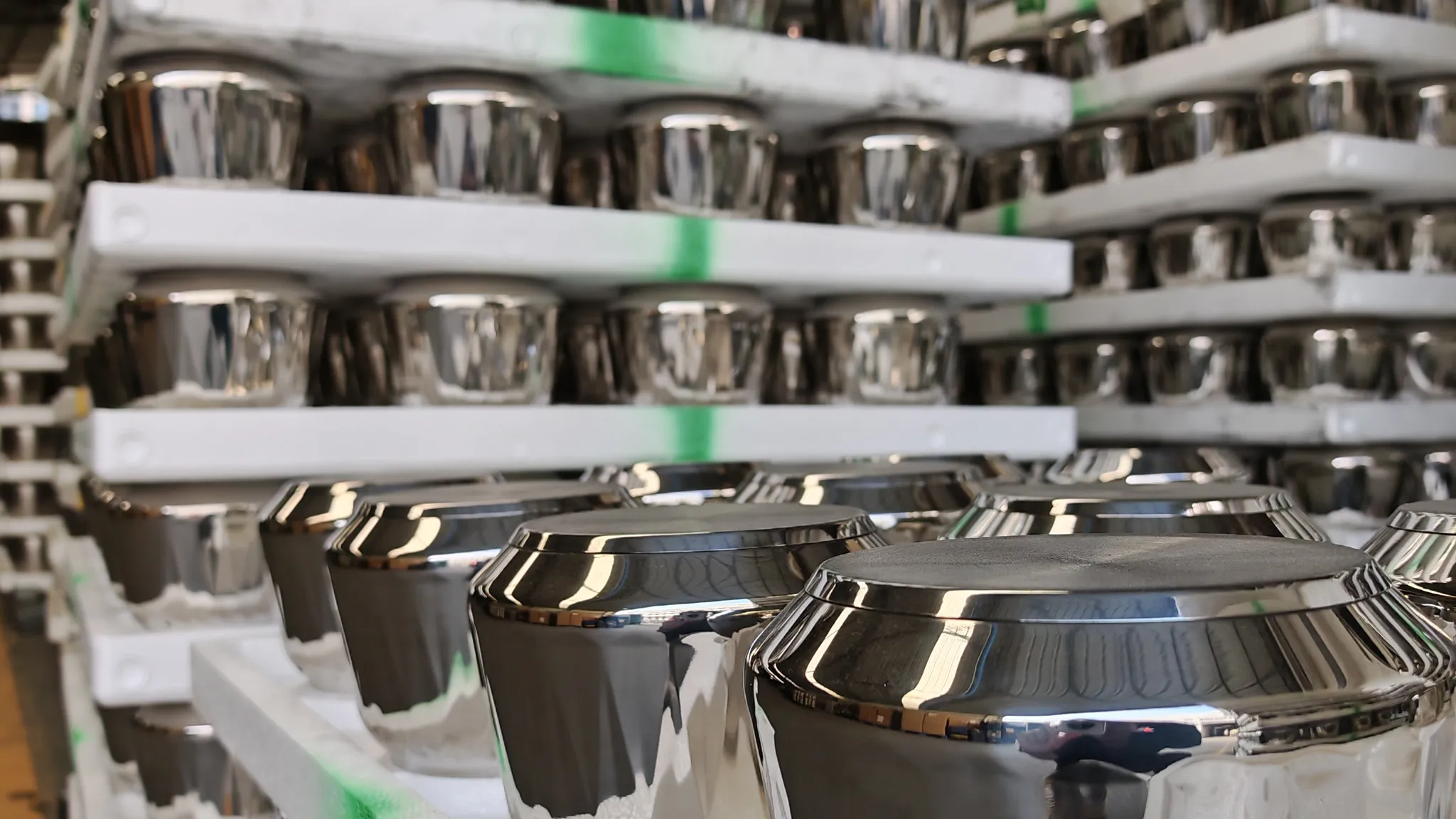
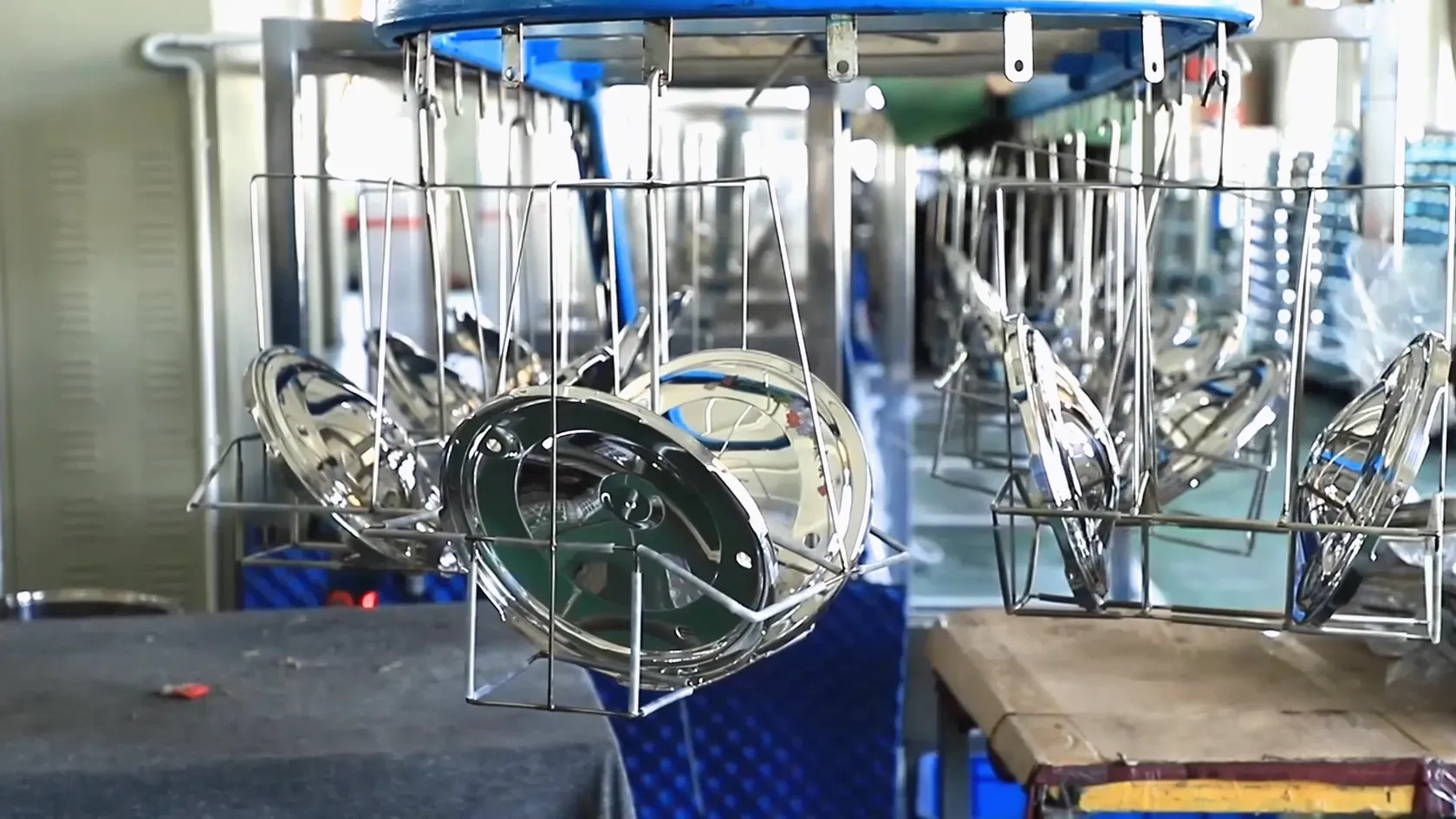
Surface protection between operations: polished bodies travel on moulded trays, and the same principle applies inside the master carton.
None of this argues against retail-ready — only for treating packaging as product engineering rather than decoration, the same lens we use on pressure-cooker programmes, where weight and lid design drive carton and assembly (what importers need to know about wholesale pressure cookers).
The dimensional chain: master carton → pallet → container
Every downstream number is set by the carton's outside dimensions: they are the input to cartons per pallet layer, pallets per container, and the freight cost per unit. Two cartons holding the same product can differ by several pallets per container, and that gap is freight you pay on every shipment.
The vocabulary is what your supplier is actually quoting:
- Case style code. The fold pattern of the blank. The FEFCO case-code catalogue is the reference most corrugated suppliers work from, and naming a code removes ambiguity about how the box folds and where it opens.
- Board grade. Corrugated board is rated by construction and by a strength measure. Buyers name edge crush test (ECT) or burst strength, and those numbers determine whether the bottom carton survives a stacked warehouse — not the look of the surface.
- Case outside dimensions. The most expensive line on the spec: it fixes the pallet and container maths.
- Pallet pattern, written as Ti x Hi — cartons per layer (Ti) by layers (Hi). The EPAL pallet pool runs on the 1,200 x 800 mm pallet, and a pattern that fits it cleanly beats a carton that overhangs the pallet edge or wastes a third of the layer.
- Container cube. Twenty-foot and forty-foot high-cube containers build differently once pallets are involved: palletised loads cost container space, floor-loaded freight uses less but arrives loose and needs more labour.
Spec line | What it fixes | Usually decided by |
|---|---|---|
Case style code | The blank, the fold, and where it opens | Supplier proposes, buyer approves |
Board grade + ECT or burst | Stacking strength in a warehouse | Buyer's distribution conditions |
Case outside dimensions | Cartons per pallet layer, pallets per container, freight per unit | Joint — buyer's freight, supplier's tooling |
Case count | Units per case, and the weight staff lift | Buyer (shelf and handling limits) |
Case gross weight | Whether the case can be handled as one unit | Buyer |
Pallet pattern (Ti x Hi) | Whether the pallet builds straight and stays stable | Buyer's vendor guide |
Marking: SKU, case count, lot, origin | Receiving scan and traceability | Buyer, plus customs |
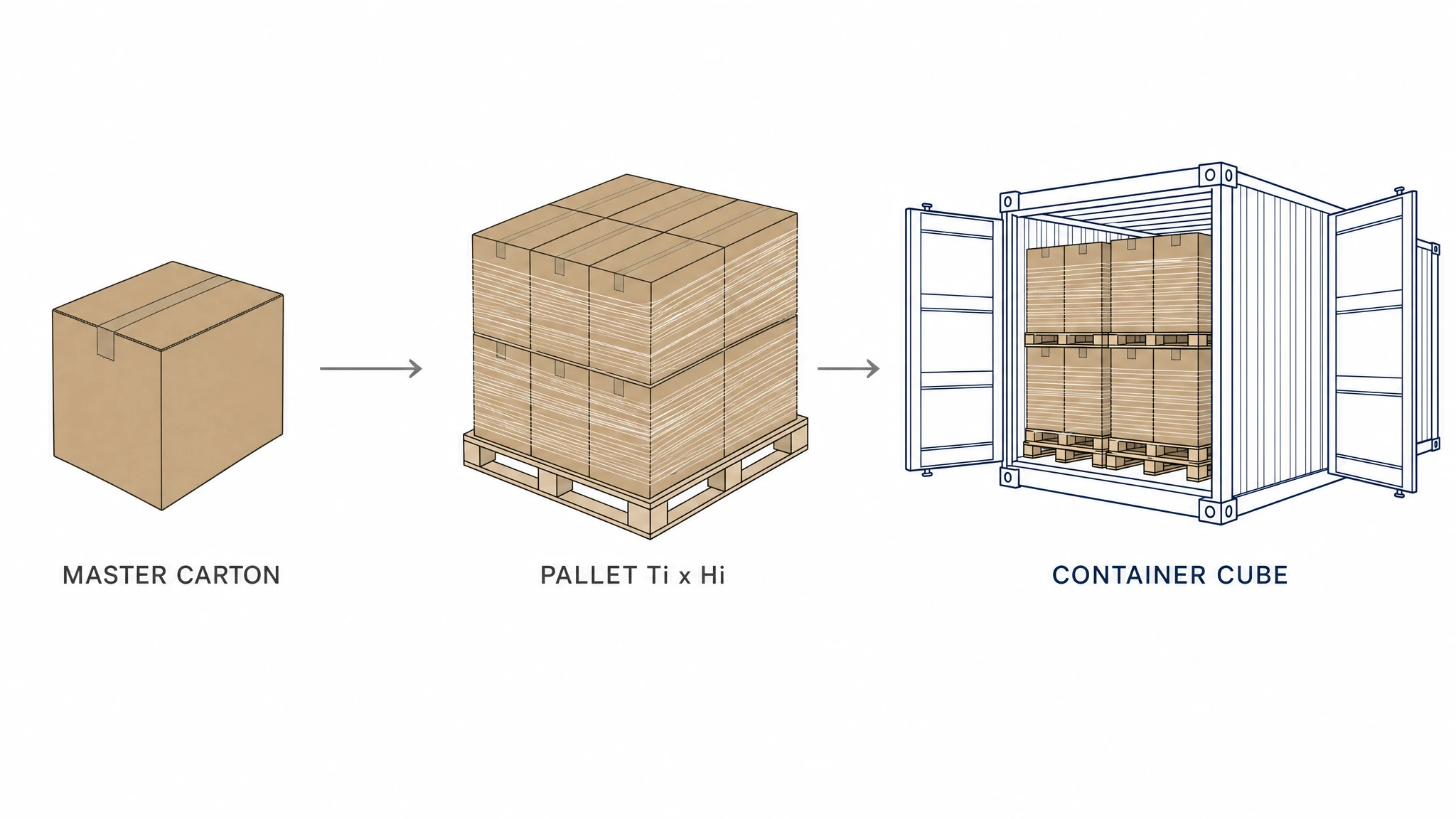
Illustrative render — the dimensional chain: carton dimensions set the pallet pattern, which sets the container cube and the freight you pay.
Inner packing: the layer that decides your damage rate
The carton is what your customer sees; the inner packing decides whether they place the second order. For stainless cookware the components are simple, and each has to be named in the spec rather than left to the line:
- Bags per unit. Whether every unit travels bagged, whether lids and strainers are bagged separately, and whether the bags are plain or printed.
- Separation between units. A divider, or a fitment in EPE foam or moulded pulp, wherever surfaces could touch or heavy bodies could shift.
- Lid and handle protection. Glass lids and projecting handles need their own protection — far cheaper than replacing a shipment.
- Retail box decision. A plain carton, or a printed colour box that becomes the shelf unit for a set. A colour box is a separate print project with its own tooling, minimum run and artwork cycle — a packaging-led decision, not an afterthought.
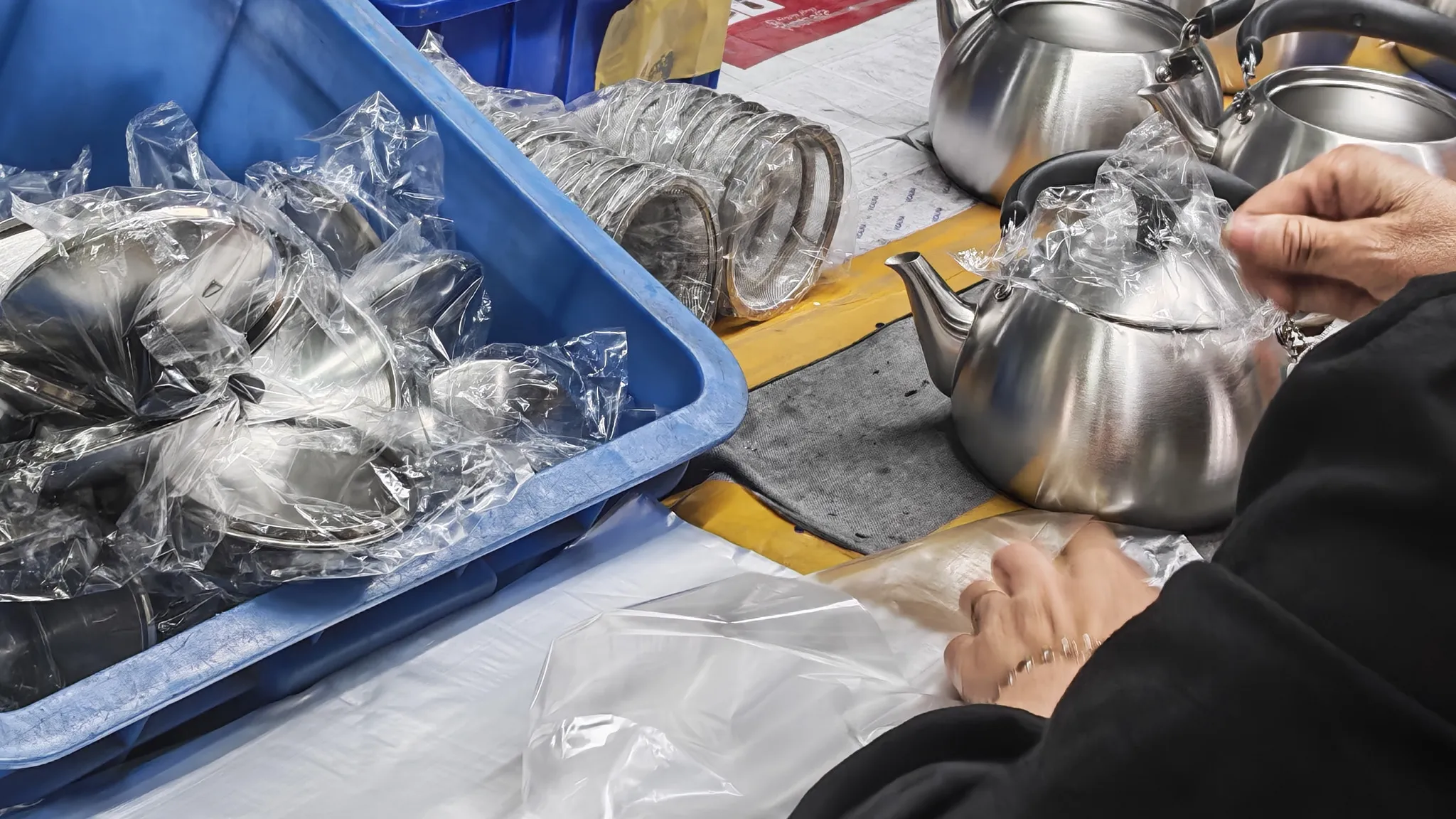
Inner packing on our own packing bench: each unit bagged, lids and strainers counted into their own bags before the master carton.
One compliance point that catches importers out: any film or board that touches the product sits in the same regulatory territory as the cookware itself. The EU framework is a migration-behaviour regime rather than a list of approved grades, the FDA recognises stainless by series against a chromium threshold, evidenced case by case through supplier letters rather than a grade list or a certificate, and GB 4806.9 works on specific release limits. In practice that means asking your supplier for the declaration and test report covering the packaging materials, not a certificate that clears the pans and says nothing about the bag they travel in. How packaging is specified on a custom run is covered on the custom solutions page; the point to hold onto is that a change of bag or fitment is a change of spec, and specs drift unless written down.
Barcodes, labels and the retail data your customer will ask for
The barcode is the one piece of packaging that has to be right before anything ships. A GTIN is the number behind it, allocated through your GS1 prefix, and GS1 sets the standard you are aligning with. Buyers usually need it at more than one level — the unit and the case — and the case-level barcode has to sit where their scanner expects it, per their vendor guide.
Expect the data request early, and expect it in a fixed format. Your customer will want dimensions, weights, case count, pallet configuration and lot data as structured item information, usually submitted by EDI and confirmed on the advance shipping notice. For cookware, case gross weight and nested-set dimensions are the two fields suppliers most often have to re-measure — easier to pull from the spec sheet than to rebuild from a delivered pallet.
Country-of-origin marking is not the same as a "made in" line in the artwork, and the rule differs by market. The US marking rules under 19 CFR Part 134 require imported articles to be marked so the origin is clear and durable; confirm the equivalent for every market you ship into. Chains with their own requirements are more demanding still, and the retail chain requirements your customer passes down land on the case before they land on the pan.
Transit testing: turning "it must survive" into a spec
Every packaging conversation includes a version of "it has to take some knocks". That is not a specification. Transit testing makes it one: a defined procedure, run on a defined case, producing a report both sides can point at.
The International Safe Transit Association publishes the test procedures most commonly named in these specs, and buyers often cite a series rather than a single test. Two practical rules apply. First, ask for the report on the case as specified — same board grade, same dimensions, same inner packing — because a report from a different configuration proves nothing. Second, treat any material change as a trigger to re-test. A board grade swap that keeps the carton looking identical on the outside is one of the most common silent changes in a supply chain, and it is the change that turns a passing case into a damage claim.
Packaging rules you inherit when you import
Packaging regulation is where an import programme acquires obligations its supplier never mentions. The EU has moved packaging and packaging waste from a directive into a directly applicable regulation (Regulation (EU) 2025/40), and the Commission maintains the operational summary of what it covers — design and recyclability of packaging, harmonised labelling, and extended producer responsibility (packaging waste).
Read that as a list of things to establish before the print run, not as a legal opinion:
- Who is the "producer" in each market you sell into — usually the importer or the local brand owner, not the factory.
- Who registers and who pays the EPR fees, and whether your supplier's packaging choice increases them.
- Whether the material you chose is recyclable in the target market's collection stream, because a label that promises recyclability the local stream cannot deliver is a problem you own.
- What labelling the market requires, and where it sits alongside your own artwork.
The requirements are being staged over several years and the detail is still being finalised, so confirm the current position for your markets with your customer or a compliance adviser. The direction of travel is clear: packaging is a compliance surface, and the party placing goods on the market carries it.
Artwork, dieline sign-off and the PO packaging annex
The most common failure is also the cheapest to prevent: an approved sample in the showroom, something subtly different on the water. The fix is a sequence that finishes before the bulk run starts.
- Spec sheet. Case style, board grade with ECT or burst, outside dimensions, case count, gross weight, pallet pattern, inner packing, marking.
- Dieline. The structural drawing the printer works to, agreed before artwork is laid out on it.
- Print proof. Colours, position and any market-specific labelling, approved as a proof rather than described in an email.
- Physical sample. The case built and packed exactly as production will build it, then signed.
- PO annex. The spec sheet, dieline number, approved sample reference and changes procedure, attached to the purchase order.
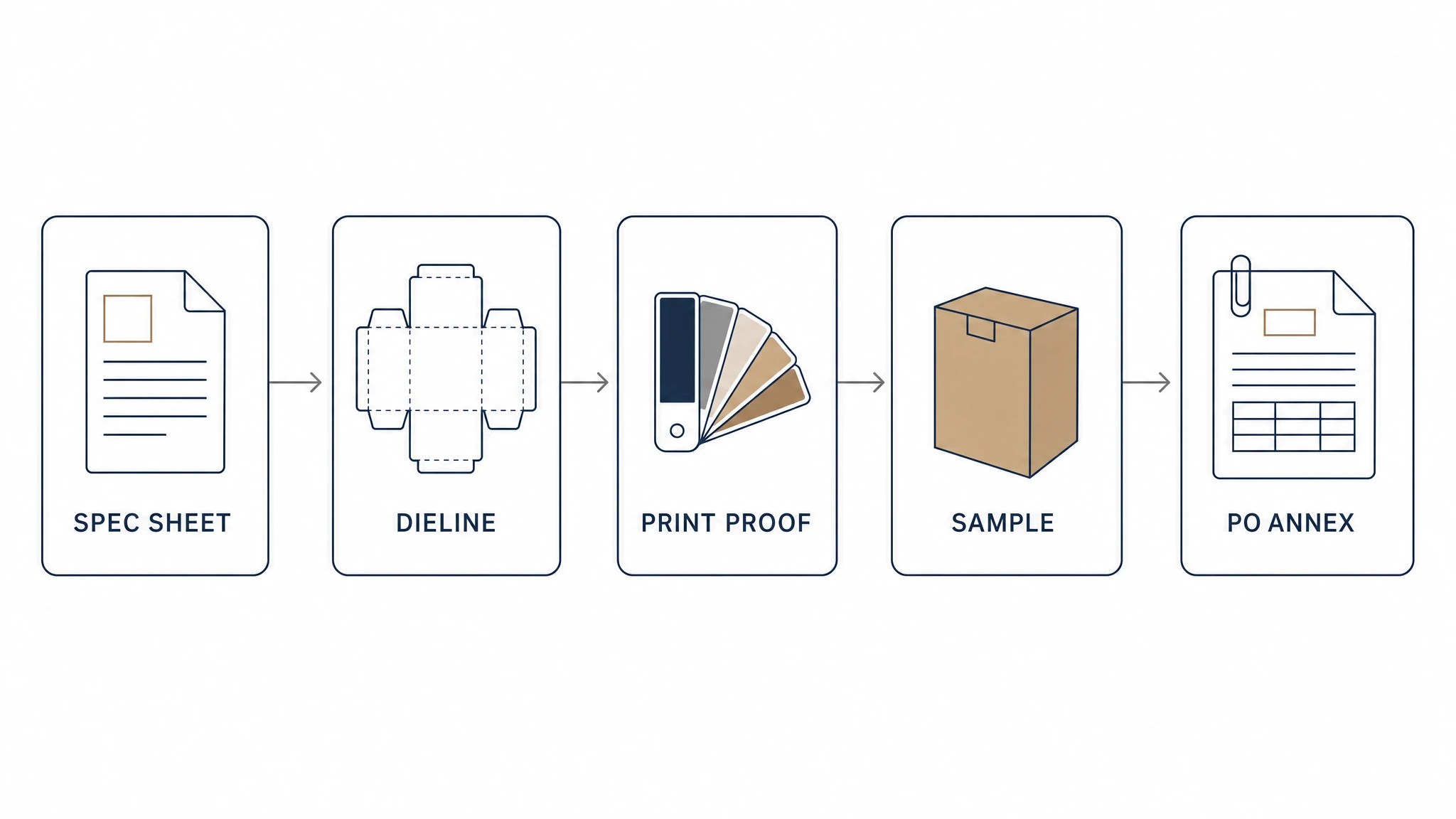
Illustrative render — the approval sequence this article argues has to finish before the bulk run starts.
That annex is what makes the rest enforceable. It should also state what happens if a material changes: who is told, what gets re-approved, and which tests are re-run. Write it once and it covers every order after; leave it out and every shipment is a fresh negotiation where your supplier holds the sample. If your packaging is being specified alongside an OEM or private-label programme, the annex belongs in the same review as the product specification — the sourcing process is where the two documents normally meet.
None of this requires a packaging department — just deciding, before tooling is cut, which format your customer can accept, what the carton dimensions do to your freight, and which details must be written down.
Common questions
What is the difference between retail ready packaging and bulk packaging?
Retail ready packaging is a case or tray that a store can place on the shelf as it arrives, so the case itself becomes the display unit. Bulk packaging is a plain shipping carton: cheapest per unit and tightest in the container, but the buyer repacks before the product can go on a shelf. The practical difference is who pays for the repack and who absorbs the retail presentation, plus the unit cost of the printed board and fitments in a retail-ready spec.
How do I specify a master carton so it does not cost me freight?
Specify the carton by its outside dimensions and board grade, not by a picture. Those dimensions set the cartons per pallet layer, the pallets per container and therefore the freight you pay per unit, so the carton and the pallet pattern have to be designed together. Ask your supplier for the case style code, the board grade with its edge crush or burst value, the case count, and the pallet pattern in cartons per layer by layers.
What inner packing should I ask for to reduce damage in transit?
For stainless cookware the inner packing does most of the damage-control work: bag each unit, keep lids and handles separated from polished bodies, and use a divider or an EPE or pulp fitment where units can move. Specify the number of bags, whether lids are packed separately, and whether the retail box is a plain carton or a colour box. Then confirm the approved sample is the reference the bulk run must match.
Who is responsible for packaging compliance when I import cookware?
In most markets the obligation falls on the party that places the goods on the market, which is normally the importer or the local brand owner rather than the factory. That covers things like extended producer responsibility registration and fees, recyclability of the materials used, and labelling. Because the requirements differ by market and are being revised, confirm the current position with your customer or a compliance adviser before the print run is approved.
Written by
Potobelo Editorial Team
Sourcing and engineering staff at Potobelo, a stainless steel cookware brand built on 30 years of Zoombo manufacturing in Guangdong, China. We write from inside the plant that makes the product, not from reviewing it.