
A Cookware Product Line for Kitchenware Wholesale Suppliers
Most advice on what cookware to stock is written for shops, not for buyers. If you import or distribute in volume, your product line is an architecture decision: which category families to carry, how deep to go inside each one, and in what order to add the next. This guide works through that sequence — using role in the range, not catalogue order, to decide what to stock first.
 Potobelo Editorial Team14 min read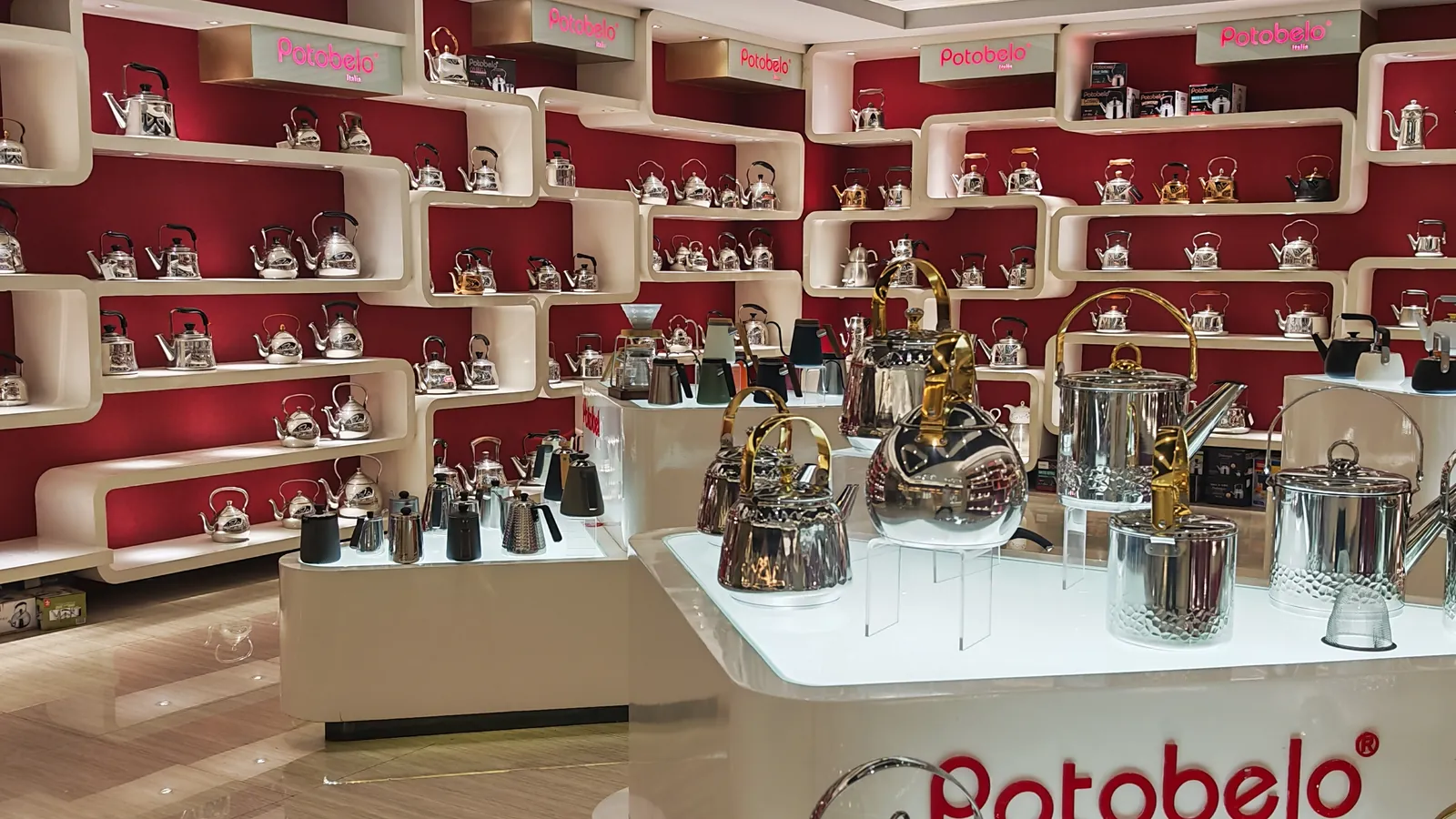
What a product line has to do once you are the wholesale supplier
When you are one of the kitchenware wholesale suppliers your own customers rely on, a product line is not a catalogue of everything a factory is able to produce. It is a prediction about which category families will still be reordering after the first container clears. Get it right and the line compounds; get it wrong either way and the damage looks the same — too wide and cash sits in slow SKUs, too narrow and buyers top up elsewhere.
Three numbers define the line, and they are decided in this order:
- Breadth — how many category families you carry at all.
- Depth — how many sizes, capacities and finishes you hold inside each family.
- Sequence — which family you add next, and what evidence triggers the decision.
Most first-time importers put their planning into depth — size grids, colour counts, lid options — and almost none into sequence, which is the one that decides whether the range pays for itself. How to start a cookware wholesale business covers the business setup: the trading model, the margin shape, the first order. This article starts one step later, at the architecture of the range itself. Everything here also sits inside the wholesale buying guides cluster.
A supplier who answers "we can make anything you want" has told you nothing about your range. The useful answer names the categories they actually run, the sizes that move, and the ones they would talk you out of — and a supplier with a real view will have opinions about your line, not just capacity to fill it.
Segment the range by the job each category does
Category names are a catalogue convention, not a planning tool. "Cookware sets" and "saucepans" sit next to each other on a product page, but they do completely different work in a range, and they fail in different ways. Group them by the job they perform for your business instead:
- Anchors. The category a customer comes to you for. It justifies the relationship and carries the freight economics. Pressure cookers and casseroles are typical anchors for stainless programmes because the buyer rarely substitutes them casually.
- Backbone. Repeatable sizes that carry the line between anchor purchases — open stock saucepans, stockpots and frying pans in the sizes that sell fastest. Backbone is where reorders actually come from.
- Footfall and basket-fillers. Low-ticket items that raise order value without raising commitment: kettles, teapots, steamers, utensils and accessories. Useful, but they rarely justify a relationship on their own.
- Channel openers. Categories that unlock a whole buyer type rather than a single sale — chafing dishes and catering items for HoReCa and buffet supply, sets for retail programmes that want a gift-ready SKU.
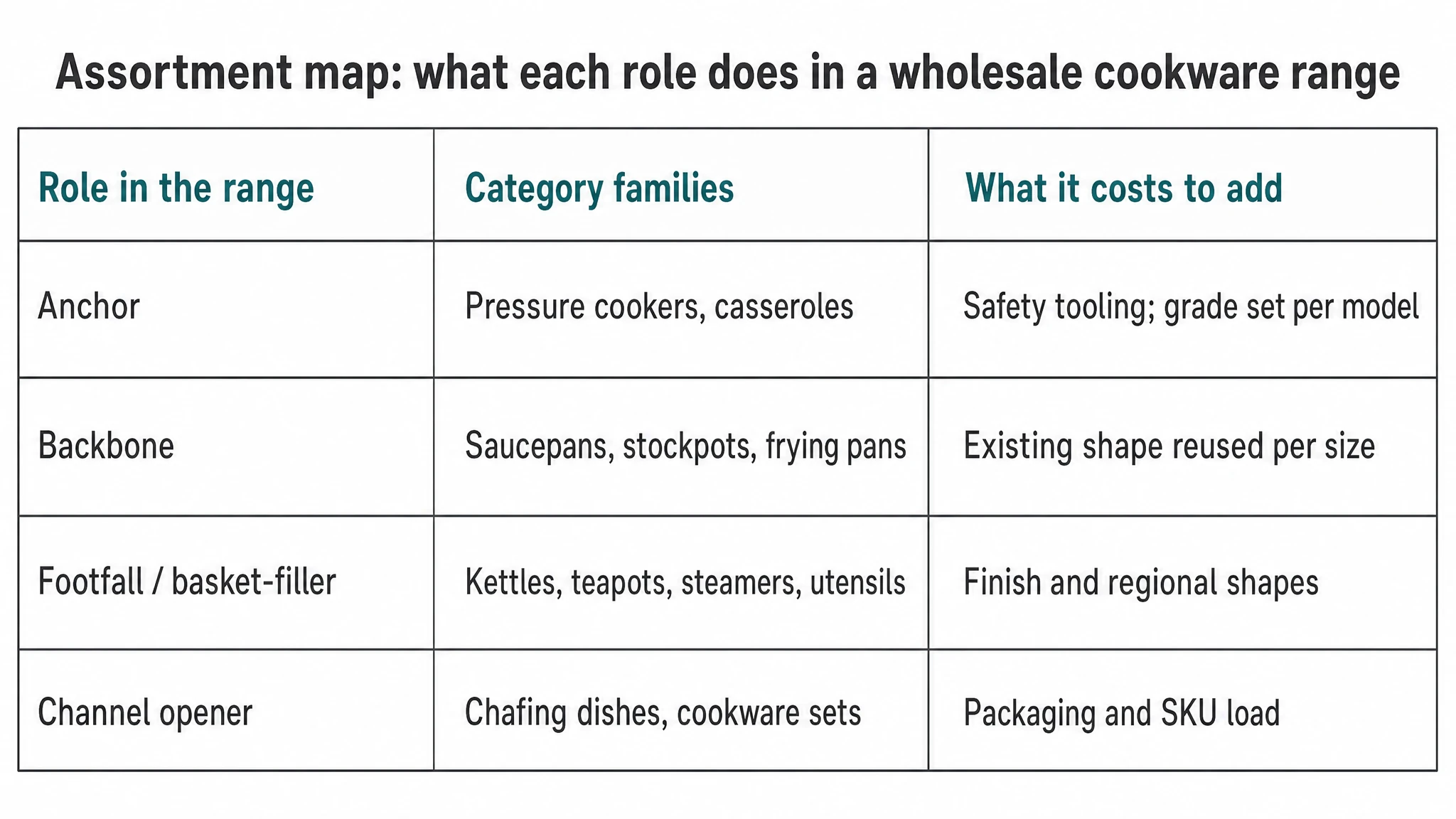
Illustrative render — an assortment map for a stainless steel range: the four roles a category can play in a wholesale line, the families that fill each one, and what adding them costs in tooling, packaging and SKU load.
The map matters because most weak ranges are built by ignoring the third column. A family that needs new tooling per size is not the same commitment as one that reuses existing dies, and a family that needs its own packaging artwork is not the same as one that shares a carton. Read your candidate list through the role column first: if three of your first five families are footfall items, you have built a catalogue rather than a line.
What to ask in writing at this stage is narrow: for each family you are considering, which construction it uses, which of your lines makes it, and which sizes share tooling. A supplier who cannot separate those answers is quoting you a range they do not control.
Start narrow: build a first assortment that can reorder
The instinct when a factory sends a catalogue is to ask what the minimum is and then spread it across as many categories as possible. That is backwards. The first assortment should be the smallest set of SKUs that can produce a reorder without any further selling effort from you.
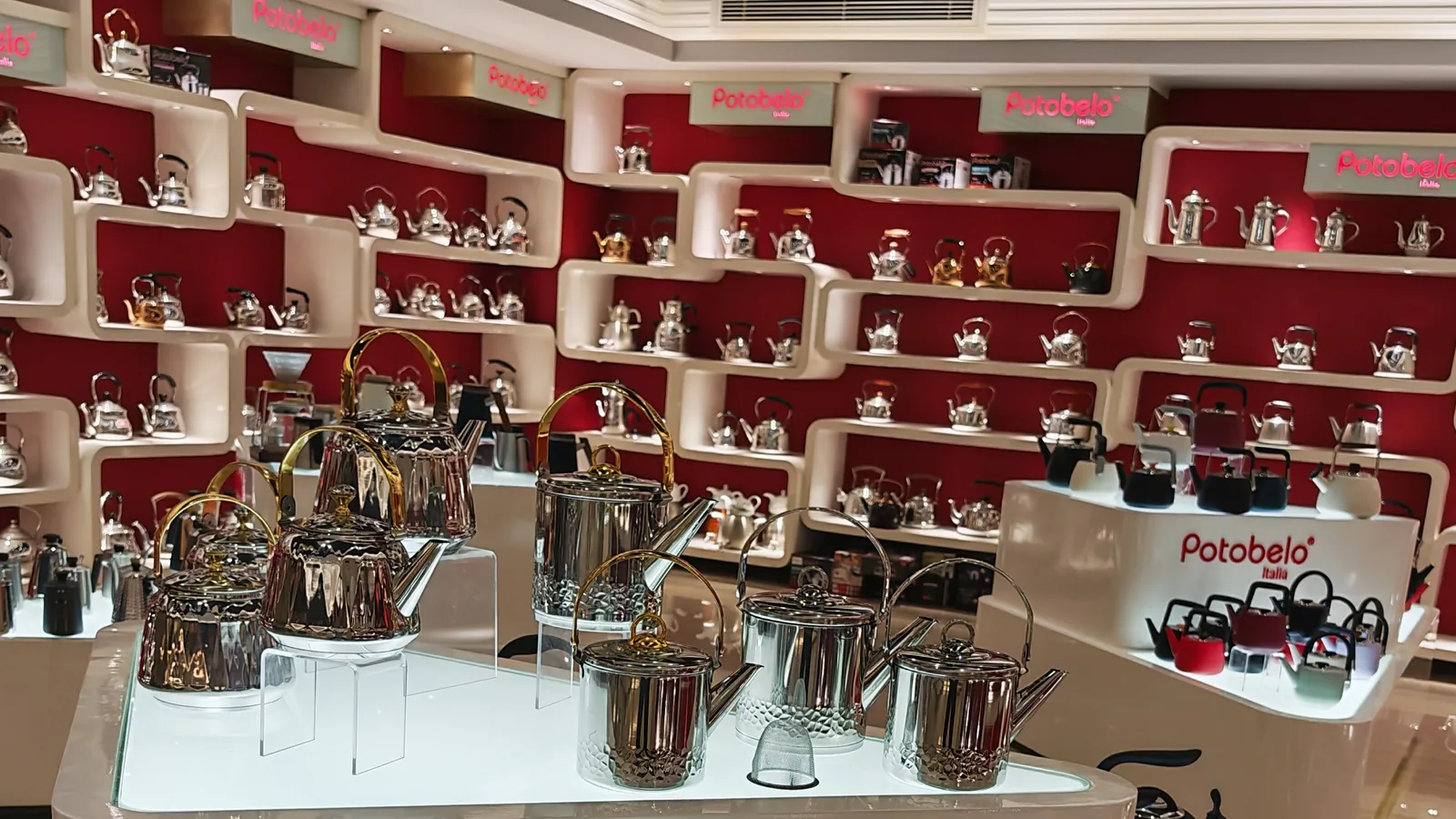
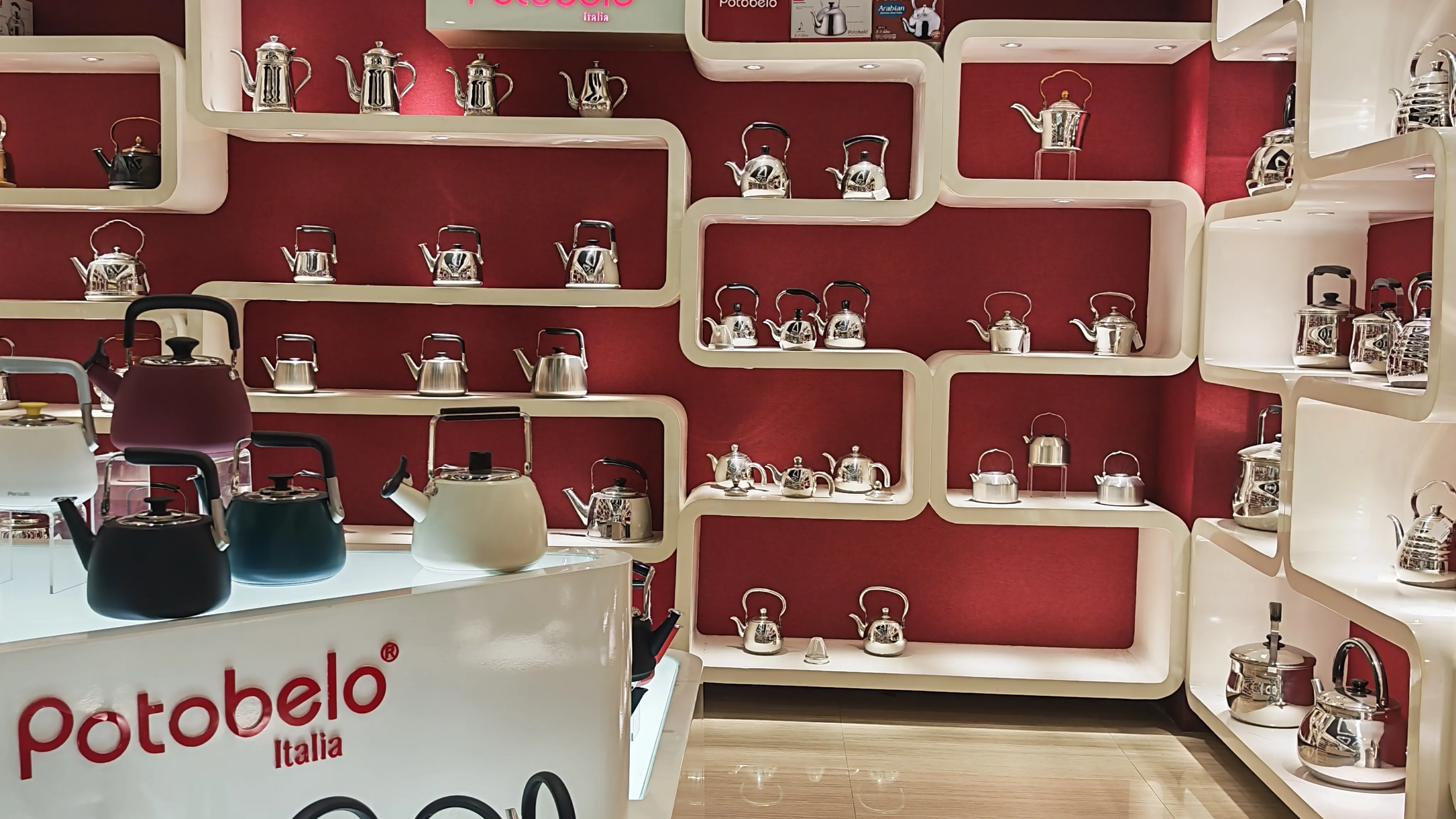
A wall of finished range like this is the destination. Your first order is one shelf of it, chosen so that every item on the shelf has a reason to come back.
Three rules keep a first assortment honest:
- One anchor, carried properly. Depth in one family — several sizes and one or two finishes — proves you can hold stock and sell it. Depth spread across five families proves only that you can place five orders.
- Depth beats breadth inside the anchor, until it does not. Buy the sizes your market actually uses. If you do not know them yet, that is a question for your buyers, not a guess for your first PO.
- Price tiers are a range decision, not a per-item one. In stainless, the material split does most of the tiering: grade and gauge set the price floor before styling enters the conversation. How stainless steel cookware grades are defined is worth reading before you compare quotes line by line, because two quotes a tier apart are usually not the same article.
Sets versus open stock belongs here too. Sets raise the average order value and make a catalogue page look complete, but they multiply packaging cost and complicate part-replacement — and a set that half-sells strands three or four components at once. Open stock repeats more predictably because every size stands alone, so treat sets as an assortment risk you take on deliberately rather than as a default. Potobelo's own product ranges are organised the same way — by family, not by price.
What a weak answer looks like: a flat minimum applied to every model and every finish. Minimums are quoted separately for a model, a finish and a packaging variant, because each consumes its own setup. Ask for the per-model figure in writing, and ask separately whether several models can share one container — that is the mechanism that lets a narrow first order test more than one idea.
Let manufacturing reality set what you can add
The single most common planning error is choosing a category from a competitor's shelf and then discovering that no factory you work with makes it the way it was made there. Cookware families are not interchangeable production; they are different processes that happen to end up as pots.
The broad split that matters commercially:
- Deep-drawn and pressed stainless. Bodies formed from sheet or drawn from a blank, then trimmed, welded and finished. This is how most stainless saucepans, casseroles, kettles, steamers and pressure cooker bodies are made, and it is where an integrated plant has the most control.
- Cast. Molten metal into a mould — cast iron and some aluminium lines. Different tooling, different factory, different MOQ logic.
- Clad and multi-ply. Layers bonded under heat and pressure. The extra cost sits in the bonding and the rolling, and the visible benefit is heat distribution rather than material grade.
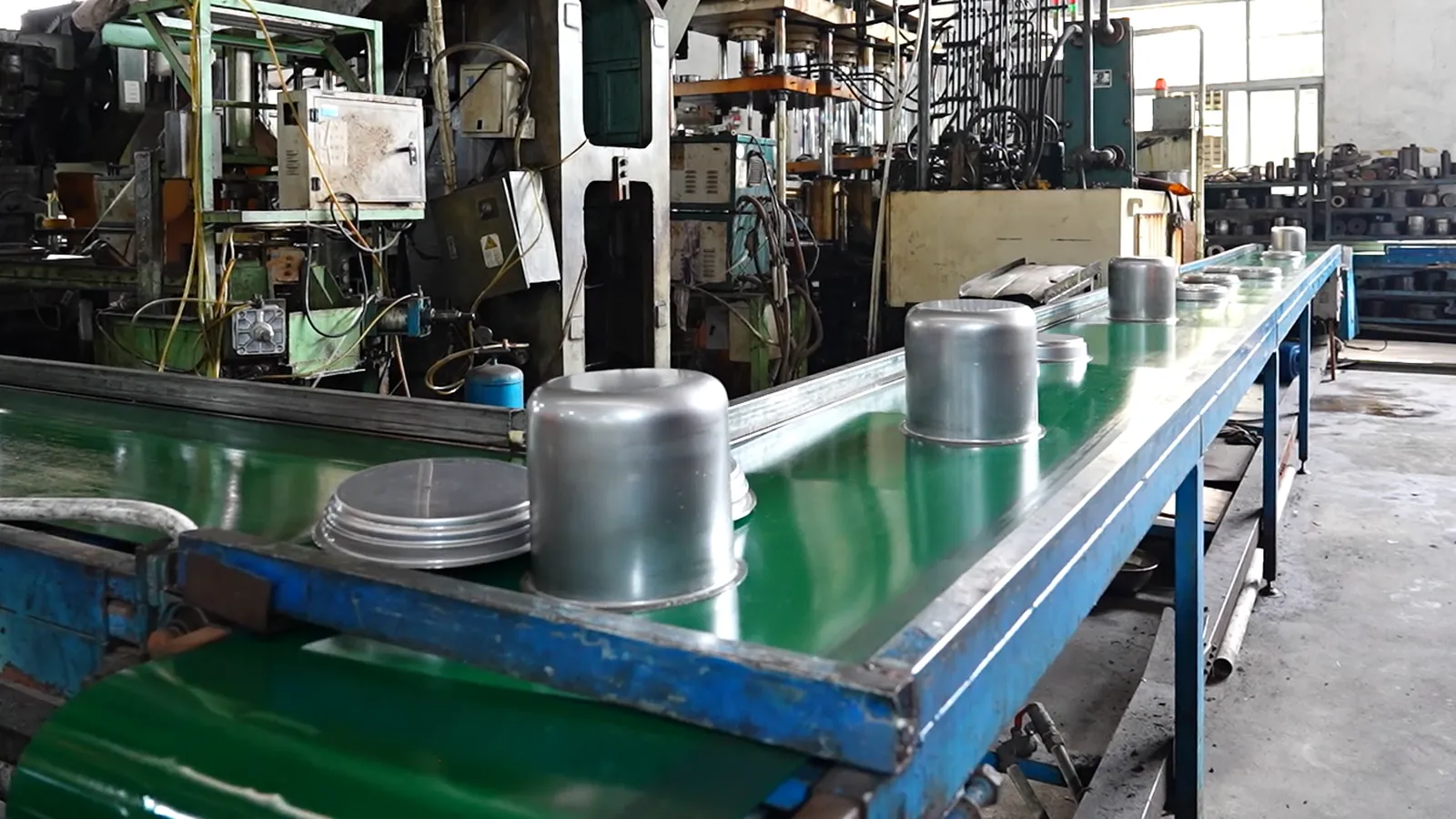
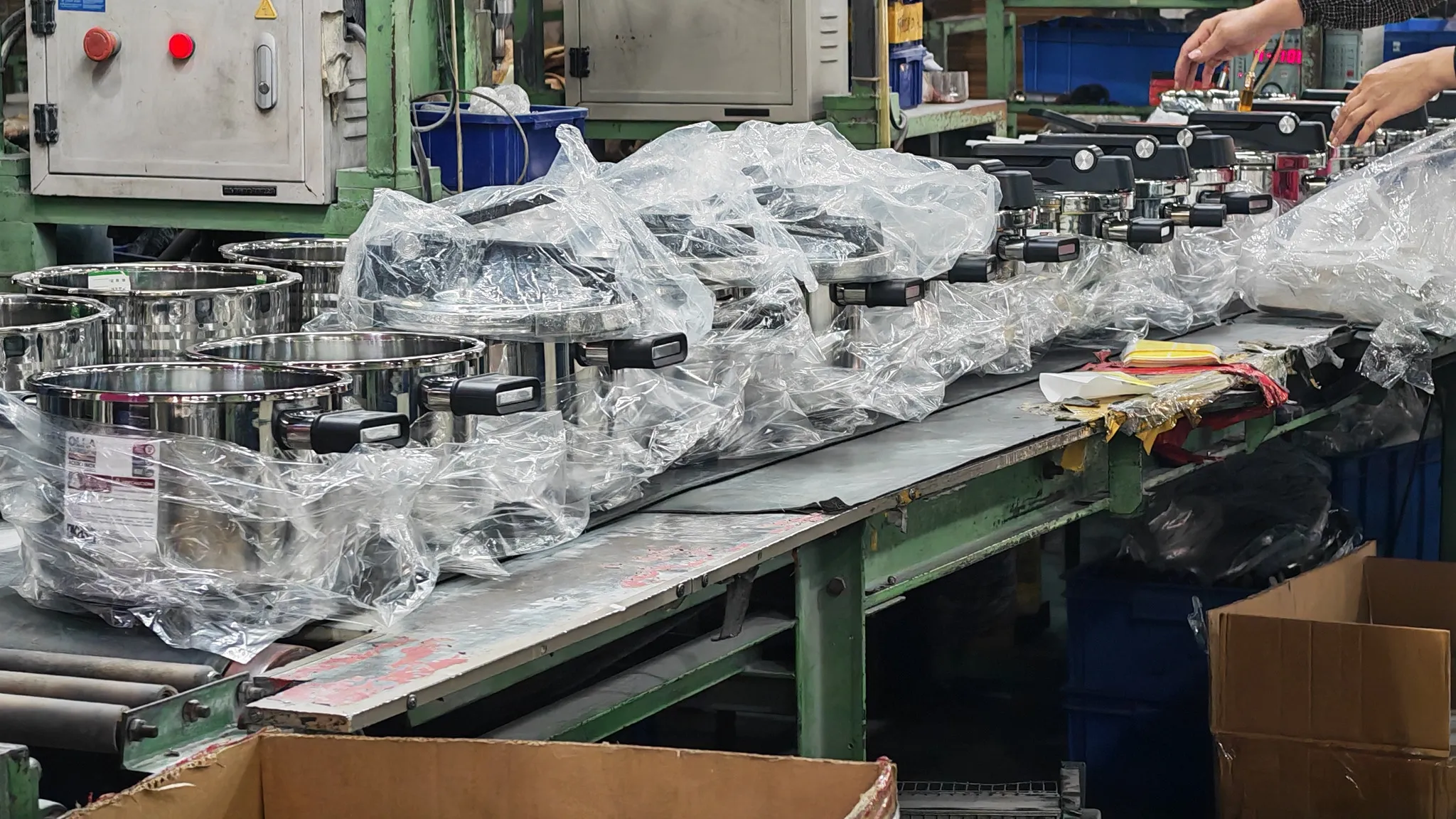
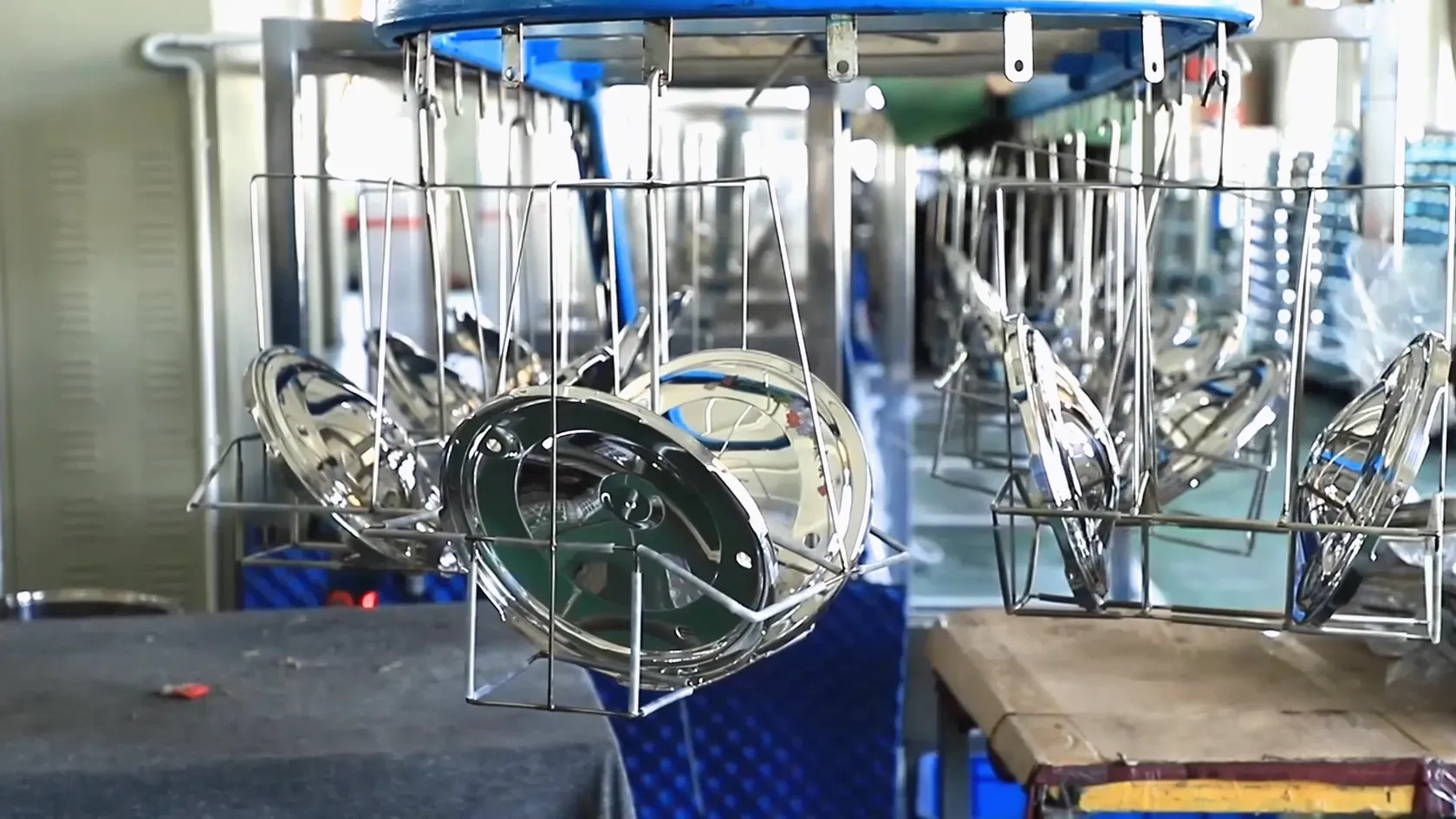
The drawn parts on this line are the reason the range conversation starts at construction: the same plant can run a saucepan body and a kettle body, but not a cast-iron skillet, and the tooling follows the shape rather than the category name.
Two constraints follow, and both hit your breadth decision harder than any market research will:
- Tooling is per shape. A new body shape, a new lid fit or a new spout geometry is a tooling event, not a line item. Reusing an existing shape in a new size is a different (usually smaller) commitment from inventing a shape — which is why a supplier's catalogue length is often a map of the tools it already owns.
- Lot sizes follow the process. A draw line, a welding cell and a finishing line all have their own economical run lengths. An aggressive per-model minimum from a supplier with genuine in-house production is usually a real cost signal, not a negotiating stance. Where a plant is integrated — planning, design, tooling, forming, polishing, welding and packing under one roof — that is exactly what makes flexible minimums possible.
This is where "who actually makes it" stops being sourcing trivia and becomes a range question. If your supplier assembles other people's production, the categories they can offer are limited to what they can buy in, and your range is capped by someone else's catalogue. Cookware manufacturer or trading company walks through the difference in the paperwork. Construction also sets the compliance path: multi-ply and coated articles carry their own questions, and the composite base an induction market needs is a production feature, not a spec sheet line.
For a stainless range, the material reality is narrowing. Pressure cookers are generally specified 304-only because of the safety and food-contact duty they carry, while kettles and some value lines run on 201 or a mix. Wholesale pressure cookers: what importers need to know goes deeper on that category specifically. Ask for the grade per model in writing, not per range.
Packaging and the container decide how wide you can go
Assortment width looks like a merchandising decision and behaves like a logistics one. Every extra SKU adds packaging artwork, an inner-packing configuration and a set of carton dimensions — and carton dimensions decide how much of your container is air.
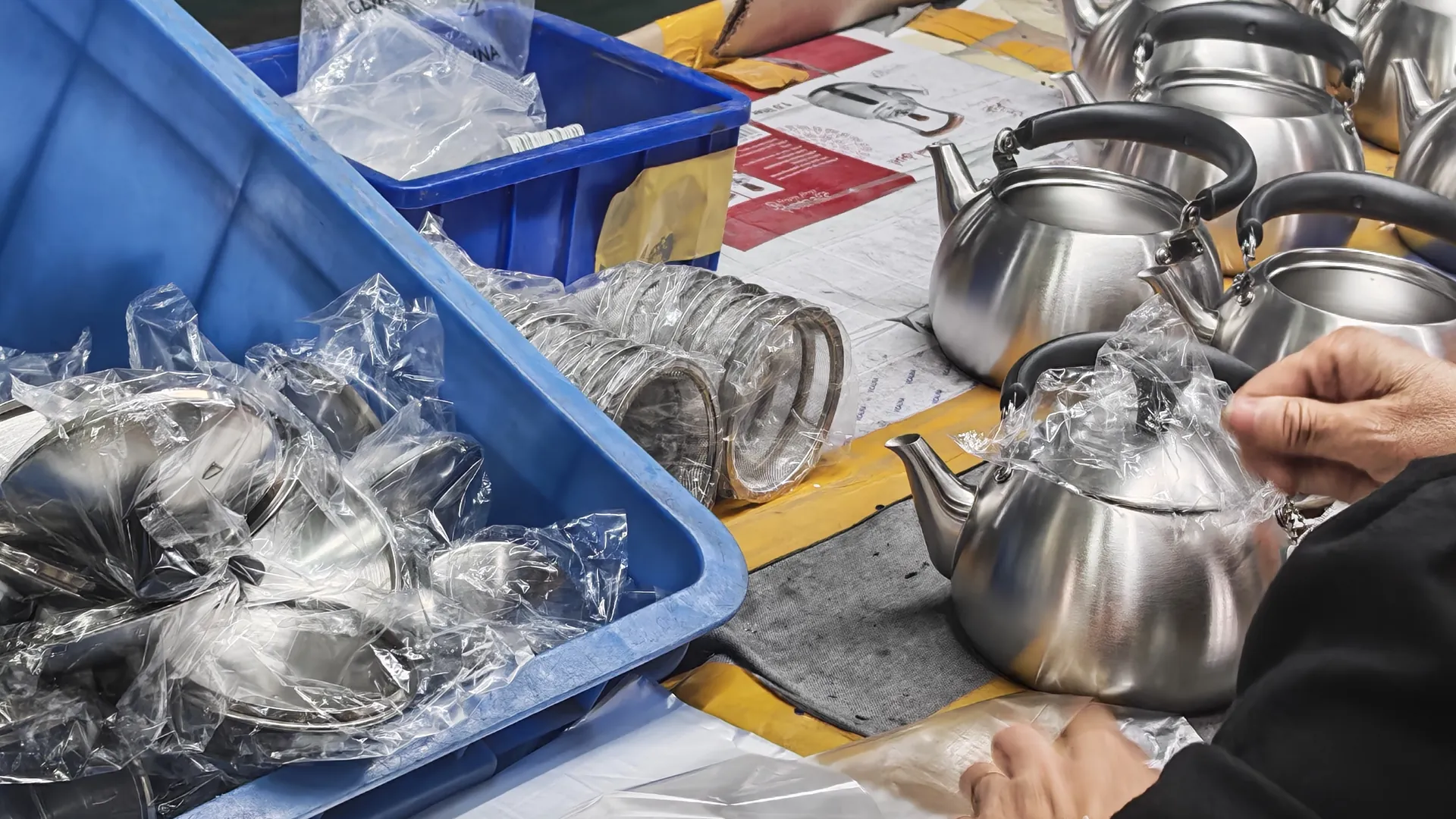
Inner packing is where a range quietly becomes expensive: each separated part needs its own protection, and every added SKU adds a carton size the plant has to build and stock.
The practical consequences for a product line:
- Width costs cube. More SKUs in smaller quantities per SKU means more partly-filled cartons and more container volume spent on structure rather than product. Two narrow families usually ship better than five broad ones.
- Packaging is a per-SKU commitment. A retail-ready outer needs its own artwork, barcode and insert set. That is why a private-label line often starts with fewer SKUs than the buyer first planned — and why retail-ready cookware packaging is worth reading before the collection is finalised.
- Classification follows the article, not the range. Each category is classified on its own terms rather than as part of your range, so the duty you pay follows the classification of the article — and several cookware families can share a single heading. Classification starts from the Harmonized System and the applicable tariff schedule for your market; the classification questions belong to your customs broker and your supplier together, in writing, before the range is fixed.
A weak answer on packaging sounds like "we can do any packaging you want." The checkable version names the carton dimensions, the inner-packing configuration and the units per carton for each SKU you are considering — and a supplier who will not put those numbers next to your SKU list is asking you to approve cube you cannot see.
Test a category before you scale it
A new category should earn its place the way a new SKU does: with evidence, in a small enough quantity that being wrong is survivable. Most ranges fail not because the categories were wrong but because the commitment arrived before the evidence did.
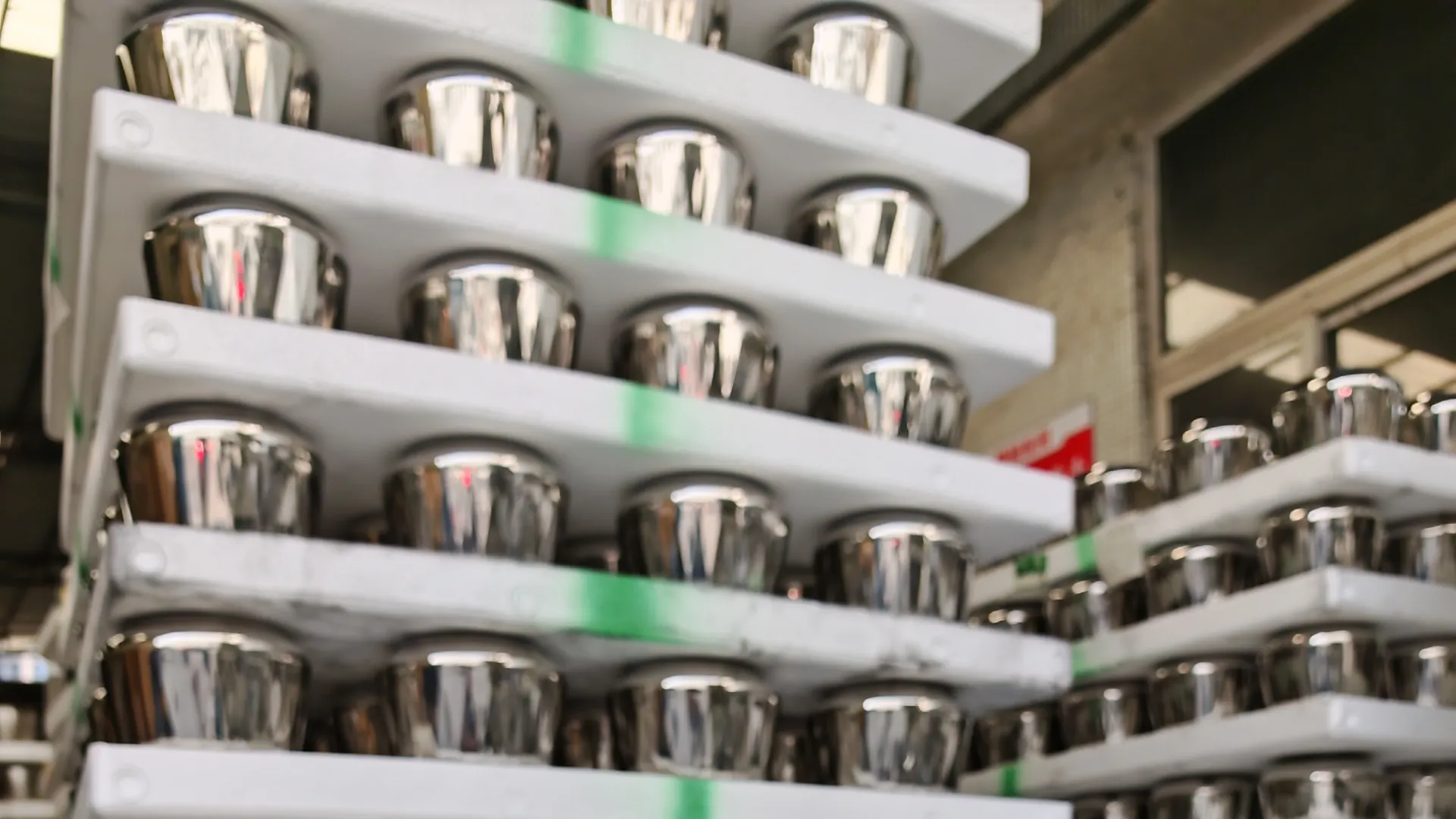
Finished goods waiting on racking are the physical form of a partial commitment — enough to test a category, not so much that being wrong is expensive.
A workable test protocol for a wholesale range:
- Enter at the smallest real production quantity. Below that you are not testing the product, you are testing a sample lot that tells you nothing about mass-run consistency. Get the quantity in writing along with the finish and packaging you intend to scale, so the test and the scale-up are the same article.
- Confine the test to one channel. Sell the new family through a single distributor or one retail programme. Blended results across channels hide the signal you are looking for.
- Watch reorder rate before sell-through. Sell-through tells you the first order left the shelf; the reorder tells you it found a home. A category that sells once and stops is a promotion, not a line.
- Price the test as a test. Sampling and a first production run cost more per unit than a scaled order; treat the difference as the price of the information, and compare it against the cost of scaling blind.
- Decide the exit condition in advance. Write down what would make you drop the category. Ranges drift wide because nothing is ever formally dropped.
Seasonality belongs in the test design, not after it. Kitchenware demand moves with gifting seasons and with your own customers' buying calendar — a retail programme orders months ahead of its shelf date, so a "slow" category may simply be out of phase with your measurement window. Test across one full cycle before concluding anything.
Match the range to the market you are selling into
The same range does not sell the same way in every destination, and the differences that matter are usually regulatory and cultural rather than aesthetic.
- European Union. Food-contact compliance sits in a migration-behaviour framework rather than a grade whitelist — Regulation (EC) 1935/2004 is the reference point, and it is the importer who is responsible for the article placed on the market. That shifts what you need from a supplier: migration test reports on the exact article you are buying, not a category-level assurance. Duty on a newly added category is settled from its classification in the EU customs tariff, which is why classification belongs in the range conversation.
- United States. Food-contact rules here work by composition rather than by certificate: in practice, stainless articles are accepted on the basis of the series and its chromium content, and buyers ask for case-by-case letters rather than a wall of certificates.
- Europe, the Middle East, South-East Asia and Africa. Programmes frequently turn on certification and marking requirements specific to the destination (SASO and SABER for Saudi Arabia, for example), and on shapes and finishes that differ by region — the kettle models built for Arabian and Nordic markets vary in form and handle, not just in colour.
Programme differences are real but should not be guessed at in a plan. Where a market claim is not sourced, write it as a question for the supplier instead: which markets has this category already shipped to, and what did those shipments require in writing? For ranges aimed at importers and distributors specifically, how we work with importers and distributors sets out the paperwork side.
What to get in writing, category by category
The pattern across every section above is the same: the range decision is only as good as the answers you can hold a supplier to. These are the items worth getting in writing before the first order, not after the first problem.
What to ask | Why it changes the range |
|---|---|
Grade per model | Sets the price floor and the food-contact path for that article specifically |
Construction per family | Determines which sizes share tooling and which need a new shape |
Per-model MOQ, per finish, per packaging variant | These are three different minimums and they gate different SKUs |
Which processes are in-house | Caps the categories a supplier can actually offer you |
Carton dimensions and units per carton per SKU | Converts assortment width into container cube |
Sampling and production lead times | Sets how fast a new category can be tested |
Test reports on the exact article, with lab, number and date | Shifts compliance evidence from the category to the thing you are buying |
Customisation options: packaging, logo, colour, handles, accessories | Separates a catalogue purchase from a private-label programme |
Two supply-side signals worth treating as warnings. A supplier who gives a single minimum for the whole range is quoting a sales line rather than a production plan. A supplier who cannot name which processes they own is either a trader or is relaying someone else's constraints — either way, the range you build with them is not really yours to widen.
The productive version of the conversation runs in the opposite direction from a catalogue: bring the categories you are considering, the markets you sell into and the channels you have, and ask which of them the plant would build in-house, at what construction, and with which sizes sharing tooling. That exchange tells you more about the range in ten minutes than a full price list does — and it is where the conversation starts.
One note on the numbers in this article: treat the frameworks as planning structures, not market data. Minimums, tooling costs and lead times are negotiation outcomes that differ by category, and the only figures that belong in your plan are the ones your supplier puts in writing against a specific model. Whether you are buying catalog stock or building a private-label programme, the discipline is the same: decide the role of each category before you decide its size grid.
Common questions
How many cookware categories should a wholesale range start with?
Fewer than most first-time importers plan for. A workable start is one anchor category carried with real depth, one or two footfall items carried shallow, and a deliberate decision to leave the rest out of the first order. The reason is cash, not courage: every category you add needs its own tooling, packaging artwork, compliance paperwork and a minimum order volume, so breadth spent early is depth you cannot afford later. A range that reorders in three families beats a range that sits in eight.
What is the difference between cookware sets and open stock?
A set sells as one SKU — several pieces boxed together — while open stock sells the same pieces individually, so a customer can buy one saucepan or replace one lid. Sets lift the average order value and photograph well in a catalogue, but they multiply packaging cost and make part-replacement harder. Open stock repeats more predictably because each size stands on its own, which is why most wholesale ranges start with open stock in a few proven sizes and add sets once the singles are moving.
Which cookware category should an importer stock first?
Start with the category your buyer already has to buy, not the one with the best margin on paper. For housewares and retail programmes that is usually open stock — saucepans and casseroles in the sizes that sell fastest. For HoReCa and catering channels it tends to be a spec-driven item such as a pressure-cooker programme. The test is whether the customer would notice if you stopped stocking it. A category nobody reorders is not a range; it is inventory.
How do you test a new cookware category before scaling it?
Add it in the smallest commercial quantity that is still a real production run, with the same finish and packaging you intend to scale, and sell it in one channel first. Then watch two signals: reorder rate and sell-through speed against your other categories. A category worth scaling reorders without prompting; one that needs a discount to move is telling you the demand was your forecast, not your customers'. Testing costs less than scaling and reversing, because reversing means absorbing packaging, freight and compliance costs on goods you cannot easily move.
Written by
Potobelo Editorial Team
Sourcing and engineering staff at Potobelo, a stainless steel cookware brand built on 30 years of Zoombo manufacturing in Guangdong, China. We write from inside the plant that makes the product, not from reviewing it.