
Wholesale Cookware Trends 2026: What Buyers Should Stock
Seven wholesale posts on this site explain how to buy cookware. This one is about what changed for the 2026–27 cycle: replacement-led demand, own-brand share, induction bases, nickel and CBAM, packaging rules that now bite, and a tariff picture that moved in February. Each shift is translated into something you can write on a drawing or a purchase order.
 Potobelo Editorial Team14 min read
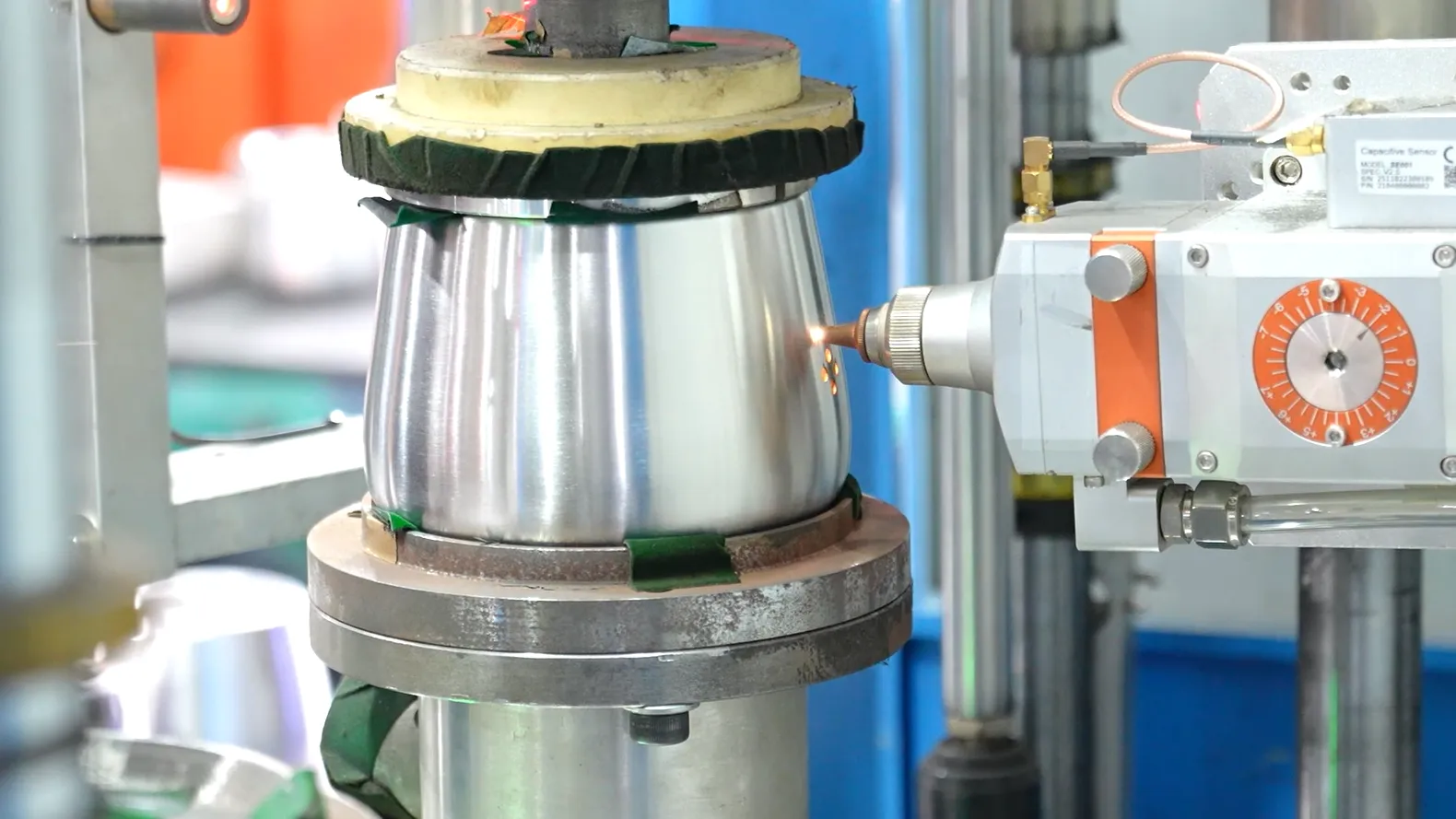
The kitchenware trends that change a purchase order
Most pages ranking for kitchenware trends are written for shoppers: colour stories, gadget roundups, scraped sales charts. They answer what somebody might carry home. A buyer's question is narrower and harder — what goes in the container, in what ratio, at what landed cost, against rules that now have dates on them.
For the 2026–27 cycle, five structural shifts have landed. Demand has become replacement-led, so money grows while units do not. Own brand has taken the unit growth that national brands lost. Induction compatibility has turned into a base specification. Stainless steel costs more, and part of that cost is now a carbon charge. Packaging regulation stopped being a background concern and acquired registration duties. On top of those sits a sixth variable — tariffs — which moved in February in a way that makes any twelve-month price a bet.
What has not moved is the arithmetic underneath: minimum order quantities, tooling amortisation and the working days between a signed sample and a vessel. Those still decide whether a good idea survives quotation.
If you are still assembling the buying sequence itself, start with how to start a cookware wholesale business — this piece assumes the sequence and argues about this year's variables instead.
Demand is replacement-led, so the range has to fit a hole
The headline number flatters the category. Circana's Future of Home forecast puts US home-industry dollar sales at $43.7 billion in 2026, up 2.9% on 2025, "even as unit demand remains pressured" — and the same release notes that 59% of cookware purchasers still intend to go ahead with planned purchases. Dollar growth with flat units is a price-and-mix story, not a volume story.
The buying behaviour behind it is specific. In HomePage News' 2026 state-of-the-industry survey, 40% of cookware respondents named replacing an existing product as their main reason to buy, and 23% cited updated features — one of the higher "innovation" scores among kitchen categories. Planned purchases clustered on frying pans (45%), cookware sets (38%) and multi-purpose pans (35%).
Translated into a container, replacement-led demand means the range has to fit a hole somebody already has in a cupboard: the 24 cm frying pan that wore out, the 20 cm saucepan whose handle loosened, the lid that no longer seats. It does not mean a new shape with a story attached. It also explains why set programmes and open stock behave differently in the same account — one replaces a whole kitchen, the other replaces a piece, and the split between them is a merchandising decision you make before you order, not after. The mechanics of that choice are set out in cookware sets versus open stock.
Own brand took the unit growth, and it moves the carton
In the channels Circana tracks for the Private Label Manufacturers Association, store-brand unit share reached 23.7% in the ten months to 1 November 2026, a record, with a 21% dollar share. Store-brand units rose 0.1% while national-brand units fell 0.9% — and store brands have outperformed national brands in ten of the eleven reporting periods this year. The price gap explains it: $4.14 average for a store-brand unit against $4.79 for a national brand in the first half of 2026.
Europe tells the same story from the supply side, and there it shows up as volume leaving local factories rather than as brand share changing hands: falling domestic output against rising import share is the same channel shift, seen from the factory end. APPLiA's Home Appliance Monitor reports European appliance sales ending 2025 at roughly 170 million units, back to 2015 levels, with the share of appliances made in Europe for European consumers falling from over 80% to 71%.
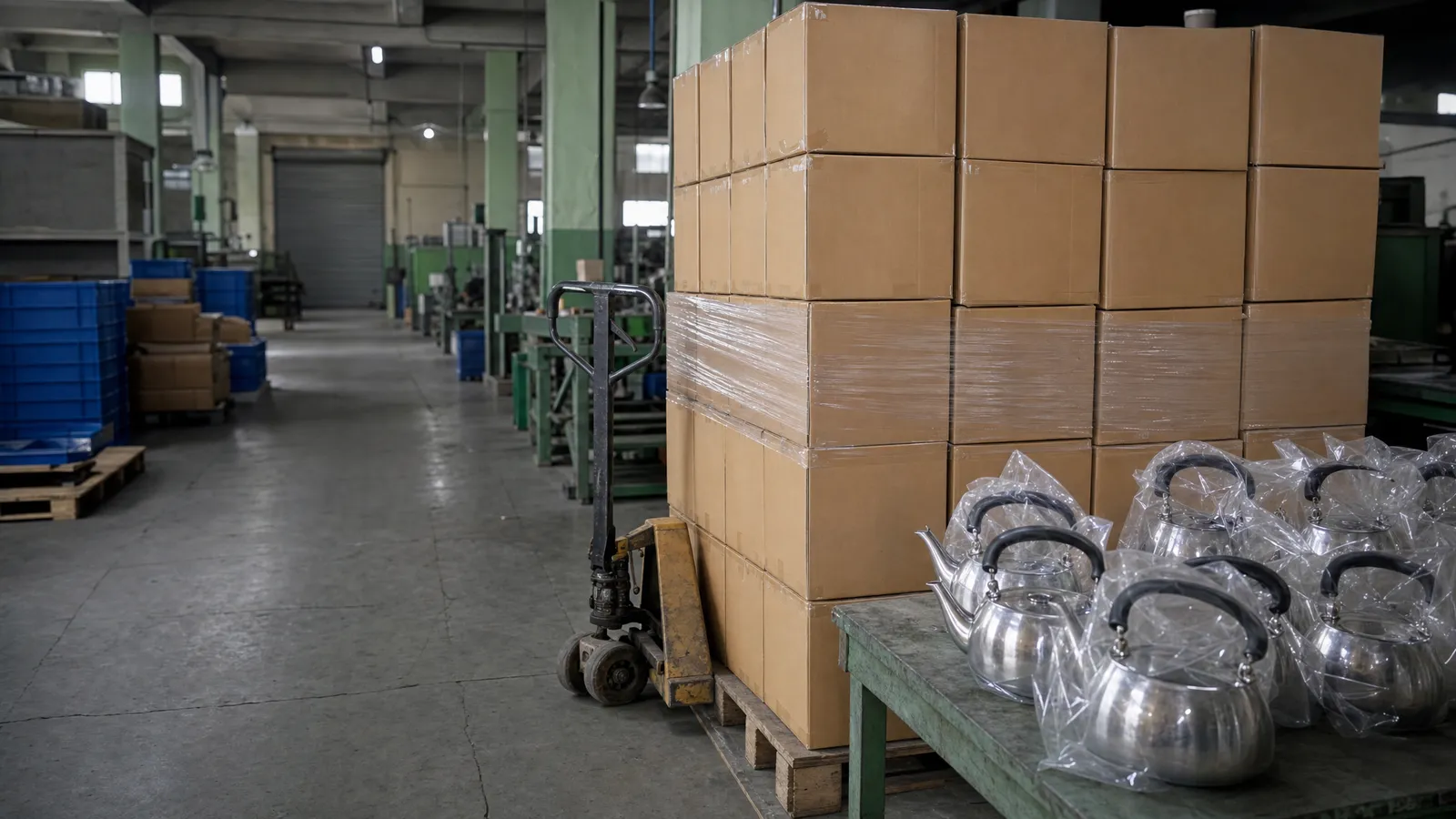
For a cookware buyer this is a carton problem before it is a product problem. An own-brand programme needs plain cases with no factory marks, artwork approved early enough to print, barcodes and carton markings that match the retailer's system, and a lid badge or body engraving that can change without changing the tool. The product can stay identical while the packaging, the brand and the price tier all change — which is exactly why private-label volume grows faster than the factories that treat packaging as an afterthought. How to sequence that range by role rather than by size is in building a cookware product line.
Induction-ready is a base specification now, not a claim
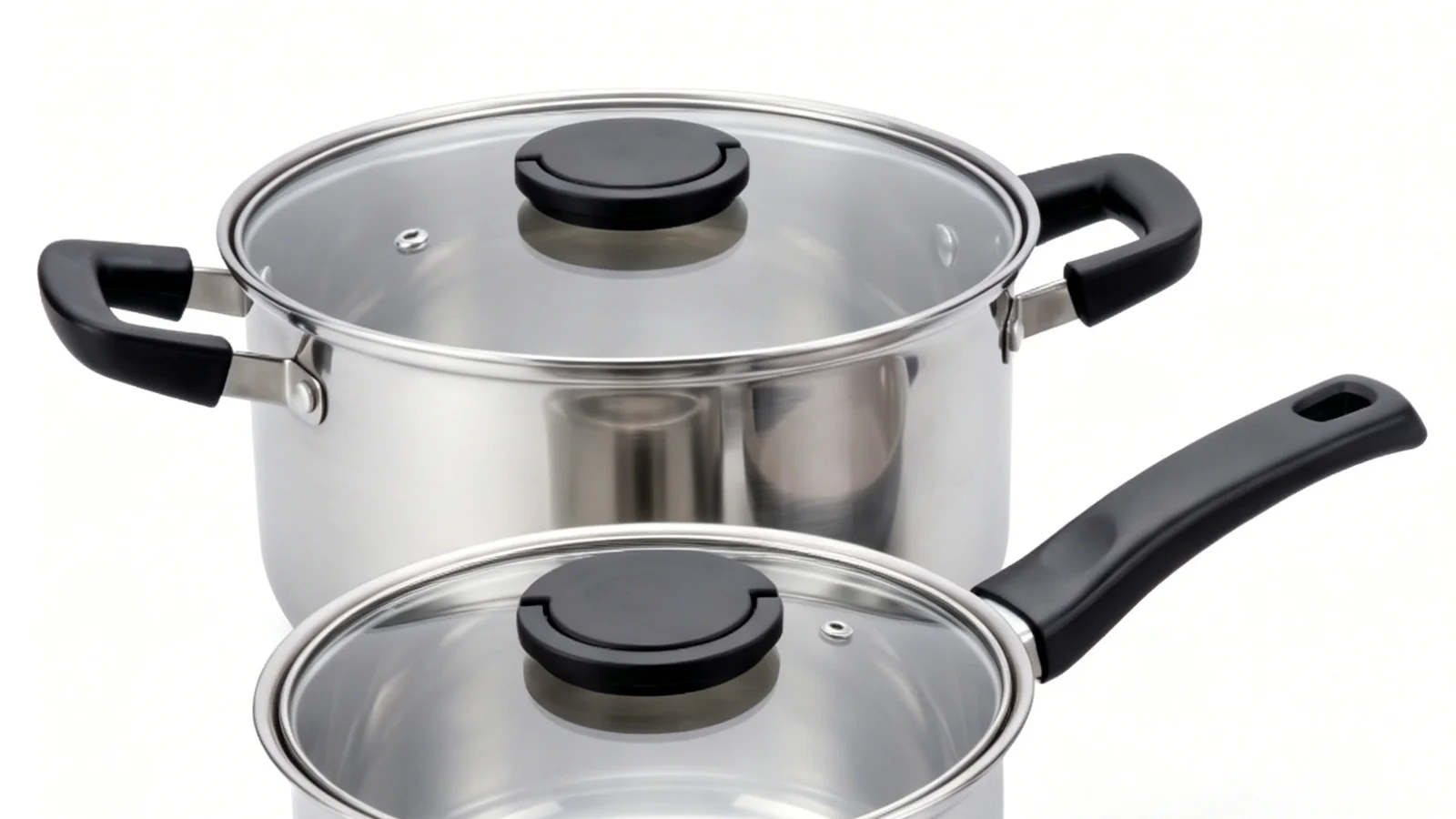
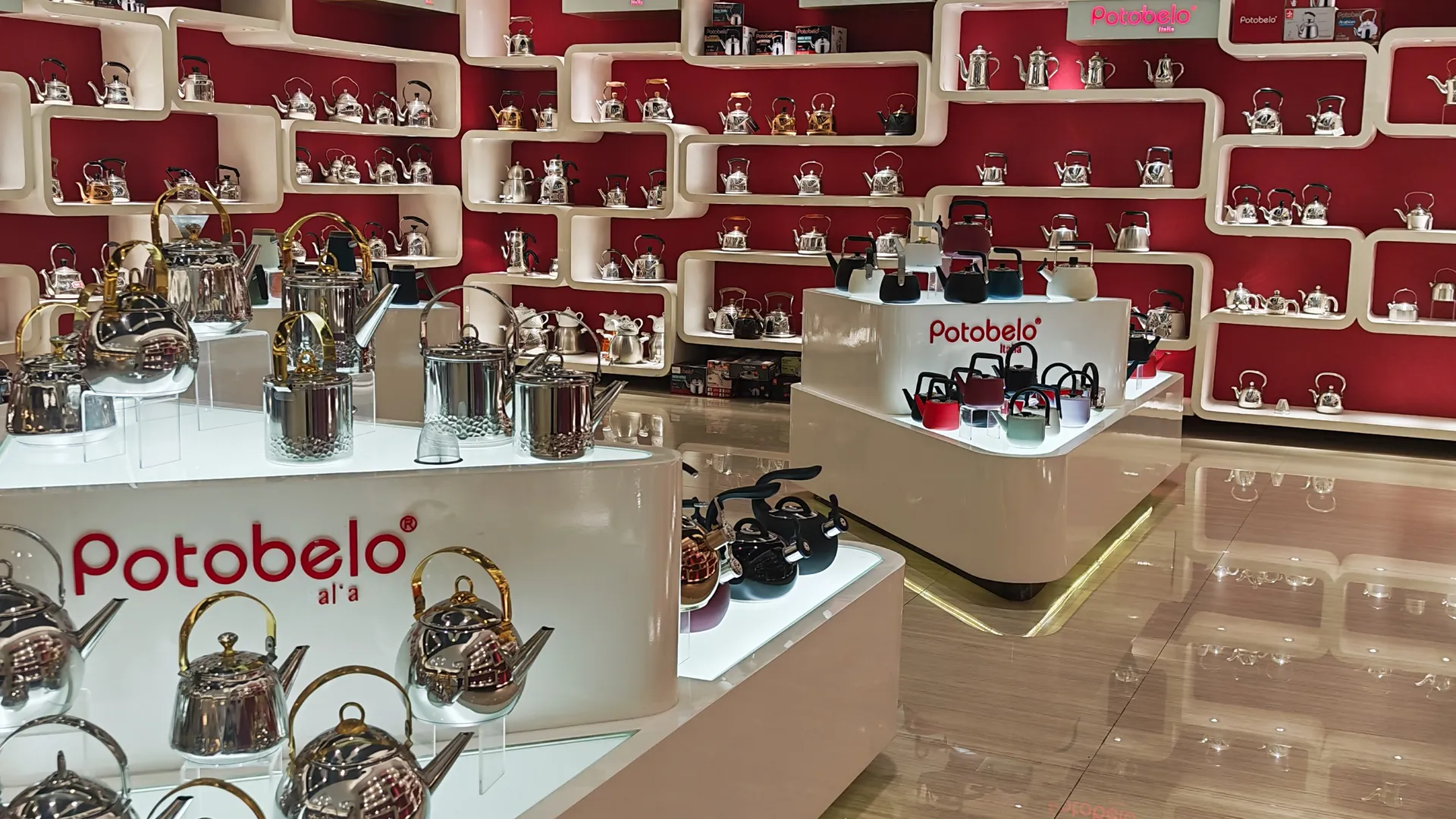
An induction hob does not heat a pot; it induces current in a magnetic layer and the layer heats. Austenitic stainless — 304 and 201 alike — is effectively non-magnetic, so the field has almost nothing to couple to, and a body made only of it will not work on an induction hob. The magnetic layer therefore lives in the base: an aluminium core for heat spreading, with a ferritic stainless outer sheet bonded to it, or a magnetic insert set into the base.
That is a construction, not a phrase, and in 2026 it is being sold as one. Tramontina's Tempo collection, announced for The Inspired Home Show 2026, is described by the company as built on a tri-ply base with a magnetic stainless steel exterior for induction compatibility and "compatible with all cooktops". Sourcing-side trade coverage has reached the same place: induction compatibility is now described as an "increasingly relevant specification", alongside products designed for gas, electric, ceramic and induction at once.
What changes in your documents is small and specific. The base construction goes on the drawing, not in a marketing line: number of layers, which layer is magnetic, total base thickness at the centre and at the rim, base flatness after the composite bottom is pressed on, and the diameter tolerance that decides whether the pan sits inside the hob's marked ring.
Then test it. A magnet that sticks proves the presence of a magnetic layer and nothing about performance; a production sample, one litre of water, a measured hob and a timer prove the rest. The full mechanism — including why a magnet test can pass on a pan that still performs badly — is in stainless steel induction cookware.
Grade is a cost lever with a paper trail
Two grades dominate this trade, and the difference is arithmetic. 304 carries roughly 18% chromium and 8% nickel — 18/10 is the same series at 10% nickel — while 201 replaces most of that nickel with manganese. Nickel is the volatile input, which is why 304 costs more and moves more when the nickel price moves.
Both layers of cost moved in 2026. MEPS reported in June that its world average stainless steel price had risen almost 10% since the start of the year, attributing the increase largely to trade legislation and to inflation linked to the Middle East conflict, and noting that supply stability had overtaken price as buyers' first procurement priority. The same briefing flagged emissions-based import charges: the EU's carbon border mechanism applied from January 2026, with UK and Norwegian equivalents from January 2027.
So a quotation needs to say what it is priced against and how long it holds. Grade substitution needs more than that. Moving a body from 304 to 201 is a specification change with three consequences you cannot see on an invoice: corrosion behaviour in a dishwasher, how the surface takes a polish, and what your market's buyers and test houses will accept. 201 is in commercial use for kettle bodies and outer parts; what it does not carry is the same established food-contact recognition in practice as 304, particularly where the surface touches food.
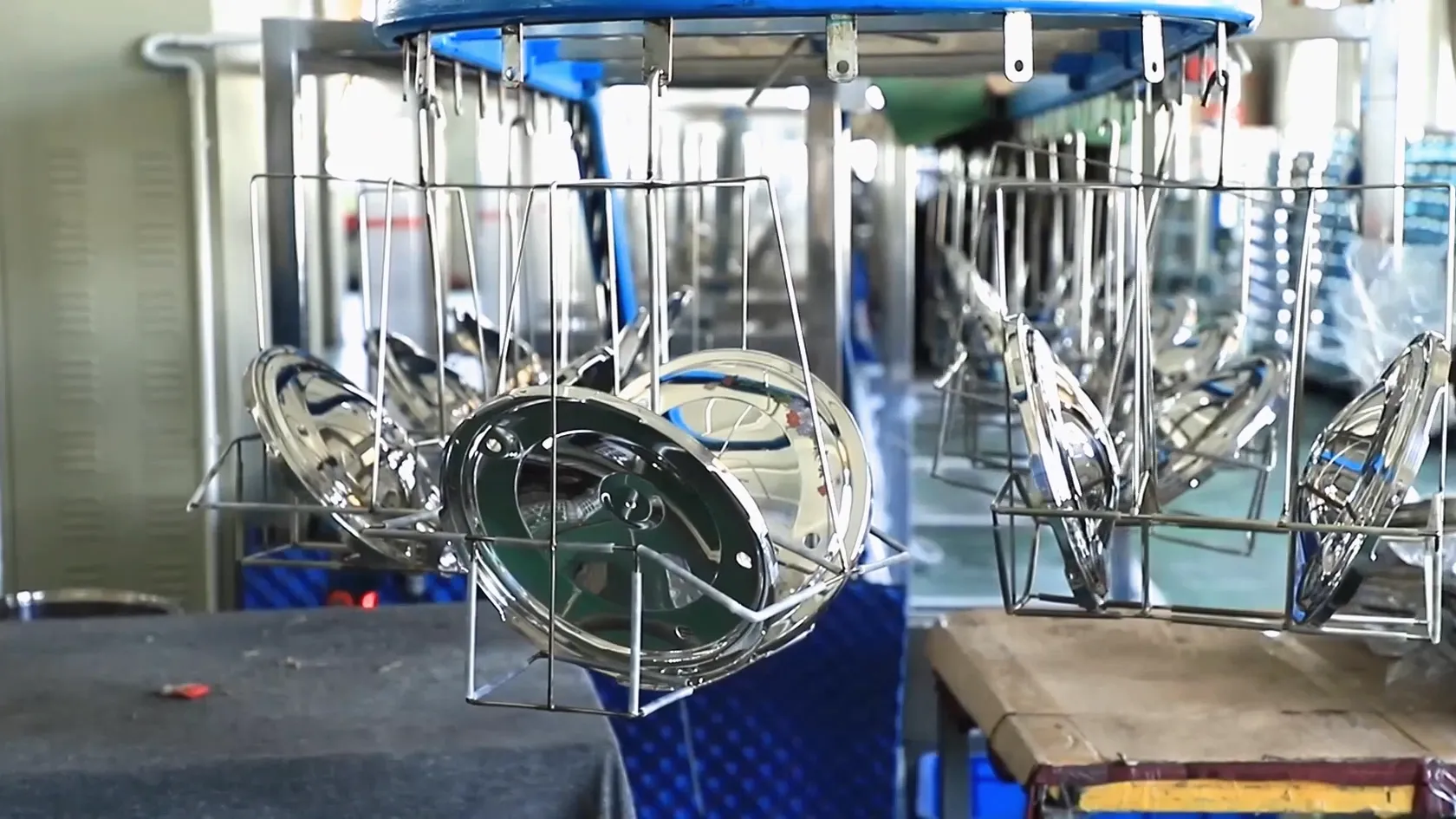
Food-contact rules are worth stating precisely, because they are routinely overstated. The EU framework, Regulation (EC) No 1935/2004, regulates migration behaviour — no transfer to food in quantities that endanger health or change the food's composition — and it does not publish a whitelist of approved steel grades. US practice recognises stainless steel by alloy series, and the grades used for cookware typically carry chromium at 16% or more. China's GB 4806.9 works by specific migration limits for metal elements. None of those three is a grade certificate; all three are satisfied by testing a named sample on a named date. If your range moves grades, the paperwork has to move with it — 201 versus 304 stainless steel covers the metallurgy.
Nesting and stacking: the container is a design constraint
Freight is still expensive enough to change a design decision. Drewry's World Container Index stood at $4,305 per 40-foot container on 12 November 2026, down 2% in a week but still at a level where the freight line is a visible share of landed cost rather than a rounding error; Shanghai to Los Angeles was quoted at $7,416 and Shanghai to Rotterdam at $3,504 in the same assessment.
That is why space efficiency has moved from a retail talking point to a container one. Global Sources' sourcing coverage makes the transport case directly: products that nest or fold "may also require less storage space during transportation and at retail locations", with clear information on folded, nested and expanded dimensions supporting selection and merchandising. Tramontina's 2026 nesting set makes a consumer claim out of the same idea — pieces that nest to save up to 50% of cabinet space, with locking handles holding the stack together.
In a purchase order, nesting only pays if it survives three questions. Does the stack nest with the lids on? A set that nests only after the lids come off loses the retail display benefit and gains a components problem. What is the nested stack height, and does the carton follow it, or is the carton still sized for the unnested version? And what happens to the seams — a nested stack puts the rim of one body against the base of the next, which is fine in a showroom and less fine after a month at sea. Get the nested height, carton dimensions, units per carton and cartons per 40-foot high-cube into the quotation, and compare quotes on landed cost per piece rather than unit price. The cube arithmetic is worked through in mixed container shipping.
Packaging: two regimes, one carton
The EU packaging regulation, Regulation (EU) 2025/40, entered into force in February 2025 and has applied generally since 12 August 2026. It sets requirements for substances in packaging, recyclability, packaging minimisation, reuse and environmental claims, together with conformity assessment and documentation duties for economic operators. Recyclability is assessed in grades from 2030, with a floor of grade B from 2038 — dates far enough away to ignore in a quotation and close enough to matter in a five-year packaging decision.
The nearer obligation is registration. In California, the packaging producer responsibility programme under SB 54 is running: permanent regulations are in force, a producer responsibility organisation has been approved, producers carry registration and reporting duties, and CalRecycle received the programme plan setting out how producers will comply on 13 October 2026, per CalRecycle's programme page. Several other states now run comparable programmes, and the fees in these schemes are calculated on material type and weight.
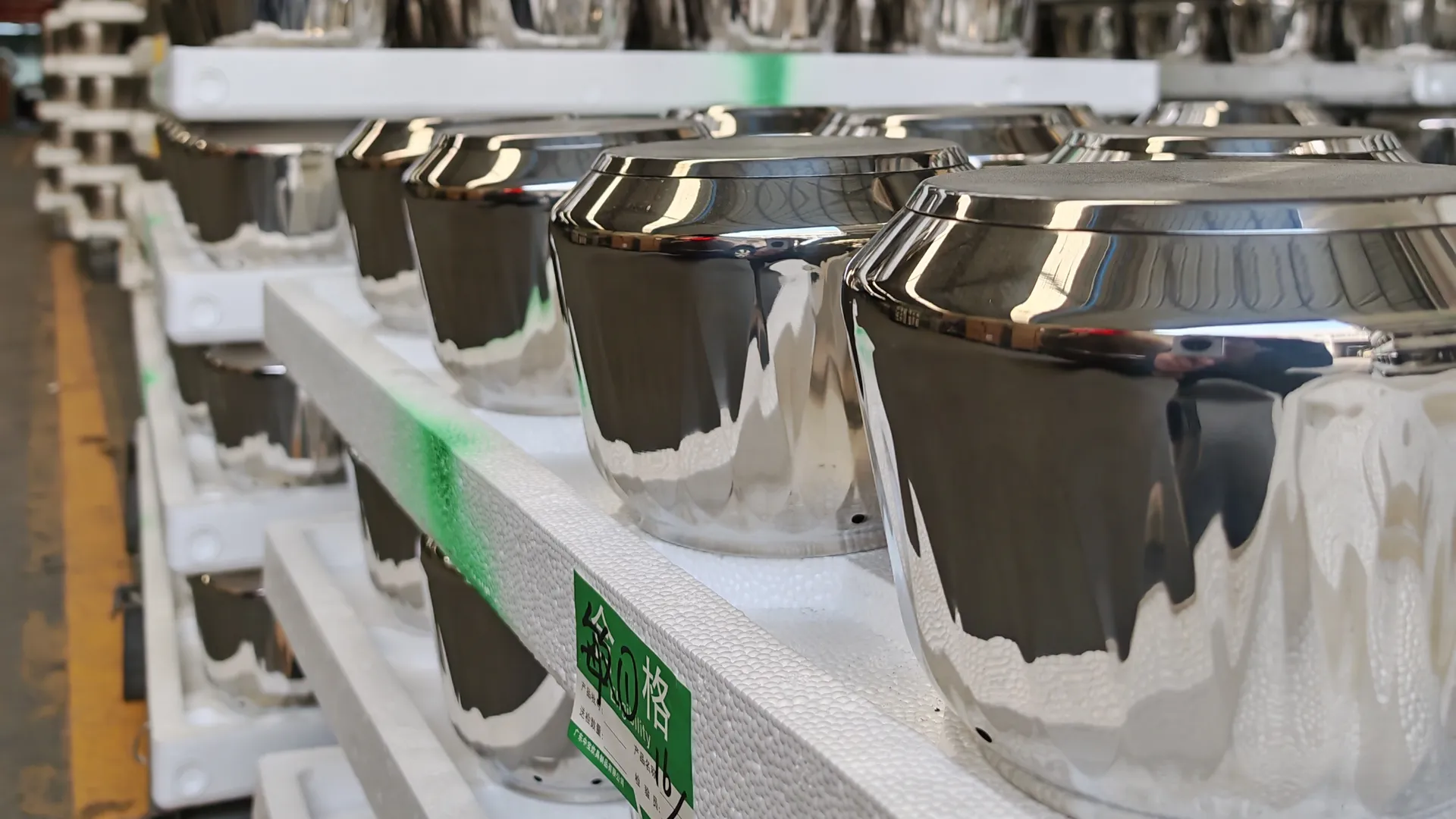
Which makes one line item newly valuable: packaging weight per SKU, by material. Ask for it as a table, not a sentence. A carton that drops a laminated window, a plastic insert and a printed sleeve is lighter on the water and cheaper in every fee schedule that charges by weight — the rare case where the compliance answer and the cost answer point the same way. The format decision itself — bulk, shelf-ready or hybrid — is covered in retail ready cookware packaging; this section is only about what the two regimes add to it.
Duty assumptions now need an expiry date
On 20 February 2026 the US Supreme Court held, in Learning Resources, Inc. v. Trump, that the International Emergency Economic Powers Act does not authorise the president to impose tariffs. The duties collected under that authority since 2025 became refundable, and refund claims have been moving through the Court of International Trade and Customs since — a cash-flow item for importers who paid them, and a warning for everyone else.
It would be a mistake to read that as the end of duty exposure. The other programmes rest on different statutes and were not resolved by that decision; as Troutman Pepper's summary puts it, IEEPA, Section 122 and the Section 301 forced-labour actions are three programmes at three different stages of litigation.
Practically: a landed cost model built on a duty rate needs the rate's date next to it, and a quotation needs a validity period and a stated basis for re-quoting. That is not a negotiating trick. It is the only honest way to price a good whose duty treatment can change inside the life of the order. The landed cost calculation sets out where each line belongs.
MOQ and tooling: small drops mean fewer shapes, not smaller runs
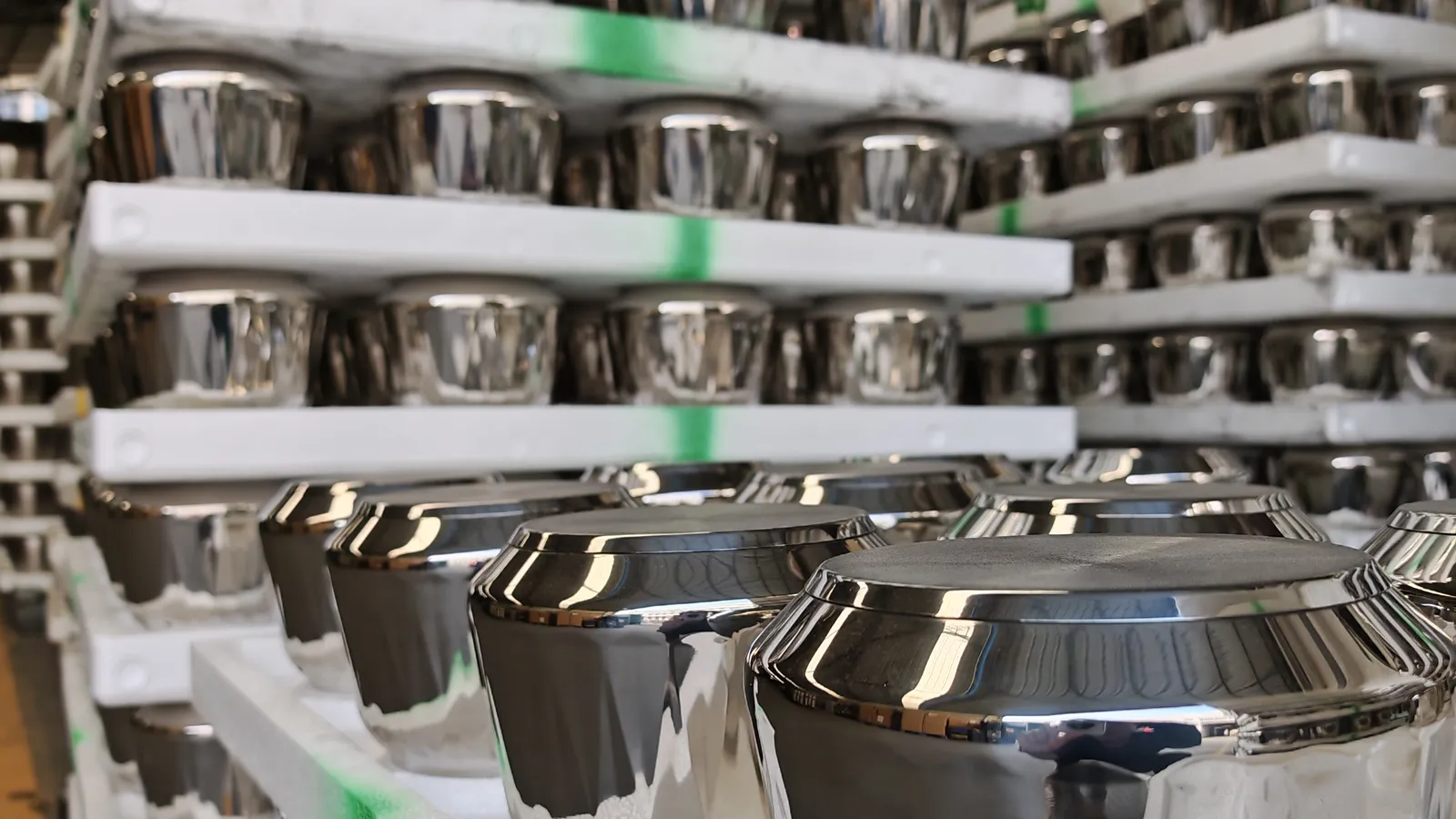
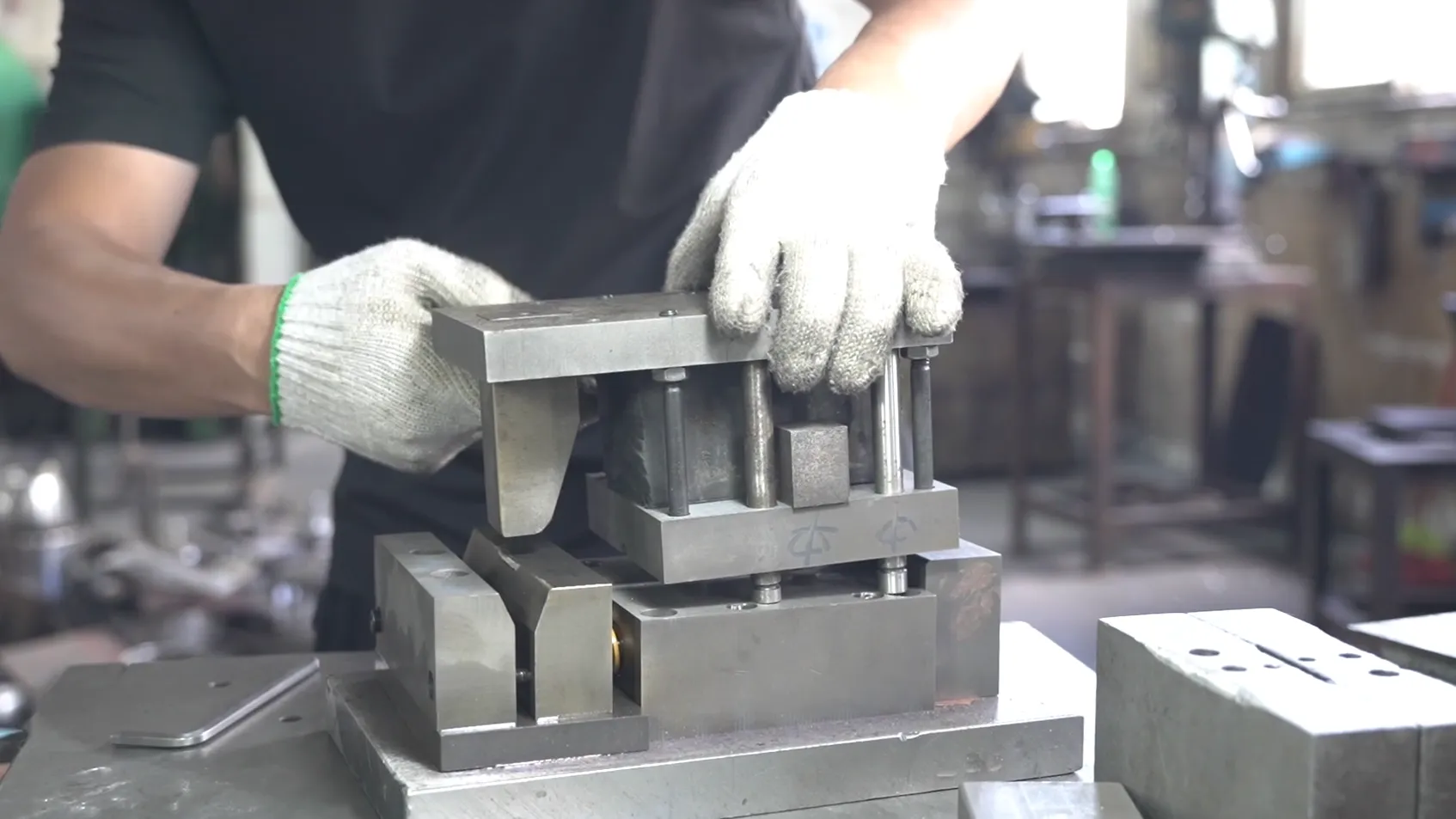
The last constraint is the one buyers try hardest to negotiate and least often can. Every distinct shape carries tooling — blanking and piercing dies, a draw die or a spinning mandrel, trim dies, welding or brazing fixtures, polishing fixtures. Some of those operations are shared across a family of sizes; the draw die, the mandrel and the polishing fixture usually are not.
So when a buyer asks for "smaller drops", what is actually available is fewer shapes, ordered deeper. Our own minimum is 1,200 pieces per model: splitting that across three shapes does not reduce the tooling bill, it triples it, and the amortisation then sits on 1,200 pieces per shape instead of 3,600 on one. The price difference between those two orders is not a discount conversation; it is arithmetic.
Ask for the tooling as a separate line, per shape, with the operations listed; ask which parts of it are shared across the size family and which are size-specific; and ask what the unit price becomes after the amortisation term ends. Why a higher minimum order can cost less works the numbers through.
The 2026–27 container, line by line
Line | What changed | Write this | Defer |
|---|---|---|---|
Shape count | Replacement-led demand rewards familiar sizes | Sizes that fill an existing cupboard gap; one hero multi-purpose pan | Novel shapes with no replacement logic |
Base | Induction compatibility now expected | Layers, magnetic layer position, base flatness, diameter tolerance; boil test on a production sample | "Induction ready" as a carton claim only |
Grade | Stainless up ~10% in 2026, CBAM live | Grade named per SKU and per market; mill certificate; test report scope per SKU | Silent substitution to 201 on a cooking surface |
Packing | Nesting pays only if it survives freight | Nested stack height, carton dims, units per carton, cartons per 40HC | Nesting that needs the lids removed |
Packaging | PPWR applicable since August 2026; US state EPR fees | Packaging weight per SKU by material; mono-material cartons | Laminate windows, plastic inserts, printed sleeves |
Price basis | Tariff treatment moved in February 2026 | Validity period, re-quote basis, Incoterm | A twelve-month fixed price built on one duty rate |
Read down the "write this" column and the pattern is the same as it has been for a decade: the buyer who specifies wins the argument later. What changed is which specifications now matter.
Where our line fits, and where it doesn't
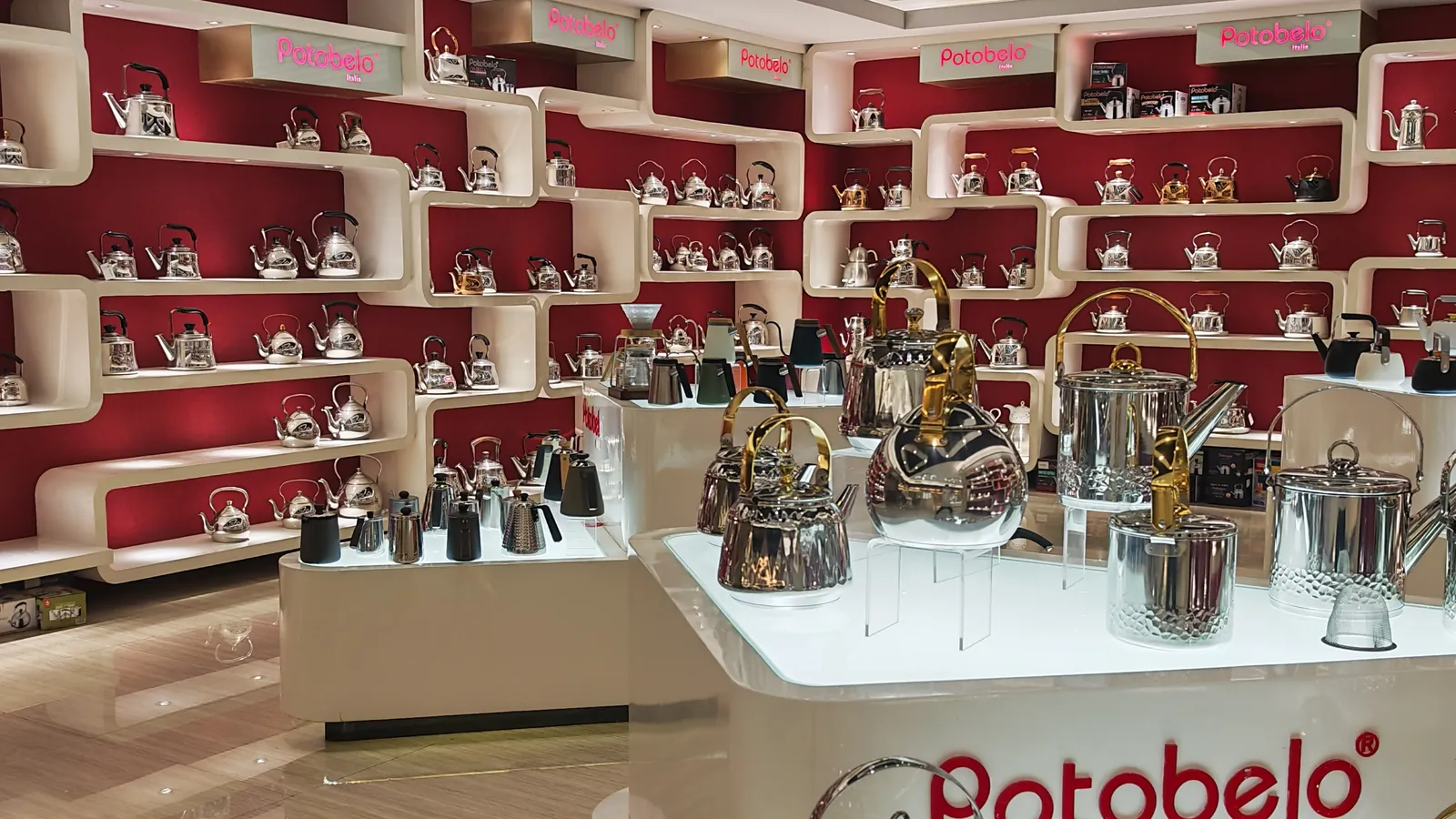
Potobelo makes four categories in stainless steel: pressure cookers, water kettles, saucepans and casseroles, and steamers. Pan cooking surfaces are 304, and pressure cookers in this line are 304 throughout; kettle bodies may be 201 or 304 by market and price tier, and non-contact parts follow the same rule. Composite bottoms are standard across most of the range, and induction compatibility is confirmed per model rather than assumed. Sampling runs seven to ten days ahead of production at thirty to fifty working days from confirmation.
We do not make chafing dishes, cutlery, tableware, small appliances or non-stick lines. If your 2026–27 range needs those, source them elsewhere — the container arithmetic in this article still applies, and mixing categories in one load is its own exercise.
What we can do is put all six lines of that table in writing for the four categories we run: the shape count, with tooling itemised by shape; base construction on the drawing; grade per SKU with the mill certificate behind it; nested height and carton dimensions; packaging weight per SKU by material; and a price with a stated basis and validity. Send the market, the categories and the volumes, and the quotation comes back in that shape rather than as a number with no history.
Common questions
What are the main kitchenware trends for 2026?
Five shifts matter to a wholesale buyer in the 2026–27 cycle. Demand is replacement-led, so dollar sales grow while unit volumes stay flat. Own-brand lines keep taking unit share from national brands. Induction compatibility has become a base specification rather than a marketing phrase. Stainless steel costs more, with the world average price up almost 10% during 2026 and EU carbon border charges applying since January. And packaging rules now carry registration and reporting duties in both the EU and several US states. Colour stories and gadget lists change none of these.
Do I need induction-compatible cookware in a 2026 range?
If the range is sold into Europe, the UK, Australia or any market where induction hobs are a large share of new installations, yes — a pan that does not heat on an induction hob is now a defect rather than a trade-off. An induction hob heats a magnetic layer in the base, so a 304 or 201 body alone will not work: the base needs a magnetic layer, usually a ferritic stainless outer sheet bonded over an aluminium core. Write the base construction on the drawing and test a production sample on a real hob, because a magnet sticking to the pan is a starting point, not a result.
Is 201 stainless steel acceptable for cookware?
201 is in commercial use for kettle bodies and outer parts, and it is cheaper and more price-stable than 304 because it replaces most of the nickel with manganese. What it does not have is the same established food-contact recognition in practice as 304, particularly for cooking surfaces, and it behaves differently in corrosion and polishing terms. So treat a move to 201 as a specification change agreed per SKU and per market, not as a cost lever a factory can pull quietly — and check what your own market's buyers and test houses expect before you sign the drawing.
Why have stainless steel cookware prices moved in 2026?
Two cost layers moved at once. Stainless steel itself rose, with MEPS reporting its world average price up almost 10% during 2026 as trade-defence measures and energy costs fed through. On top of that, the EU carbon border mechanism began applying in January 2026, with UK and Norwegian equivalents following in January 2027, which puts a price on the emissions embedded in the steel. Nickel volatility sits underneath both, because 304 carries roughly 8% nickel. That is why a quotation should state which price it is based on and how long it holds.
Written by
Potobelo Editorial Team
Sourcing and engineering staff at Potobelo, a stainless steel cookware brand built on 30 years of Zoombo manufacturing in Guangdong, China. We write from inside the plant that makes the product, not from reviewing it.