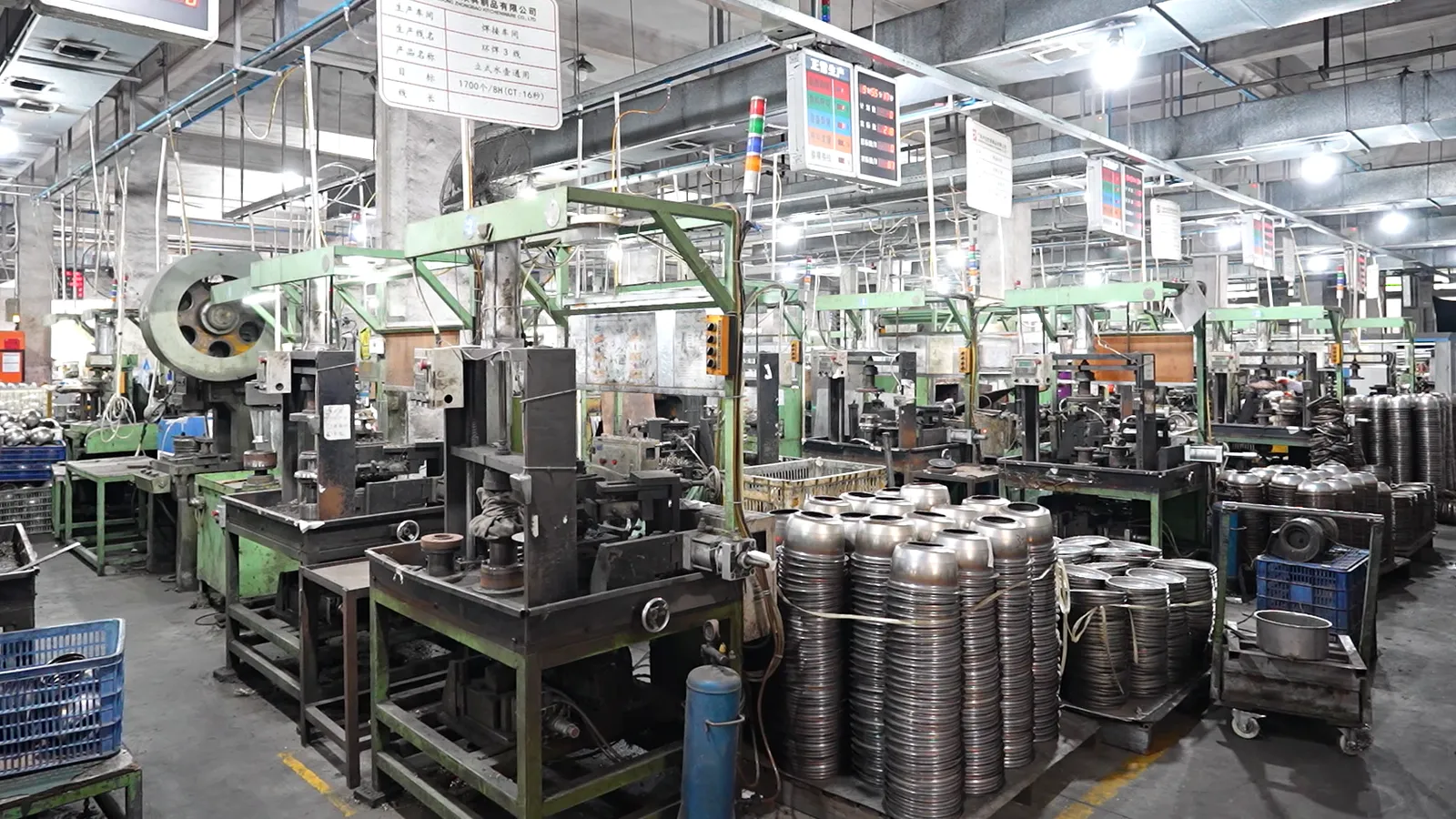

What Affects Wholesale Cookware Prices? Landed Cost, Materials and Margins
For importers, distributors and private-label buyers who have a quotation and need to know what is inside it. This piece builds a delivered unit cost the way a factory builds a price — coil mass at a grade and gauge, forming route, finishing hours, tooling, cartons — then adds freight, duty and the cost of money, and shows how to read a quotation line by line so the gap between two offers becomes attributable.
 Potobelo Editorial Team15 min read
Landed cost is the delivered cost of one sellable piece: the factory price, plus freight and insurance, plus duty and import fees, plus inland transport, plus the cost of the money tied up while the goods move — divided by the pieces you can actually sell. That is the whole landed cost formula, on one line.
The problem is the first block. On a container of stainless cookware the factory price is most of the number, and it is the only block in a landed cost calculation that is a build-up rather than a rate somebody quoted you. Every guide on page one starts at "product cost" and never takes it apart. This one starts at the coil.
If you cannot take the factory price apart, a twelve per cent gap between two quotations is unattributable — and an unattributable gap always gets settled by negotiation instead of by specification.
What a landed cost calculation actually adds up
Landed cost per unit = (goods + freight + insurance + duty and fees + inland + financing) ÷ sellable units. That is how to calculate landed cost; each block has a different driver, and only some are yours to move.
Block | What is in it | What sets it | Can you move it |
|---|---|---|---|
Goods | Coil mass at a grade and gauge, forming, finishing, tooling, packing | Your specification | Yes — change the specification |
Freight and insurance | Ocean or air, surcharges, cargo cover | The carrier market and your cubic volume | Yes — carton size and load plan |
Duty and fees | Tariff at the ten-digit line, processing and harbour fees, brokerage, exams | Classification and country of origin | Partly — both are decisions |
Inland and handling | Drayage, terminal, delivery to the warehouse | The lane | Marginally |
Money | Deposit, balance timing, currency, financing days | Your terms | Yes — terms and currency |
The blocks are not independent: duty is charged on a value that already contains some of the others, and freight on a carton the factory chose. The procurement sequence these sit inside — enquiry, sampling, audit, shipment — is in the sourcing guide for China.
Block one: the factory price is a physical build-up
A stainless pot is quoted per piece, but it is costed per kilogram, per press hit, per polishing minute and per carton. Five drivers account for nearly all of it — material, construction, forming and finishing, tooling and packing — and the five sections that follow take them one at a time.
Grade and gauge: the two settings that move the material line
Grade is an alloy decision, gauge a mass decision, and buyers routinely negotiate the second while ignoring the first.
Grade | What is actually specified | Magnetic | Cost position | Where it fits |
|---|---|---|---|---|
304 | 18 % chromium, 8 % nickel (17.5–19.5 Cr, 8.0–10.5 Ni) | No, in the annealed condition | The reference grade | Bodies, lids, the pressure-cooker range |
201 | Chromium held, manganese substituted for part of the nickel | No | Below 304 | Price-led bodies where the buyer accepts a smaller corrosion reserve |
430 | 16–18 % chromium, no nickel, ferritic | Yes, strongly | Below 201 | Magnetic layers such as an induction base, and outer shells |
316 | 304 plus 2–3 % molybdenum | No | Above 304 | Salt and acid exposure, marine markets |
Those ranges are the published AISI/UNS ones listed by the British Stainless Steel Association. What you buy when you step up a grade is nickel, and in 316 molybdenum.
Grade also carries a compliance consequence that sales emails blur. EU 1935/2004 governs migration behaviour, not a list of approved grades; the US FDA accepts stainless steel by series — 200, 300, 400 — with chromium at 16 per cent or above in a food zone, which is what NSF/ANSI 51 sets out; GB 4806.9 works from specific migration limits. So no grade carries food-contact recognition by name alone — what matters is the test report for the article you are buying, in your market. 201 is commonly quoted without a migration test report for that market: an open item on the quotation, not a property of the grade. Depth is in the grades guide and 201 against 304; in this line, pressure cookers are quoted in 304 only.
Gauge is simpler and less forgiving. Stainless at about 7.9 g/cm³ gives 4.74 kg per square metre at 0.6 mm, 3.95 kg at 0.5 mm, 6.32 kg at 0.8 mm. Take a 20 cm body, 14 cm deep: its wall and base come to about 0.12 m², and the blank that becomes it — with flange and trim allowance — about 0.14 m². That is 0.66 kg of steel at 0.6 mm against 0.55 kg at 0.5 mm — a 17 per cent cut in material for one step of gauge.
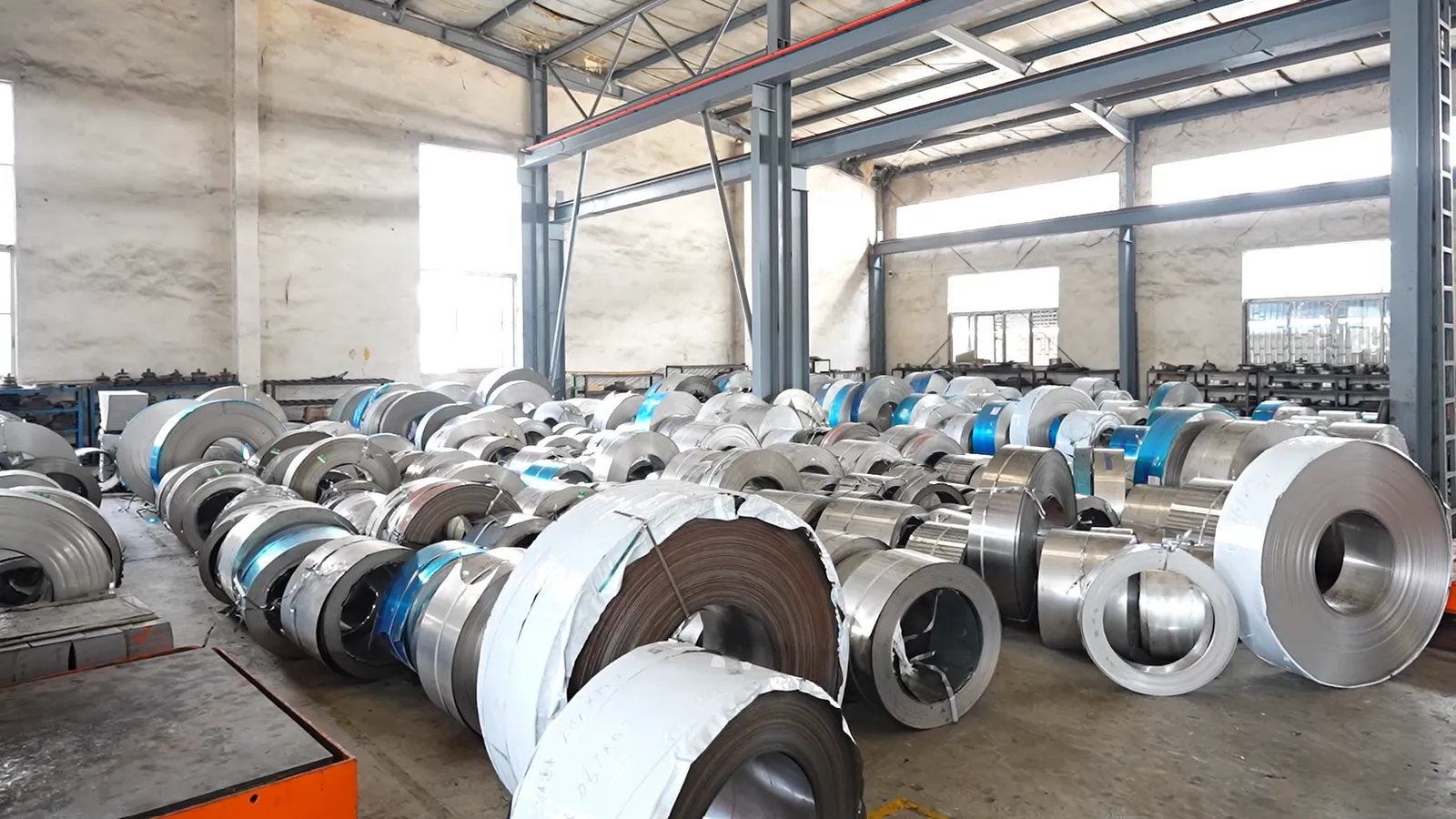
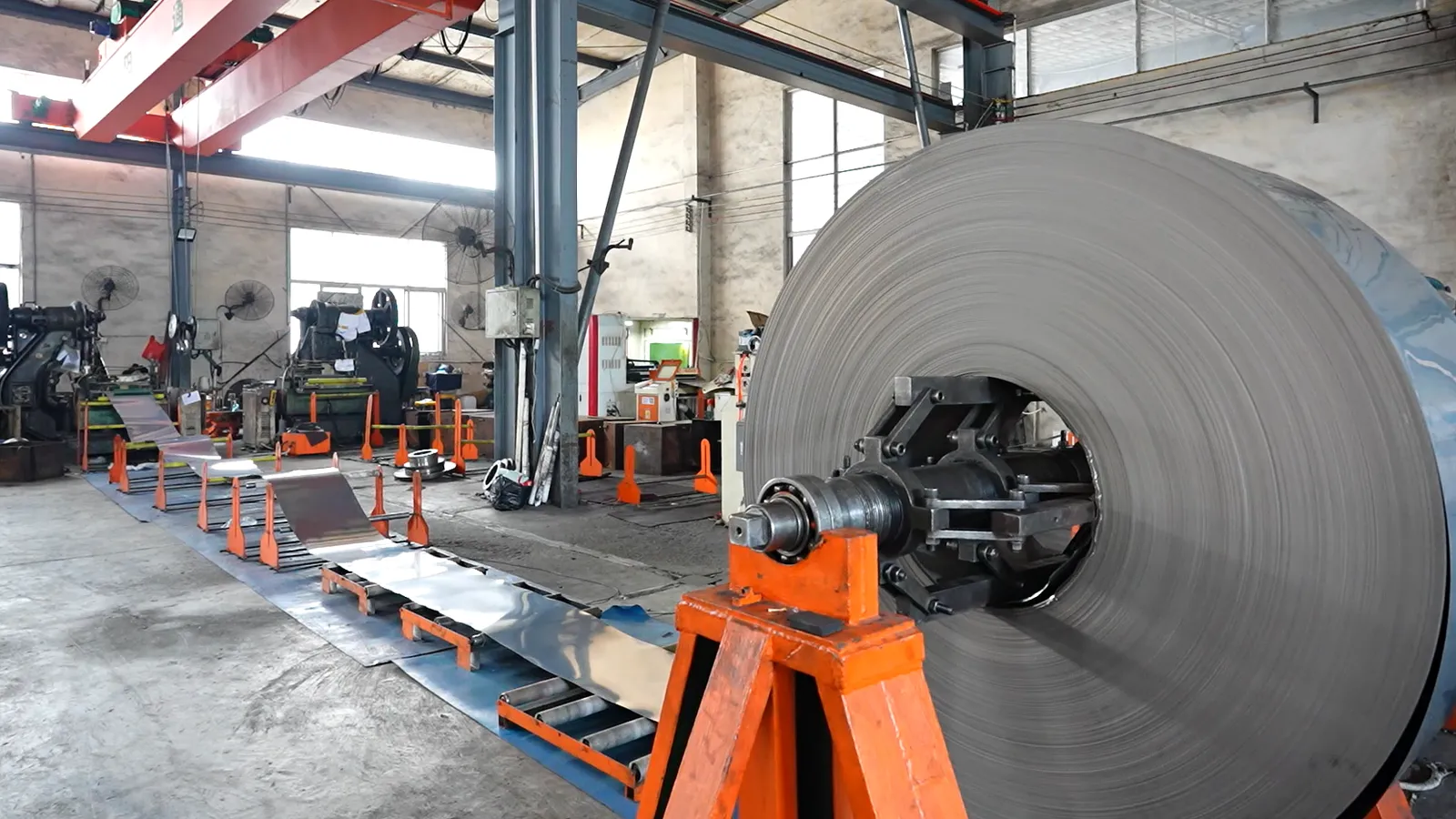
The specification is fixed in the store: width, grade and thickness are chosen here, and the whole cost build-up follows.
That cut is real money, and it is not free. Bending stiffness scales with the cube of thickness, so 0.5 mm is about 58 per cent as stiff as 0.6 mm: a thinner body dents in transit, needs better packing, and generates claims the saving does not cover. Price a gauge change by adding the packing and claim cost back before you book it; whether the trade is worth taking is a positioning decision, not a costing one.
Construction: single-ply, bonded base or clad
Single-ply is one sheet of stainless drawn into a body: one material, one forming route, no bonding step, no aluminium. It heats unevenly: austenitic stainless conducts heat poorly. Type 304 sits at about 14.4 W/(m·K) against 237 for pure aluminium — a factor of sixteen, per the thermal conductivity tables. That number is why the other two routes exist.
Impact-bonded base puts an aluminium disc under the stainless base and bonds the two with a high-energy press hit that welds them through deformation before the base is formed. The constraint is the press: energy per blow has to deform both metals across the whole disc, with the disc located concentrically first. Brazing works on the same logic — a ring of alloy between base and disc, heated until it flows, usually by an induction coil shaped to the base diameter. That coil is the constraint: one geometry per base size, and a fixed cycle time per piece.
Clad (tri-ply) arrives as coil from a mill that rolls the layers together, so the factory forms a sandwich rather than building one. It gives the most uniform bond and moves cost into the material: clad coil is bought by weight, at a mill minimum, with the scrap rate of a three-metal blank.
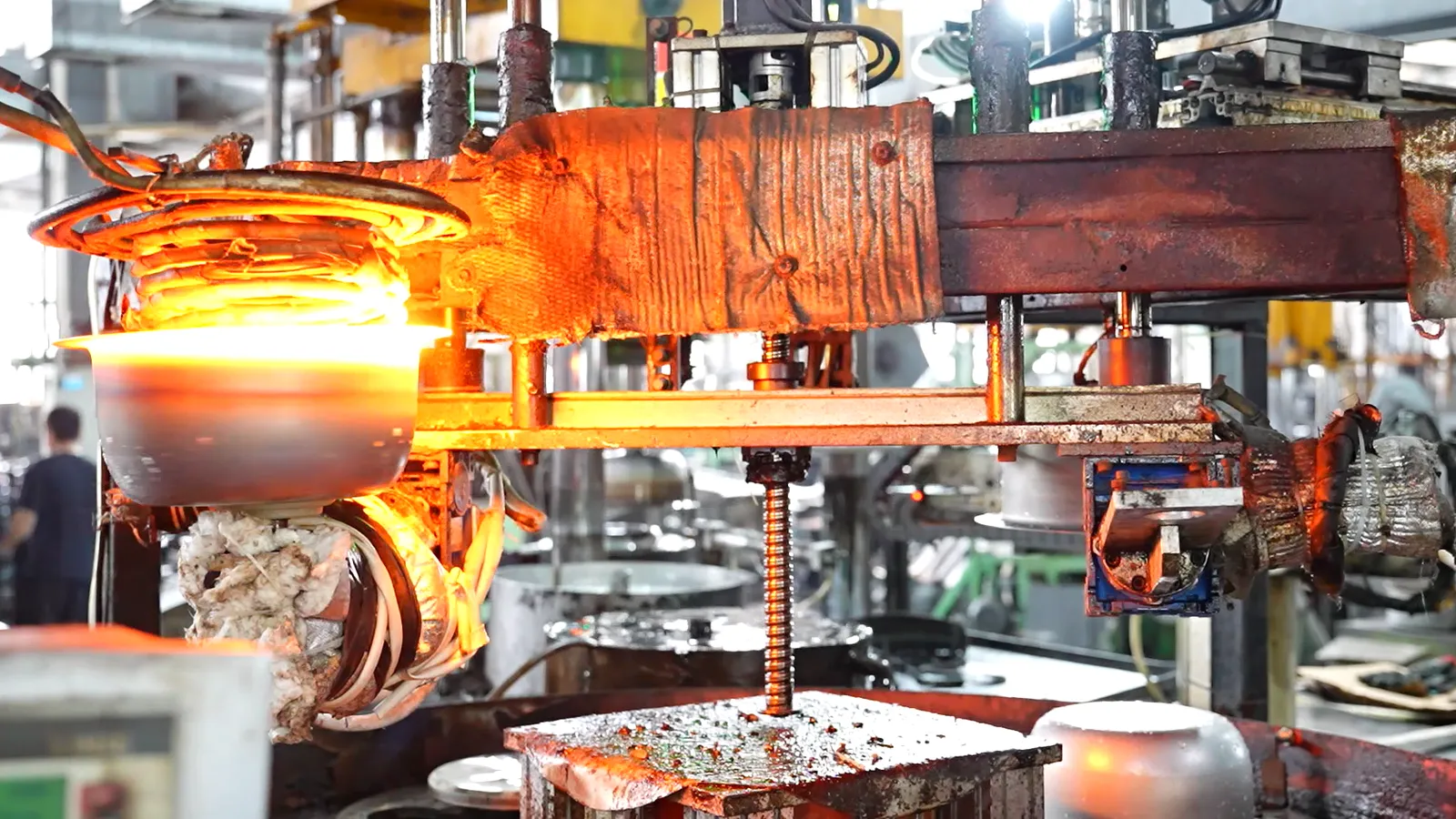
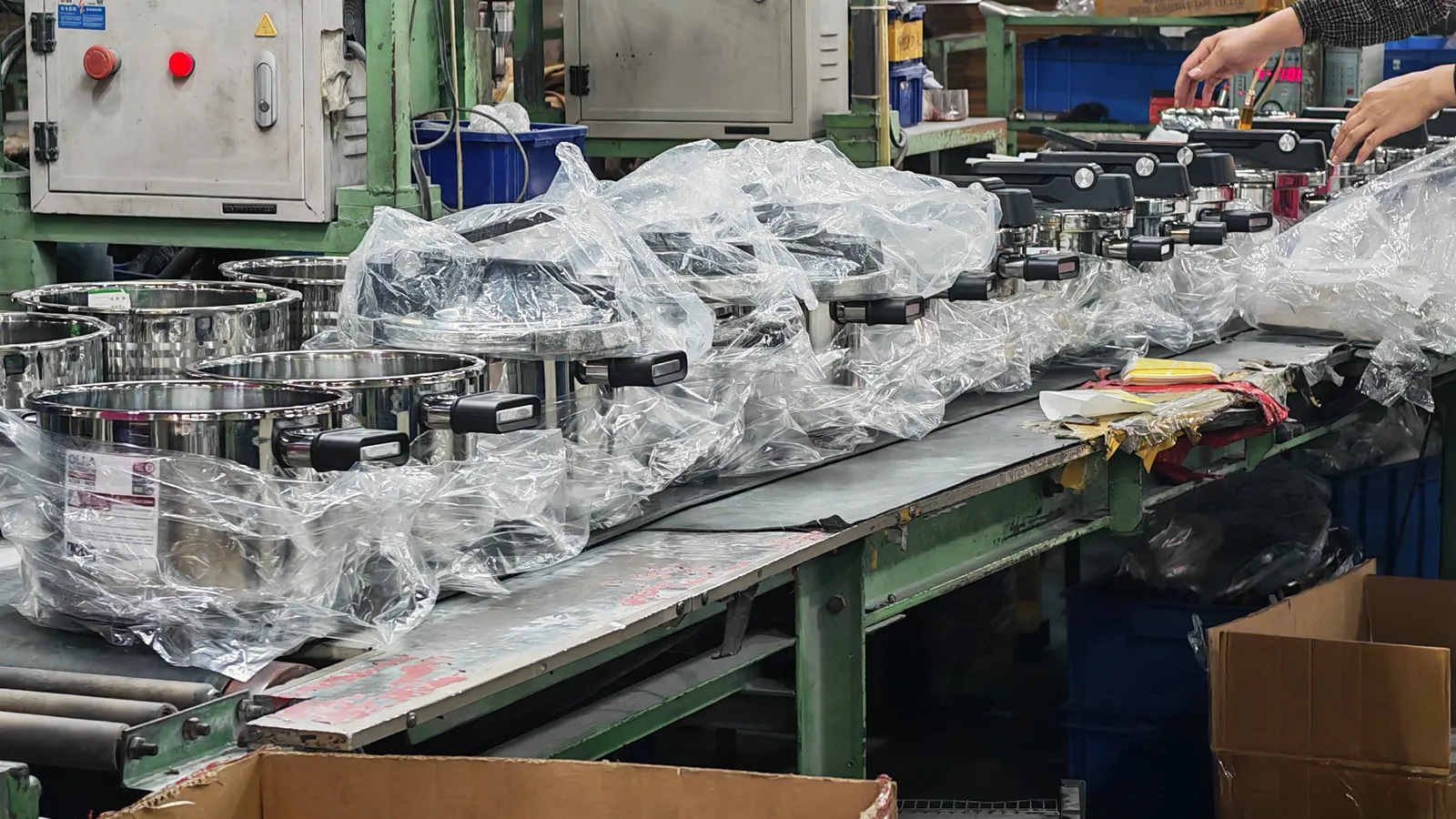
Steel at temperature. Heat is a per-piece cost — coil power, cycle time, fixture — which is why a bonded base is not simply "an extra disc".
The cost consequence is a step, not a slope: single-ply is cheapest per piece and to tool; a bonded base adds a disc, a bonding operation and a forming step; clad adds the mill's cladding premium to every kilogram. Where five-ply stops earning its premium is in 3-ply versus 5-ply.
Forming and finishing: hours, not kilos
Past the material, the cost is time, and time divides into per-piece labour and per-batch setup.
Blanking and drawing. A body starts as a blank cut from strip, then goes through draw stages. A press can only take a shape so deep in one hit before the metal tears, so depth is reached over several stages, each with its own die, each work-hardening the steel further. Tonnage and draw ratio set how many stages a pot needs — which is why a tall stock pot costs more to form than a shallow pan of the same diameter.
Spinning. Some shapes are spun over a mandrel instead of drawn: one mandrel per profile, an operator at the machine, a slower cycle than a press line — how a factory makes a shape whose volume does not justify a draw die.
Welding and assembly. Handles, lugs and rims are welded on fixtures, usually TIG, one operator per station. Per-piece labour with a quality signature: a weld that is not dressed properly becomes a polishing problem downstream.
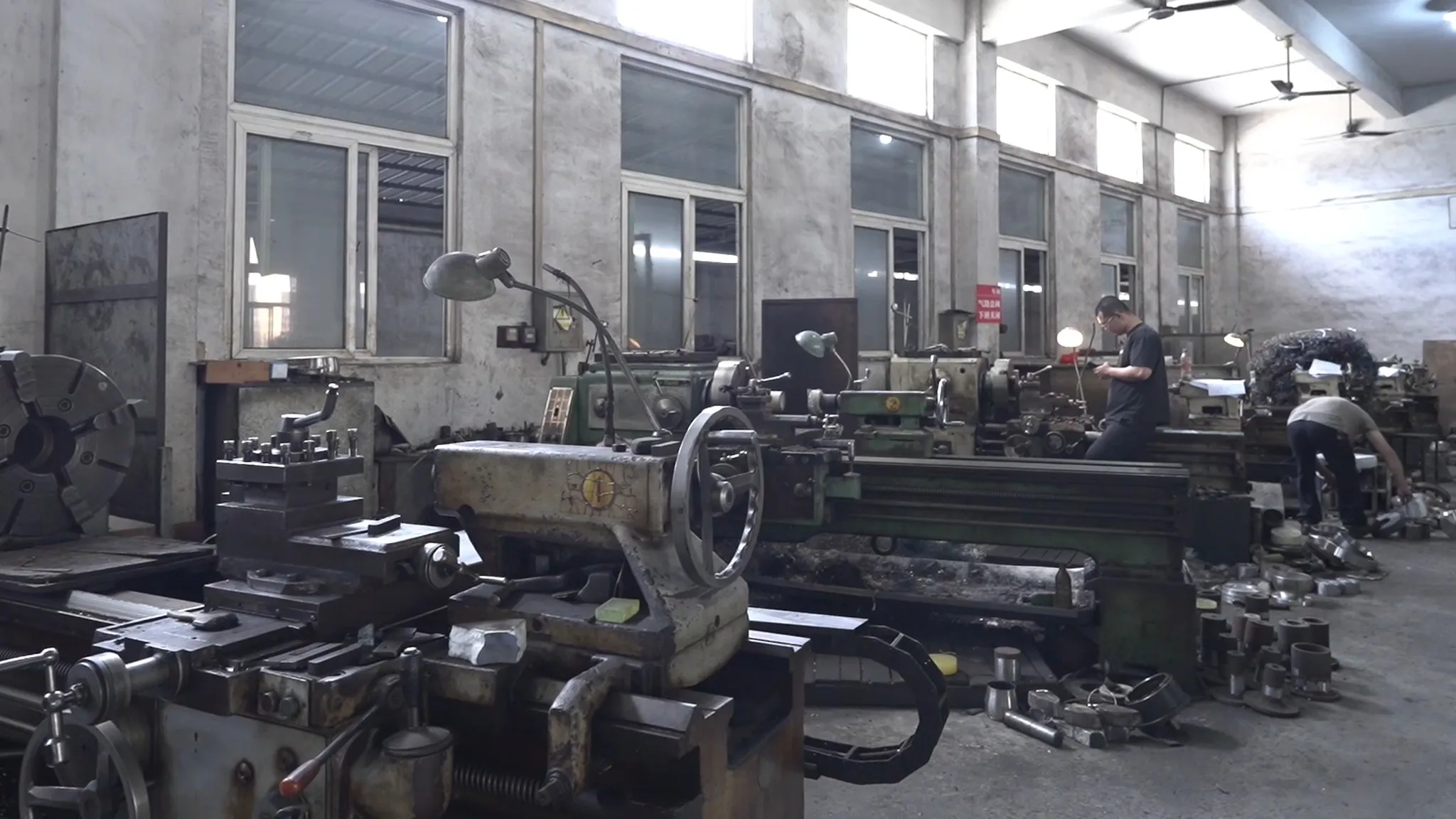
Polishing. Mirror finish is abrasive belts against a rotating body, the most labour-dense step in the build. Belts wear, operator time is per piece, and the gap between a satin interior and a mirror exterior is measured in minutes per unit rather than grams. This is where a quotation that looks cheap usually got cheap.
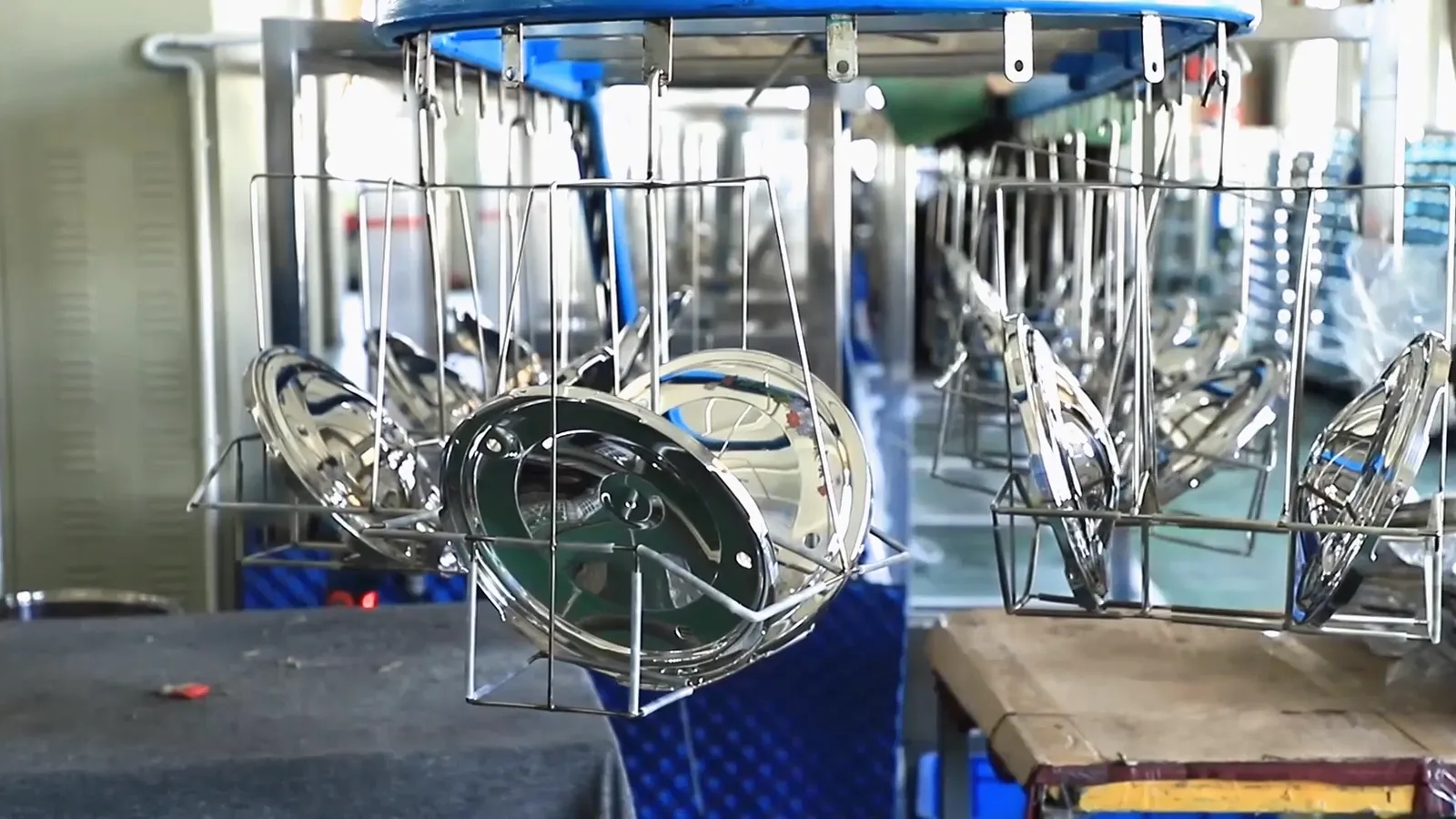
Fixtures carry a fixed number of pieces per pass. You cannot run a third of a load, so finishing behaves like a batch cost even when the labour in it is per piece.
Tooling: the line that is often not on the quotation
A pot shape exists because a set of dies does: one per draw stage, one for the trim, one for the handle piercing, plus the welding fixture.
Factories handle this three ways, and the difference matters more than the amount: a separate line, absorbed into the unit price, or absorbed but conditional on volume. The third catches buyers: the unit price was calculated on a batch that has not happened yet.
Two questions settle it. Who owns the die? If you paid for it, it is yours and should be transferable — an asset on your balance sheet, not a gift to your supplier. What is it written off over? A die has a physical life in hits, so amortising over 6,000 pieces and over 1,200 are not the same price, even when they print the same number.
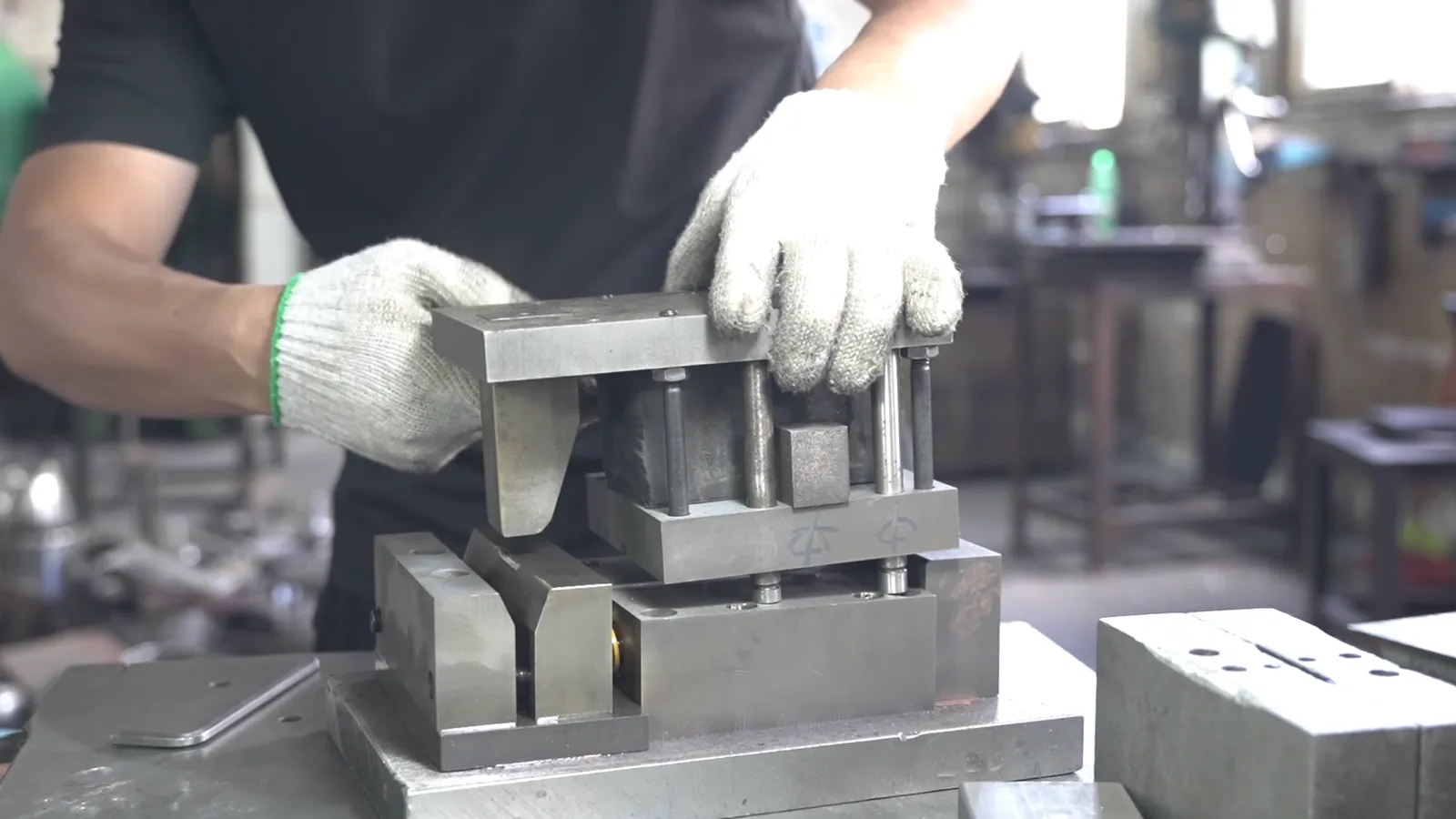
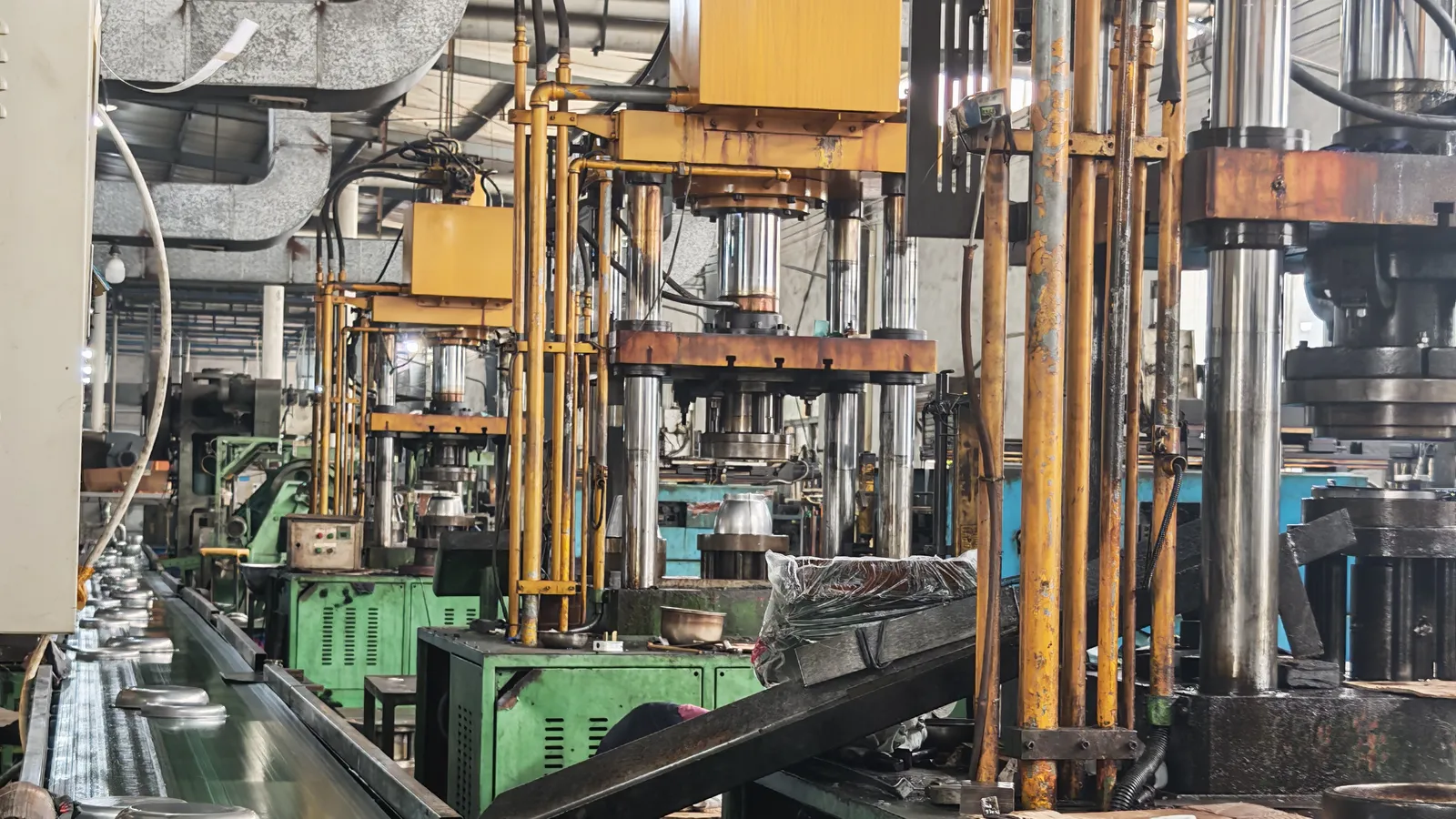
A die going into a press: the physical object a tooling charge buys, with a life measured in hits rather than in years.
A model's minimum is 1,200 pieces, the batch at which per-model setup stops dominating the unit; the line-hours a changeover consumes are in the MOQ economics piece. Its answer belongs in writing before the deposit.
Packing decides your freight, not your weight
Freight is charged per container, and a container fills on whichever limit it hits first — volume or payload. The arithmetic below assumes a full 40′ high-cube; at minimum-order volumes you are shipping less than a container and paying per revenue ton instead — the break-even between the two is in mixed container shipping.
Maersk publishes a 40′ high-cube at 76.4 m³ and a maximum payload of 28,690 kg. Divide one by the other and the break-even is 375 kg per cubic metre: denser cargo runs out of weight, lighter cargo runs out of space. Stainless cookware is in the second group. A carton holding a three-piece set at roughly 45 × 30 × 25 cm is 0.034 m³; at about 5.2 kg it sits near 153 kg/m³, well under half the break-even. Load a 40′ HC to 85 per cent of its cube and you get around 1,900 cartons — about 9.9 tonnes, a third of the payload.
The consequences are counter-intuitive:
- A 10 per cent smaller carton is a 10 per cent lower freight cost per piece. At $2,400 per container, a set carrying $1.26 of ocean freight carries $1.13 — about $240 across a full container, for a carton redesign.
- A 10 per cent lighter pan saves nothing on freight unless the shipment is near the weight limit, and a per-kilogram freight rate is the wrong unit for a product that ships by volume. Ask for a per-container rate and divide by the pieces you can load.
Packing also hides the print minimum: a colour box has a print run of its own, and a carton ordered below it is expensive or plain. Combining models so the cube is used properly is worked through in mixed container shipping.
The carton is the unit freight is charged on: its dimensions, not the pan's weight, decide what a set costs to move.
From FOB to delivered: the lines you add
Incoterms decide where your cost stops. EXW leaves inland haulage onwards with you; FOB adds export clearance and loading; CIF adds ocean freight and insurance; DDP puts duty on the seller. The rules are the ICC's Incoterms 2020, and FOB against CIF is the distinction that most often blurs in a supplier's email.
Duty is charged on a value, and the two big markets define that value differently. In the United States the base is transaction value — broadly what you paid for the goods — under 19 CFR 152.103, so the international freight sits outside it. In the European Union the customs value is CIF, so freight and insurance to the border are inside the dutiable amount, per Access2Markets. The same invoice therefore produces two different duty bases, and a model built for a US entry will understate duty if reused for an EU one.
Classification is the biggest single variable. Stainless steel table and kitchen articles fall under HTS 7323.93.00, "of stainless steel", at a 2 per cent general rate at the time of writing, with separate statistical suffixes for teakettles, bakeware and other kitchen ware; the USITC tariff schedule carries the current text and rates. Anything stacked on that base rate depends on origin: for Chinese-origin goods, whether your ten-digit line sits on an active Section 301 list decides whether you pay the base rate or a multiple of it, and those lists are revised. Check the whole stack rather than one list: more than one authority can apply to the same ten-digit line, each with its own rate and effective date.
Then the fees. A US entry carries a merchandise processing fee, ad valorem with a per-entry floor and cap — 0.3464 per cent under 19 CFR 24.23 — and, on ocean cargo, a harbour maintenance fee of 0.125 per cent under 19 CFR 24.24. Brokerage is per entry and dilutes with volume; drayage and delivery are per container.
Run the whole thing on a three-piece set, with every non-tariff figure declared as an assumption:
Line | Basis | Per set |
|---|---|---|
Goods, FOB | Quotation | 12.00 |
Ocean freight | $2,400 per 40′ HC ÷ 1,909 sets | 1.26 |
Cargo insurance | 0.35 % of CIF | 0.05 |
Duty, base rate | 2 % of 12.00 | 0.24 |
Section 301, if the line is listed | 25 % of 12.00 | 3.00 |
Merchandise processing fee | 0.3464 %, per-entry cap | 0.04 |
Harbour maintenance fee | 0.125 %, ocean only | 0.02 |
Broker and entry | Per entry ÷ sets | 0.06 |
Drayage and delivery | Per container ÷ sets | 0.30 |
Finance | 30/70 terms, 60 days at 7 % | 0.14 |
Landed, per set | 17.11 |
Strip out the tariff line and the same set lands at 14.11. The duty layer is 17.5 per cent of the delivered cost — more than freight, insurance, fees and finance combined. That ordering is why a factory-price negotiation that shaves 3 per cent is smaller than a classification question.
Reading a quotation line by line
A quotation is not a price but a set of claims about a process. Read it that way and most ambiguity resolves before you reply.
Line in the quote | The question that tests it |
|---|---|
Unit price | Per piece, and at what quantity, grade and gauge? |
Material | Which grade, and what thickness — body, lid and base separately |
Construction | Single-ply, bonded base or clad? Which aluminium thickness if bonded? |
Tooling | Separate line, absorbed, or conditional on volume — and who owns the die? |
MOQ | Per model, per finish, per packing format or per order? |
Process | Drawn or spun; polished to what finish; any coating, and which process? |
Packing | Carton dimensions, pieces per carton, print or plain, pallet type |
Carton weight and volume | Grams and cubic centimetres — the two numbers freight is charged on |
Incoterm and port | FOB which port, and what is excluded |
Payment terms | Deposit percentage, balance trigger, currency, LC or transfer |
Lead time | From what date — order confirmation, deposit, or artwork approval |
Three tests do most of the work.
Does the line trace to a physical quantity? Grams, square metres, hours, cartons, hits. If it traces to one it can be checked against the specification; a line called "processing" that traces to nothing is a margin with a neutral name.
Is it per piece or per order? Tooling, brokerage, setup and print runs are per order or per batch; material, labour and packing are per piece. A per-order cost quoted as per-piece is either a mistake or a very expensive sentence.
Does it move when the specification moves? Ask for the same item one gauge step thinner and one grade step down. If the price does not move, the price was not built from the specification, and the numbers you are comparing are not comparable.
Where margin hides in the line
Margin reaches a quotation three ways. A factory can carry it inside a process line — a polishing step priced above its minutes, a "processing" charge with no quantity behind it. A trader adds it as a separate line after the factory price, indistinguishable from a service unless you ask who performed the work. The third is yours: the margin you put on landed cost, the only one you control. One test separates them: ask for the same specification at your volume and at twice your volume. A price that barely moves at double the quantity is carrying margin, not setup — amortised setup halves, margin does not. A supplier who will not quote both has answered the question.
The red flags are consistent. A grade named without a series. A gauge missing entirely. "Packing included" with no carton dimensions. Tooling described as free while the minimum quietly rises. A single conversion rate applied to a currency that has moved since the quotation was written — the last block in the model, and the one most often left at zero.
None of this requires the supplier to open their cost sheet — only that the quotation is specific enough for the specification, not the relationship, to do the work. The same standard governs how a sample is judged (sample versus mass production), and why a factory's quotation and a trader's read differently is covered in manufacturer versus trading company.
Landed cost is a small calculation with a large input. Get block one specific — grade, gauge, construction, process, tooling, carton — and the other four blocks are spreadsheet arithmetic you can run in an afternoon. Skip it, and the model is precise about everything except the part that decides whether the order makes money.
Common questions
How to calculate landed cost per unit?
Add the goods price to international freight, cargo insurance, duty and import fees, inland transport and the financing cost of the order, then divide by the number of sellable units that arrived. The divisor is the part most models get wrong: units damaged, short-shipped or held back as samples are not sellable, so dividing by the invoiced quantity quietly understates every unit. Carry the calculation to the piece, not the container, because that is the number you price and reorder against.
Is the FOB price the same as landed cost?
No. Under FOB the seller delivers the goods on board the vessel at the named port, so the price includes export clearance and loading but stops there. Everything after that — ocean freight, insurance, import duty, port handling, brokerage, inland delivery and the cost of the money tied up while the goods travel — is still yours. On a container of stainless cookware those additions commonly amount to a fifth to a third of the delivered cost, and the duty layer can be the largest of those additions.
How much duty does stainless steel cookware attract into the United States?
The base rate is set by the tariff line. Stainless steel table and kitchen articles sit under HTS 7323.93.00, which carries a 2 per cent general rate at the time of writing. Anything stacked on top of that — Section 301 for Chinese origin, for instance — depends on whether the specific ten-digit line appears on an active list, and USTR publishes both the lists and the rates. Classify at the ten-digit suffix, not the heading: teakettles, bakeware and other kitchen ware are separate statistical lines under the same duty rate.
Does a thinner gauge or a lower grade always lower the landed cost?
It lowers the material line and almost nothing else. Dropping a body from 0.6 mm to 0.5 mm removes about 17 per cent of its steel mass, but bending stiffness falls with the cube of thickness, so the same body becomes roughly 58 per cent as stiff and needs more care in handling, packing and claims. A lower grade cuts alloy cost while changing what the article can be sold as in each market. Neither change touches freight per piece much, because cookware shipments run out of container volume long before they run out of payload.
Written by
Potobelo Editorial Team
Sourcing and engineering staff at Potobelo, a stainless steel cookware brand built on 30 years of Zoombo manufacturing in Guangdong, China. We write from inside the plant that makes the product, not from reviewing it.