
3-Ply vs 5-Ply Stainless Steel: Which Construction Should Your Brand Stock?
Ply count is the most quoted and least checkable number in stainless steel cookware. This is what three bonded layers and five bonded layers actually do differently, what a "5-ply" claim can and cannot tell you, and the fields to put in the specification before it stops being a marketing word.
 Potobelo Editorial Team15 min read
The short answer: what to spec, and when the cheaper build is the right one
For most stainless steel cookware lines, 3-ply is the correct specification and 5-ply is a premium option you sell at a higher price — not an upgrade you apply across a range. Reach for 5-ply when the product carries the extra metal for a real reason: a large-diameter pan sold on not warping, a vessel that must hold heat through a long service, or a premium tier whose story justifies the higher unit cost. For a 1.5-litre saucepan or the filler pieces of a ten-piece set, the fifth layer is money you cannot recover on the shelf.
That answer holds only once two things are settled, because ply count is the last variable in the decision rather than the first: where the layers sit (cladding up the wall is a different product from cladding stopped at the base) and what the layers are (the count says nothing about the alloy on the food-contact side or the base thickness in millimetres).
3-ply | 5-ply | |
|---|---|---|
What the number counts | Three bonded layers through the build | Five bonded layers through the build |
Typical stack, food side out | Stainless 18/10 or 18/8 · aluminium core · magnetic stainless | Stainless 18/10 or 18/8 · aluminium · aluminium alloy bond layer · aluminium · magnetic stainless |
What spreads the heat | The aluminium core | The same aluminium core — there is simply more of it |
Heat-up and response | Less mass to bring up to temperature, so it reacts to burner changes faster | More mass, so slower to react and slower to cool |
Weight | Lighter in the hand and in the carton | Heavier, and the gap widens with pan diameter |
Cost structure | Lower material cost, fewer bonding and machining steps | More aluminium, more process steps, more scrap, heavier cartons |
Where it earns its price | Everyday saucepans, most set components, kettles, steamers | Large-diameter pans sold on warp resistance, long-hold use, premium tiers |
What to watch in the spec | A "3-ply" claim can mean base-only cladding | A "5-ply" claim can count a bonding layer as one of the five |
What "ply" actually counts: the layers, in order
A ply is a bonded layer of metal in the body or the base of the vessel. Nothing else on a piece of cookware is a ply.
The three layers in a tri-ply build
Almost every clad stainless pan is built from the same three material roles.
The food-contact layer is an austenitic stainless from the 18/10 or 18/8 part of the 300 series — what the trade calls 304. It carries the corrosion and food-contact questions, and the naming around it matters more than it looks: 18/10 and 18/8 are not interchangeable labels, and suppliers use them loosely.
The core is aluminium, and this is where the useful physics sits. It conducts heat at roughly ten times the rate of the stainless on either side — about 162 W/m·K for a 3003-type alloy at 25 °C in published alloy data, against a low-teen figure for austenitic stainless in the SSINA property tables. That gap is why a clad base exists.
The outer layer is a magnetic stainless, normally from the ferritic 400 series rather than the 300 series used inside, because induction needs a ferromagnetic layer to couple with the coil. Austenitic stainless in the annealed condition is essentially non-magnetic; the ferritic grades will work. That split is why "is it induction ready?" is answered by the outer layer, never by the ply count.
What the fourth and fifth layers are
A 5-ply build does not swap the materials. It inserts more of them. The two extra layers are normally an additional aluminium layer and an aluminium alloy bond layer between the stainless and the core — a stack that reads stainless, aluminium, alloy, aluminium, stainless.
Two consequences follow, and both matter commercially:
- The mechanism does not change. Heat is still spread by aluminium. A 5-ply base is not a different kind of conductor, it is a thicker aluminium sandwich — a question of capacity rather than capability.
- Copper is a separate choice, not a tier above five. Some builds put a copper layer in the core for faster spread; copper conducts better than aluminium, costs more and weighs more again. It is an option you specify for a reason, not proof of a better pan.
What is not a ply
This is where the count drifts between suppliers. A non-stick coating is a coating, not a ply. A decorative base cap or a separately attached induction plate is not counted the same way by everyone. And brazing or bonding interlayers are sometimes counted as their own layer — which is how a stack a buyer would describe as four metals becomes "5-ply" on a quotation.
The practical outcome: two suppliers can both print "5-ply" and ship visibly different amounts of aluminium in the base. Neither is lying, because no universal definition fixes how the five layers are sized.
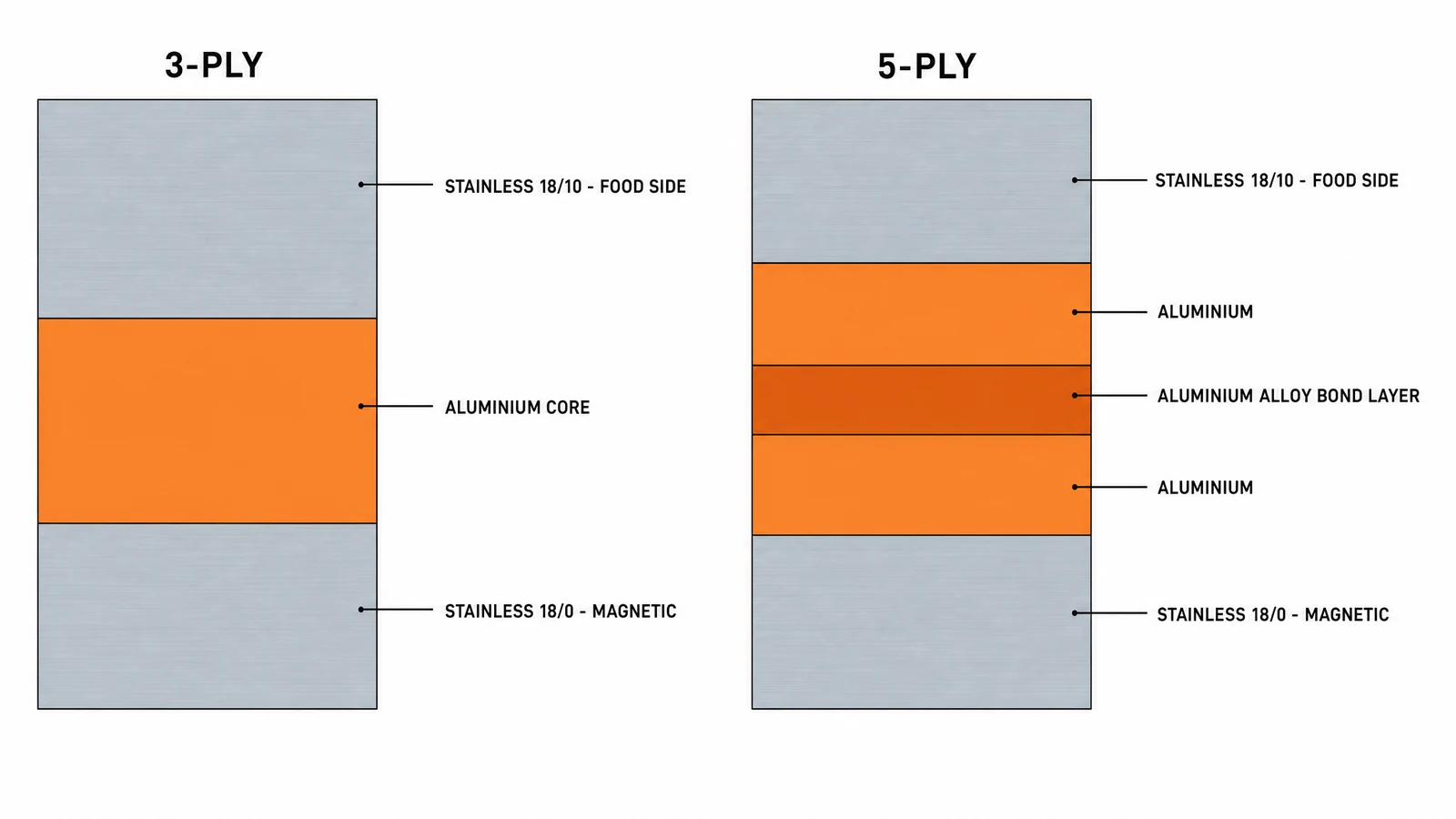
Illustrative render, not a photograph: a 3-ply and a 5-ply base drawn to show the layer order. Bands are schematic and not to scale.
Where the layers sit matters more than how many there are
"3-ply versus 5-ply" sounds like a comparison between two pans. Very often it is not, because the two builds are shaped differently.
A full-body clad vessel carries its bonded stack up the wall as well as across the base. A bonded base, sometimes called a composite or disc base, has a layered pad pressed and bonded onto the bottom only, while the wall stays a single sheet of stainless. Both get sold as "3-ply" or "5-ply" depending on how many layers the manufacturer counts.
So a 5-ply bonded base and a 3-ply full-body clad are not the same vessel with one extra layer. They put the extra metal in different places:
- Full-body cladding carries heat up the side of the pan — it matters on a shallow pan or a wide sauté, where edge temperature drives browning.
- A bonded base concentrates everything in the bottom — useful on a deep stock pot, where the food load sits on the base anyway, and cladding the wall there adds weight and cost for very little return.
For a buyer, the geometry is the part that appears on the specification as a statement about where the cladding stops, and the part a factory answers with tooling rather than a sentence. It also decides whether two quotations are comparable at all: asking for "5-ply" without saying whether the layers run up the wall can return two products that share nothing but the number.
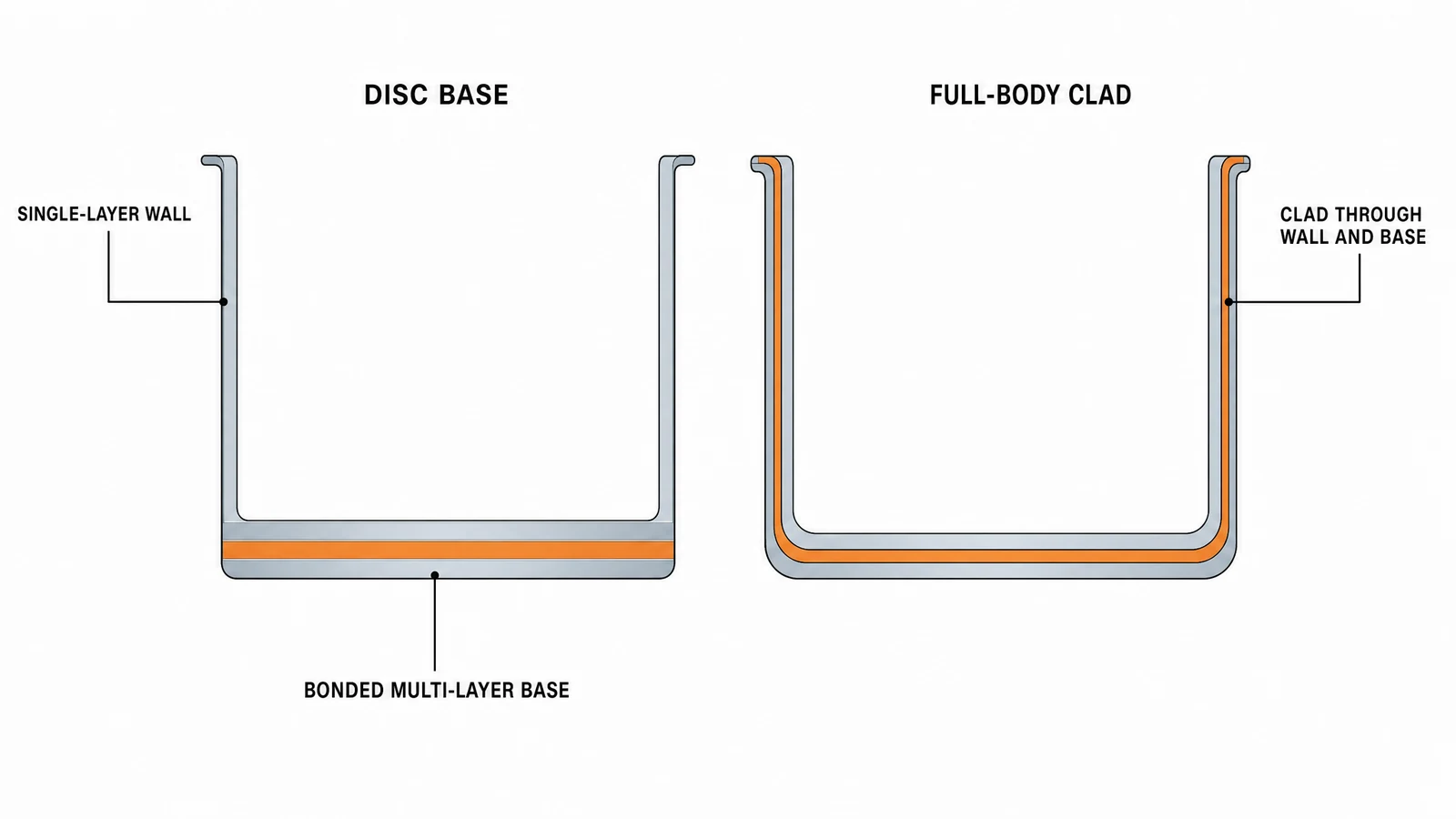
Illustrative render, not a photograph: the same pan drawn with a bonded base on the left and full-body cladding on the right.
What the extra layers change — and what they do not
The layers are not glued together. They are bonded under heat and pressure, and the combined blank is then drawn or spun into a body — a route austenitic grades handle well if the drawing schedule respects how fast they work-harden, which is what the Nickel Institute's fabrication guidance covers.
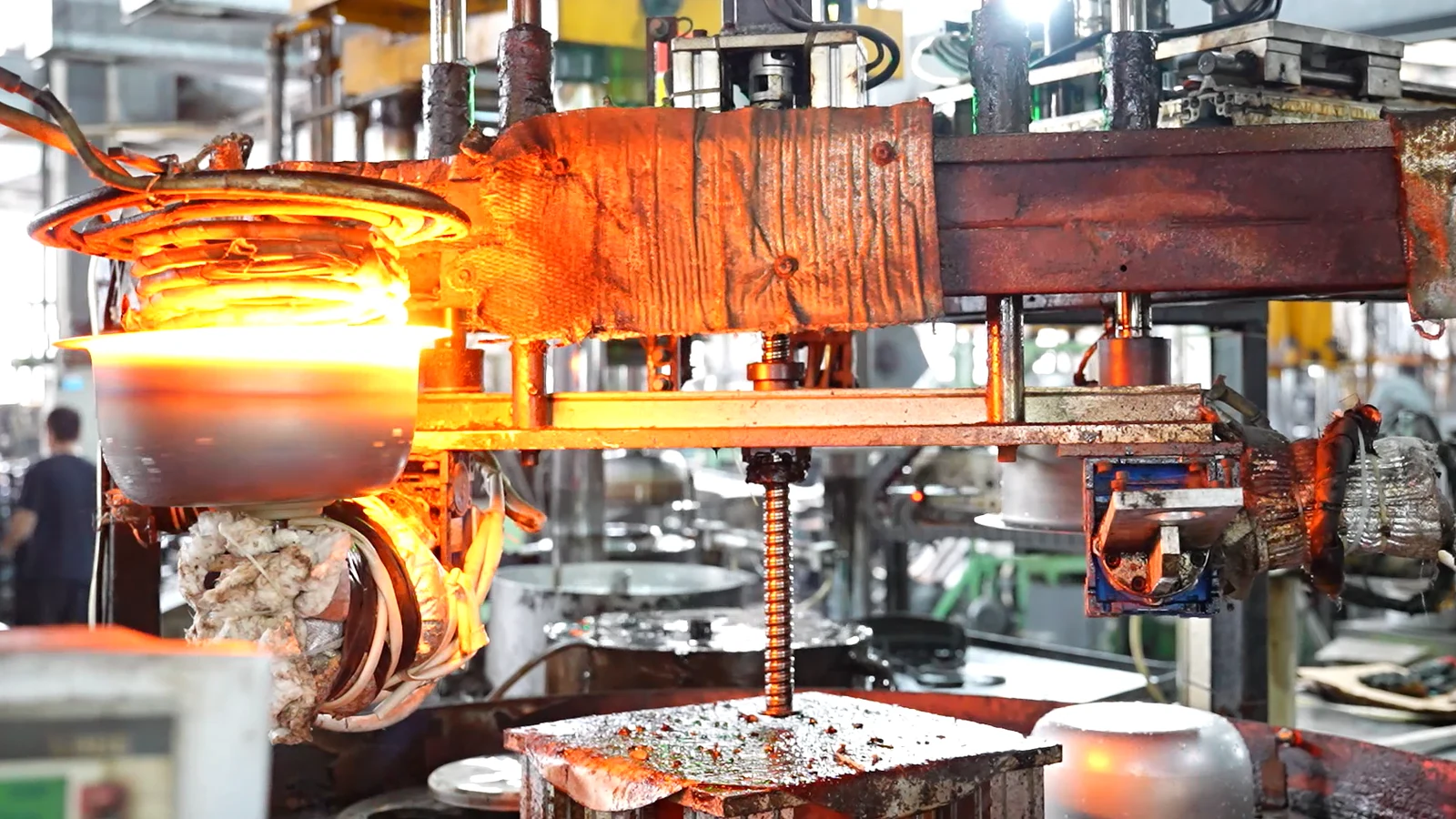
That step is why the useful claims and the marketing claims come apart.
Heat spread, hot spots, and which layer does the work
Evenness is a function of the aluminium. Adding layers changes how much aluminium the base holds, not how well aluminium conducts, so a 5-ply base spreads heat across a larger mass of metal rather than a more uniform one.
Where a pan really shows hot spots, the usual causes are a base too thin under the centre or a gas ring wider than the base, so the flame licks past the edge of the clad pad. Both are thickness and diameter problems, and a 5-ply built to the same thinness would show them too.
Heat retention and response time
This is where the extra layers earn or fail. More metal means a longer heat-up, a slower response when you change the burner, and a longer hold once there — an advantage for a stock pot or volume feeding, and a disadvantage for a frying pan, where the point is to drop the heat fast enough to stop cooking. The weight it adds is a separate cost, covered below.
Warping, delamination, and where failures actually start
Warping follows in practice from a base too thin for the burner load, or an unsupported diameter that lets centre and rim expand at different rates. A thicker, heavier base resists it — the strongest real argument for 5-ply on large-diameter pans, and an argument about thickness rather than about the number five.
Delamination is separation of the bonded layers, and it is a bonding-process failure: temperature, pressure, dwell time and surface condition at the press. A badly bonded 5-ply delaminates; a properly bonded 3-ply does not. That makes it a process-control question, which is what the documents below are for. The materials side of it is covered in our guide to whether stainless steel cookware is safe over its working life.
Why "5-ply" on its own is not a checkable specification
The claim worth taking to your next negotiation: ply is a construction term, not a performance grade.
A grade is a material identity — what the metal is. Ply is a build description — how many pieces of metal are bonded together. Neither implies the other, which is why a five-layer pot built around a weak food-contact layer is still a five-layer pot. The same distinction runs through stainless steel cookware grades and what each one is recognised for: a specification that names a grade and stops describes half a product, and one that names a ply count and stops describes even less.
Three reasons a ply count cannot be accepted on its own:
- No definition fixes the sequence, so two accurate suppliers can quote different builds under the same words.
- Counting conventions differ, so the number is not even measuring the same thing across quotations.
- It carries a tier connotation it did not earn. The convention popularised by All-Clad's D3 and D5 lines taught buyers to read ply counts as quality tiers. That was a brand naming decision, copied widely; it is not an industry standard.
The food-contact layer is a separate question
The food-contact layer sits inside the build, which is why buyers fold it into the ply question.
In the European Union the framework works through migration behaviour rather than a list of approved grades: Regulation (EC) No 1935/2004 sets the general safety requirement, and compliance is shown by migration testing against the relevant measures for the material, not by a grade on a whitelist. In the United States the FDA approaches stainless components through its food-contact regulatory framework, where stainless grades are recognised in practice by series and a chromium content of at least 16 percent, with the manufacturer holding the documentation. China's GB 4806.9 works on specific migration limits.
The practical upshot: grades such as 201 do not have established food-contact recognition in practice for the markets most importers ship into. That is a statement about recognition in practice, not about what any regime permits — and it has nothing to do with ply count. A 5-ply build with a 201 food-contact layer is a weaker product than a 3-ply with 304, not because of the layer count but because of the layer material. The comparison between 201 and 304 is where that decision belongs.
The specification sheet that makes a ply claim verifiable
What you need is not proof that a supplier is inflating a number, but a document saying what you are buying, so the first-off from the tooling can be checked against it dimensionally. Grades on that document should be traceable to a recognised sheet specification such as ASTM A240/A240M, which the mill certificate will cite.
# | Field on the specification | Why it decides something | A vague answer looks like |
|---|---|---|---|
1 | Food-contact layer grade | Drives the food-contact compliance path | Vague: "food grade" |
2 | Food-contact layer thickness in mm | Thin walls are cheaper and dent earlier | "Standard gauge" |
3 | Core material and form | Aluminium alloy, and whether strip or cast | "Aluminium core" |
4 | Layer sequence, in order | The only way to compare two "5-ply" quotations | "5-ply" |
5 | Thickness of each layer in mm | Settles what each of the five actually is | "Multi-layer" |
6 | Clad geometry: full body or base only | Changes performance and cost more than the count does | "Clad" |
7 | Total base thickness in mm at the centre | The number that governs warping and spread | "Heavy base" |
8 | Base diameter against body diameter | Burner coverage and warp resistance | "Standard size" |
9 | Outer layer grade with a magnetic check | Induction compatibility lives here, not in the count | "Induction compatible" |
10 | Bonding method; base machined flat after bonding | Bonding drives delamination, flatness drives rocking | "Bonded bottom" |
11 | Rim and edge treatment; oven and dishwasher duty | Exposed clad edges, oven use and dishwasher cycles are a corrosion risk | "Polished edge" |
12 | Market test documents, plus per-batch material certificate | The part your buyer's compliance team will ask for | "Certified" |
Documents that travel with the batch
A specification is worth what it is enforced by, and enforcement is a document trail rather than an argument:
- A material certificate for the stainless and the aluminium, per batch, traceable to the heat number and matching the grades on the specification.
- A dimensional check on the first-off from the tooling: base thickness at the centre, wall thickness at the rim, base diameter, flatness. This is the step that catches a build that drifted from the sample.
- Destination-market testing coordinated for the market you sell into — FDA and LFGB testing for the US and the EU, CE and GS where they apply, and region-specific schemes such as SASO and SABER for the Middle East. These sit alongside the factory-level ISO and BSCI certification, which are management-system credentials rather than per-product approvals.
Two of our guides go deeper on the surrounding workflow: matching a pre-production sample to mass production and how to choose a stainless steel cookware manufacturer.
Choosing construction by product line, not by ply count
The ply count should fall out of the product, not the other way around.
Product line | Starting construction | Why it fits | What to watch |
|---|---|---|---|
Saucepan, 1.5–2.0 L | 3-ply; full-body clad if the wall matters | Fast response; weight must be manageable one-handed | Handle attachment and balance when full |
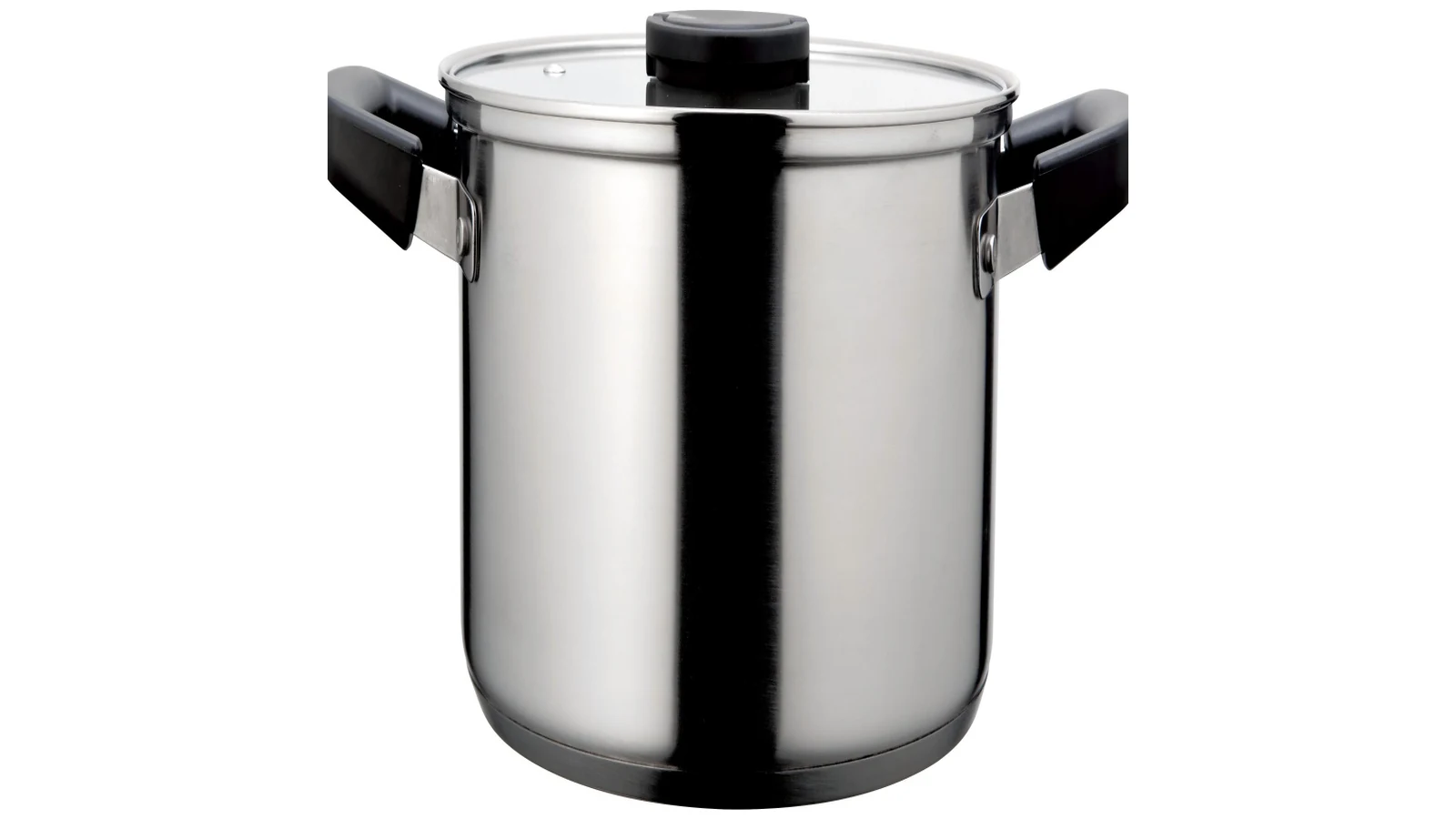
Casserole, stock pot 4–8 L | 3-ply bonded base; 5-ply for table service and long holds | The food load sits on the base, so base mass is where the value is | Base flatness and warp resistance at larger diameters |
Frying pan, sauté 24–28 cm | 3-ply full-body clad | Needs fast response; the wall carries heat to the sides | Centre base thickness; this piece sees the highest heat |
Pressure cooker | Heavy base, tight dimensional discipline | The engineering risk is the safety structure, not the clad count | Locking structure and market testing, not ply |
Kettle | Single-wall body, bonded induction-ready base | Steam does the work; cladding the body adds nothing | Outer layer must be magnetic for the market's cooktops |
Steamer and inserts | Single-wall or light clad | Steam cooks; a layered base earns nothing here | Lid fit and stacking height in the carton |
Cookware set | 3-ply across the set, 5-ply on the hero piece | Keeps the set price workable while anchoring the range | Wall gauge consistency across pieces |
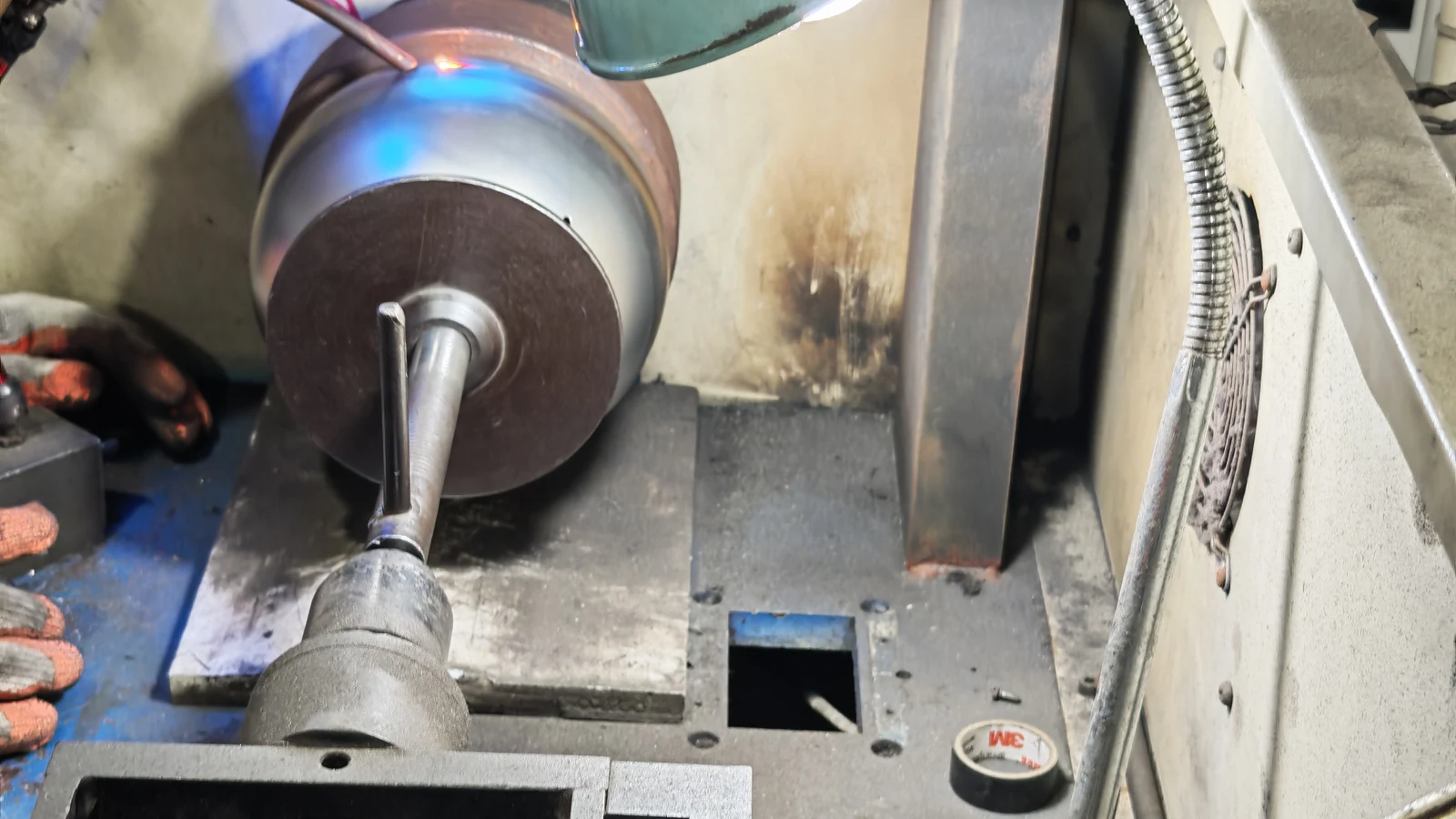
If the construction decision lands on our desk, it comes out of one plant rather than a relay of traders. Potobelo runs 66,000+ m² at 26,000 units a day across 70+ proprietary process lines, with tooling, forming, polishing, welding and packing in house — so changing clad geometry or base thickness is a tooling conversation, not a re-sourcing exercise. Minimum order starts from 1,200 pcs per model and depends on the model, finish, packaging and the certification your market needs; we sample first in 7–10 days, then run standard production in 30–50 working days from confirmation, with FOB, CIF or DDP stated before you commit. Our stainless steel saucepans and casseroles are built this way, and those are the terms we quote to importers and distributors.
The landed cost of the ply decision
The extra layers are not the expensive part. On a 5-ply build the additional aluminium is a modest line item; what moves it is the extra process steps, the scrap at forming, and the weight.
Weight is the item buyers miss. A heavier pan means a heavier carton and fewer units per container, so landed cost per piece climbs faster than the FOB price does — a fifth layer that looked affordable in a quotation stops looking affordable once your freight bill is divided by the units that fitted.
The way to decide it numerically is short:
- Ask for unit price at both constructions, and the packed carton weight at both.
- Multiply the difference in units per container by your freight rate for the real landed cost gap per piece.
- Compare that gap against the retail price step you can achieve with a heavier, premium-anchored product. If the market will not pay the step, the construction is marketing you are funding yourself.
Where the premium pays back: large-diameter pans sold on warp resistance, cookware that holds up under volume feeding, and the hero piece of a premium range. Where it does not: set filler pieces, kettles, steamers, and any line whose shelf price is set by the competition.
Key takeaways >- Ply count is a construction term, not a performance grade. Both builds spread heat with an aluminium core; five carries more of it.- Where the layers sit — full body or base only — changes a product more than adding two of them does.- A "5-ply" claim cannot be accepted or rejected on its own: no definition fixes the sequence, and counting conventions differ between suppliers.- What makes it checkable is a specification carrying the layer sequence, each layer's thickness in millimetres, the clad geometry, the base diameter and a per-batch material certificate.- The extra layers cost twice: once in the unit price, again in the freight, because a heavier pan fills a container with fewer units.- Judge the construction against the product: 3-ply for everyday saucepans and set filler pieces, a bonded base for deep vessels, 5-ply where thickness and mass are the selling point.
Common questions
Is 5-ply better than 3-ply stainless steel?
Not by itself. Five bonded layers usually mean more aluminium in the base, which gives the pan more thermal mass: it holds heat longer and responds to burner changes more slowly. That is an advantage for a large stock pot or a pan sold on heat retention, and a disadvantage for a frying pan where you want to drop the heat quickly. Five layers also add weight and cost, which shows up in your carton weight and your freight before it shows up in the pan. For most everyday stainless lines, 3-ply with a properly specified base thickness is the correct engineering answer.
What is the difference between 3-ply and 5-ply stainless steel?
Both are bonded builds made of the same three material roles: a stainless food-contact layer on the inside, an aluminium core that spreads heat, and a magnetic stainless outer layer that lets the pan work on induction. A 3-ply has three bonded layers in total. A 5-ply adds two more in the middle, typically an additional aluminium layer and an aluminium alloy bond layer. Copper can also appear in the core. So the difference is mainly how much aluminium is in the stack and how the supplier counts it, not a difference in how heat moves through the pan.
Does 5-ply heat more evenly than 3-ply?
Even heating comes from the aluminium core, not from the count of layers, and both builds use the same mechanism. Adding layers increases the mass of aluminium that has to be brought up to temperature, which lengthens heat-up and retention but does not make the surface more uniform than a 3-ply with comparable base thickness. Where a 3-ply pan shows hot spots, the usual causes are a base that is too thin under the centre or a burner ring wider than the base. That is a thickness problem, and a 5-ply built the same way would show it too.
How can a buyer verify that cookware is really 5-ply?
Ask for the layer sequence in order, each layer's thickness in millimetres, the alloy designation of the food-contact and the outer layer, and whether the cladding runs through the wall or stops at the base. A specification that says only "5-ply" cannot be accepted or rejected, because no universal definition fixes how the five layers are sized or what counts as one. Where a supplier answers with the sequence, the thicknesses and a per-batch material certificate, you can check the first-off from the tooling against the document and settle the claim dimensionally.
Written by
Potobelo Editorial Team
Sourcing and engineering staff at Potobelo, a stainless steel cookware brand built on 30 years of Zoombo manufacturing in Guangdong, China. We write from inside the plant that makes the product, not from reviewing it.