
Mixed Container Shipping: How to Combine Cookware SKUs in One Load
For importers and brand owners whose first order will not fill a container from one model. This is the working method we use with buyers: which cookware SKUs mix without damage, why 76 m³ never ships as 76 m³ of product, what each SKU needs on paper, and how to plan a load that unloads in the right order.
 Potobelo Editorial Team15 min read
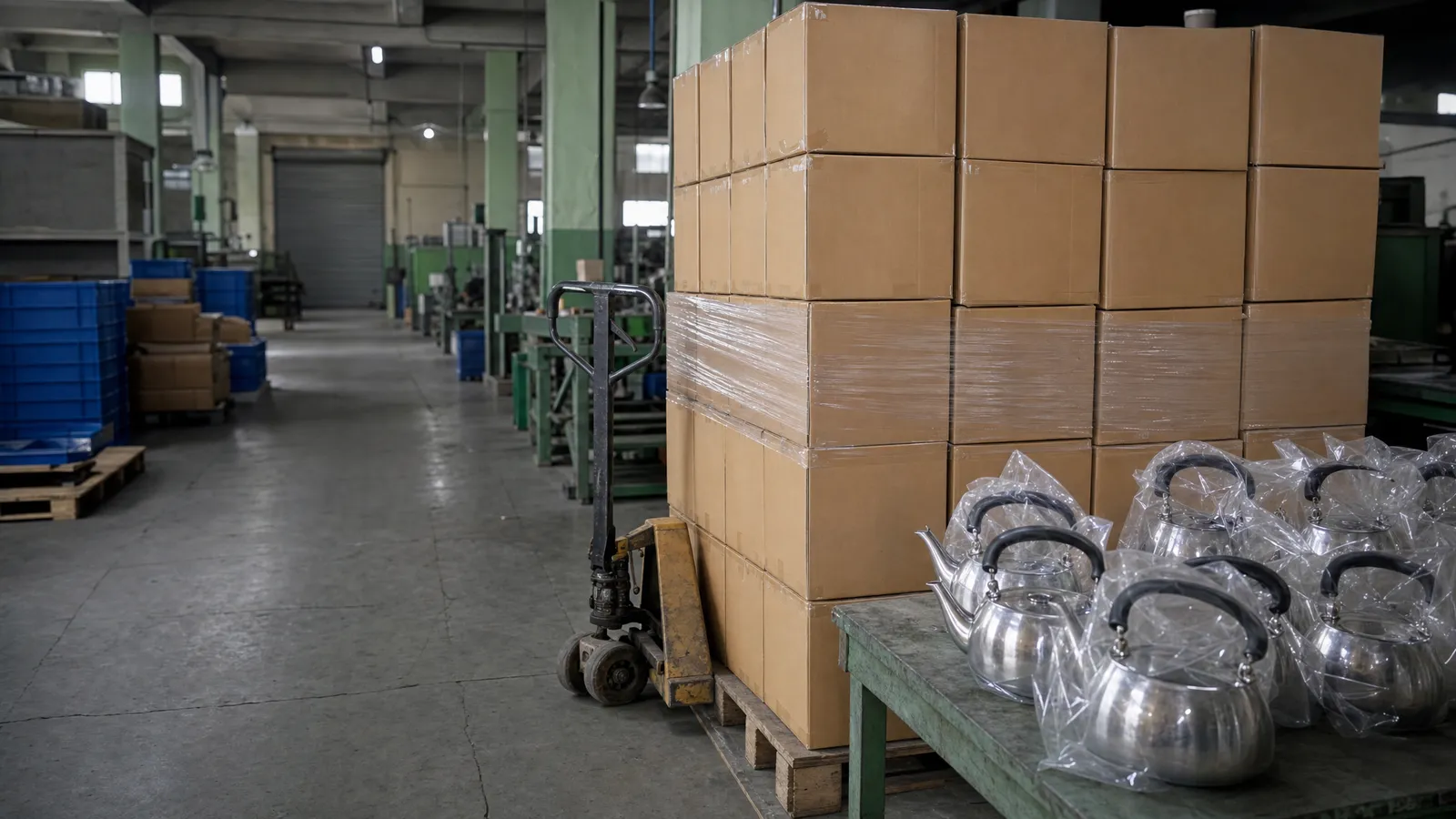
A container that is 60% full is not 40% cheaper. It is a full container rate spread across 60% of the goods, and the difference is paid on every unit inside it. That is why the first mixed load tends to decide the margin on the whole programme — quietly, before anyone has sold a single piece.
A mixed container is not a discount on freight. It is an engineering problem with two ceilings, a paperwork problem with a line per SKU and a set per product family, and a handling problem whose plan runs backwards from the unloading dock. Get the three right and a mixed load is the cheapest way to build an assortment. Get them wrong and you have bought air, paid duty on the wrong heading, and shipped cartons the warehouse cannot count.
What "mixed container" actually means
Three different structures get called mixed container shipping, and they decide your cost and your risk before a single carton is loaded.
One factory, several SKUs. You place one order for pressure cookers, kettles, saucepans and steamers with a single manufacturer. One exporter of record, one commercial invoice, one packing list, one bill of lading, one origin. The factory plans the load because it knows every carton in it: cleanest paperwork, most control, and what most buyers mean by a mixed container.
Several factories, one forwarder. You buy from three suppliers and a forwarder runs a freight consolidation — consolidated shipping — at a container freight station. The container is shared, but each supplier is a separate shipper with its own invoice, its own origin documents and its own idea of how a carton should be packed. You gain assortment breadth and lose the single point of quality control and the single loading plan. Consolidation is legitimate; it is simply not the same purchase, and should not be specified as if it were.
LCL shipping. You buy cubic metres in someone else's container. You are charged by volume or weight against a minimum, your cargo is handled at both ends by a third party, and your cartons are loaded and unloaded twice more than an FCL's, which costs transit time at both ends. The FCL versus LCL question is really a question about how full the box is.
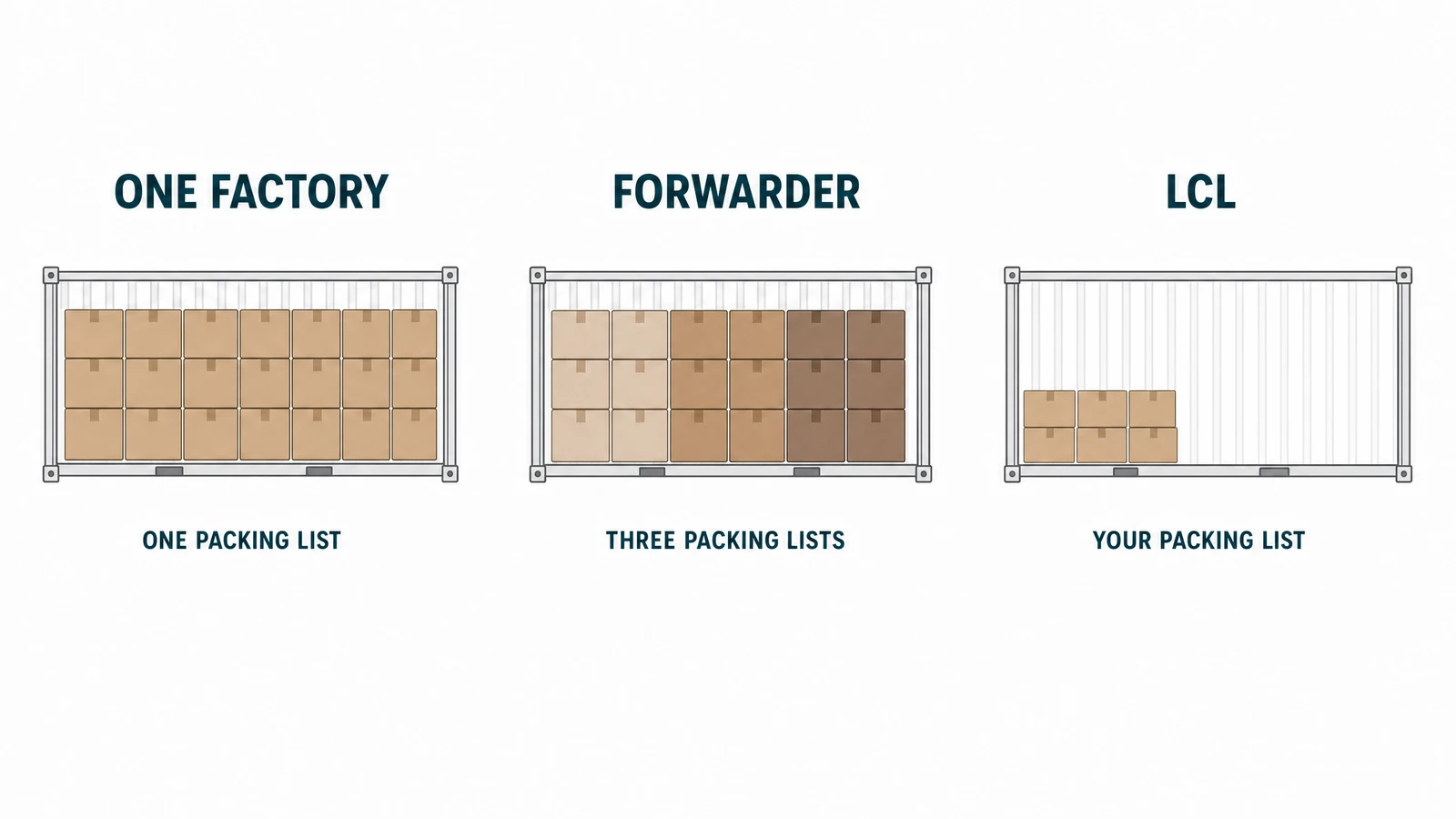
Illustrative render — the container looks the same in all three; the paperwork, the liability and the loading plan do not.
The distinction matters for one practical reason: who owns the packing list. In structure one it is the factory that built the load; in structure two, a forwarder reconciling three suppliers' documents, where any line that does not reconcile holds the whole container; in structure three, you. If you want the list to come from the party that packed the cartons, that is structure one — the wholesale buying guides cover the commercial side of the same decision: MOQ economics, landed cost and packaging formats.
What mixes well in a cookware load, and what fights
Cookware does not mix by category. It mixes by density and by how much punishment the carton can take.
Saucepans and casseroles nest, the single best property in the category: a nested set packs more kilos into a smaller carton, which raises the density of the load and reduces the air you pay for. Pressure cookers are the opposite — tall, thick-walled, heavy per litre, with near-cubic cartons that stack beautifully and add weight fast. Water kettles are bulky for their weight: a fixed cylindrical body, a projecting handle, a carton that is mostly void. Steamers sit in between, usually shipped as stacked sets.
That gives you a density dial rather than a compatibility list. A load that is all kettles runs out of cube long before it runs out of payload. Pressure cookers sit at the other end of the dial: they are the category that can push a master carton past the weight threshold, while a single-unit retail carton of the same cooker often still travels cube-bound — which is why the test below starts with your own packed carton rather than with the category. Mixing the two is what lets a buyer tune the load towards whichever ceiling is about to bind.
Three physical rules override any commercial logic:
- Round bodies in square cartons waste about a fifth of the footprint. A single round body inscribed in a square carton leaves roughly 21% of the floor area as air. Nesting recovers most of it; a loose single pan does not.
- Glass lids are the fragile line item, not the pan. They break at the carton face and under a stacked load; lids travel separately, in a fitment, or away from the panel that takes the handling.
- Enamelled and coated bodies cannot touch each other or bare steel. Enamel chips at a point contact and the chip is a return, not a cosmetic issue. They do not belong in the bottom layer, or beside a carton with exposed handles.
Pressure cookers deserve their own reading before they enter any mix: their weight per litre sets the ceiling for everything around them. What importers need to know about wholesale pressure cookers covers the carton and lid logic.
The arithmetic buyers get wrong
A 40 ft high cube is quoted as 76 m³. It does not ship 76 m³ of product, and the gap is not a rounding error.
The rule: 76 m³ is a ceiling, not a capacity. Plan against 70–80% of it, and check the payload before you believe either number.
Two ceilings apply at once, and they are not measured in the same unit:
40 ft high cube | Value | What it means |
|---|---|---|
Internal volume, as quoted | ~76 m³ | the number on your freight quote |
Internal volume on ISO 668 minimums (11.998 × 2.330 × 2.655 m) | 74.2 m³ | even the headline figure is a best case |
Maximum gross mass | 30,480 kg | set by the standard, marked on the door plate |
Tare | check the plate; a steel box is typically in the high threes of tonnes | |
Payload | ~26.5 t | gross mass minus tare |
Density at which the ceilings meet, on paper | ~350 kg/m³ | 26,500 ÷ 76 |
The same crossover at the 57.6 m³ this pattern actually uses | ~460 kg/m³ | 26,500 ÷ 57.6 |
The test to run on your own carton
That last row is the one worth keeping. Weigh one packed carton, divide by its outside volume, and compare with 460. Below it you run out of cube first; above it you run out of weight and sail with empty space above the stack. Neither is a mistake — but only one is the one you planned. The 350 figure assumes a cube nobody uses; 460 is what ships.
Where the cube goes
The worked example runs on the commercial box behind the 76 m³ figure — 12.03 × 2.35 × 2.69 m internal. Take a carton of 500 × 400 × 300 mm at 13 kg: 0.06 m³ and 217 kg/m³, comfortably cube-bound.
- Along the 12.03 m length, 24 cartons fit (12.00 m); across the 2.35 m width, 5 fit (2.00 m) — 120 per layer, using 85% of the floor and leaving a 350 mm strip.
- Stacked eight layers to 2.4 m — a height the top row can still pass through the door — that is 960 cartons. A ninth layer would be 2.70 m, taller than the interior and taller than the door.
- The cargo is 57.6 m³, or 76% of the quoted cube, and 12.5 tonnes, or 47% of payload.
- You have bought 76 m³ and shipped 57.6. The other 18 m³ is air, and it is the single largest line item nobody quotes.
Change one input and the ceiling moves. The same carton at 30 kg — 500 kg/m³, the density of a heavy multi-unit master carton — cannot fill those 960 slots: payload caps it at 883 cartons, or 53 m³. Weight binds first, and you sail with 23 m³ of air while the freight bill is identical.
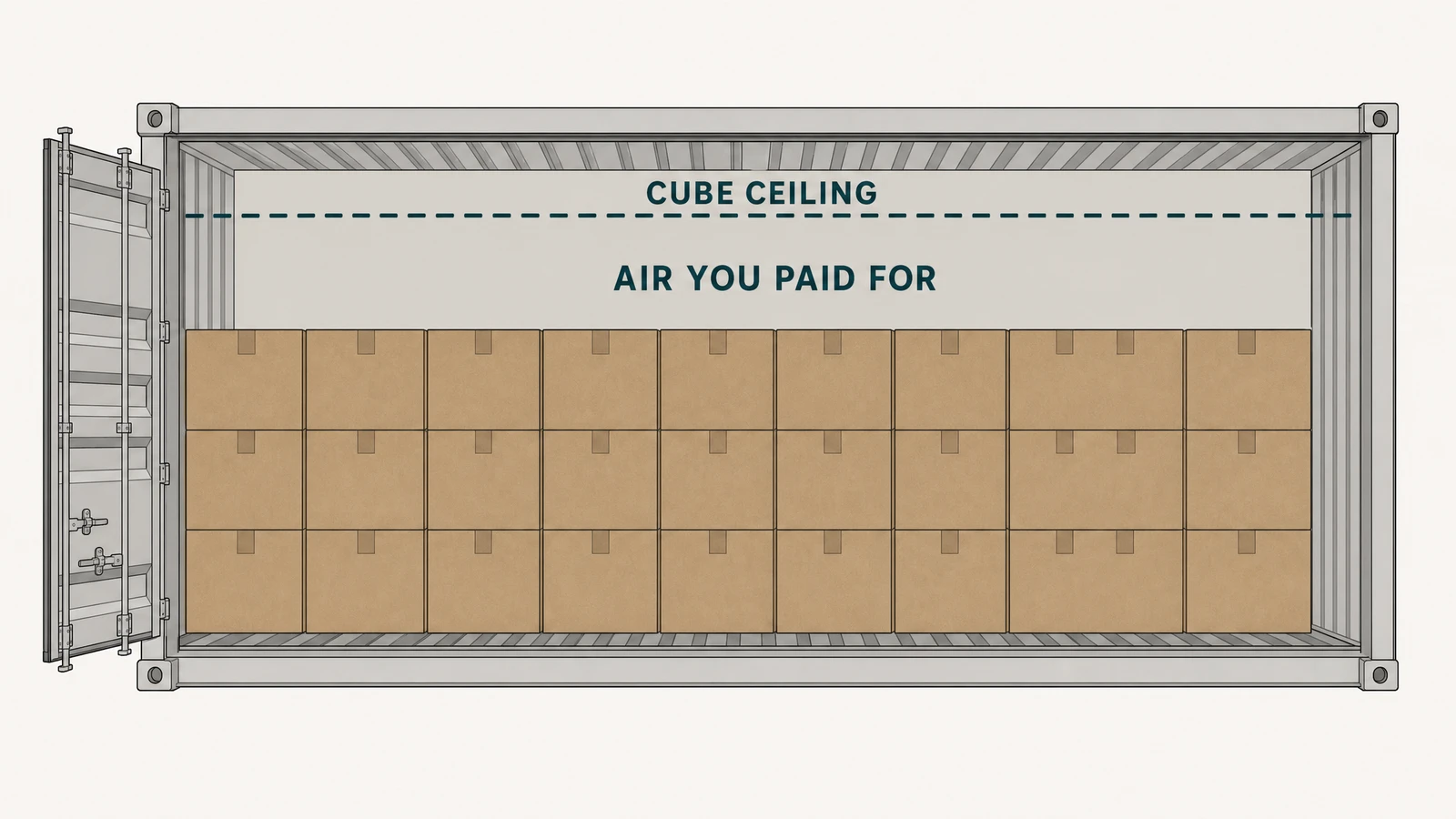
Illustrative render — the cube ceiling is the interior height; a stack stops below it because the top row still has to pass through the door.
Two further losses are structural. Palletising spends height first: a 144 mm pallet is half a carton layer, and the pattern gaps cost more than the pallet. The door opening is lower than the interior ceiling, so the last row must be built to clear it. The difference between a floor-loaded and a palletised plan of the same cartons is routinely a pallet or two of cargo — which is why carton outside dimensions are the most expensive line on a specification. The carton and pallet side of that chain is covered in carton and pallet specification for retail-ready programmes.
How MOQ works when the load is mixed
A minimum order quantity applies per model, not per container — and that is the arithmetic most first-time mixers sourcing from China miss.
Eight SKUs do not give you one minimum; they give you eight. At 1,200 pieces per model, an eight-SKU load is 9,600 pieces before anyone discusses freight. Published ranges — ours included, from 1,200 pieces per model — are indicative and confirmed per model at quotation, because the real number moves with the tooling, the colour and the carton.
Colour and artwork minimums sit on top and multiply faster than buyers expect: a colourway is usually a separate minimum per SKU, and a printed carton a separate print run per size. Three SKUs in three colours is not one order; commercially it is closer to nine.
The trade-off is breadth against unit cost, and it cuts both ways. Every SKU you add spreads the freight further — the benefit everyone quotes. It also adds a setup, an artwork proof, an inspection line, a packing-list line and a slice of the cube that the SKU you actually reorder could have used; and if that SKU runs short, you reorder early at a worse rate. The practical rule: put your reorder SKUs deepest, and use the rest to fill the container, not to define it. If you are still deciding how wide the line should be, building a cookware product line works through the range logic first.
The documents that have to match the mix
A mixed container load is counted by SKU, and a document set that only counts cartons will fail somewhere between the factory gate and the customs broker.
The packing list is the document that matters, and it needs one line per SKU: SKU code, description, quantity, carton count, gross and net weight, carton dimensions, and carton numbering from 1 to N across the whole load. Add a column for the layer or pallet. Without it, the warehouse can count boxes but cannot reconcile them, and a shortage claim becomes an argument about arithmetic rather than about goods.
Then the classification. Stainless steel table and kitchen articles sit in customs heading 7323 — table, kitchen or other household articles of iron or steel — covering pots, pans, kettles and steamers. Add an electric kettle and the load splits: electric appliances move to heading 8516. That is a different chapter, a different declaration line, often a different test file and sometimes a different duty rate. It is not a problem — it is a reason to give the broker the SKU split before the container sails, not after. The published texts are here: heading 7323 and heading 8516.
Which Incoterm you bought on — FOB or CIF — decides who owns the loading plan. On FOB, you or your forwarder book the container and approve the plan; on CIF the supplier books it, and the packing list is the only thing you see before the doors close. Neither is better, but only one of them puts the drop sequence in your hands.
Two more documents travel with every load. Origin: from one factory, one declaration covers the lot; from a consolidation, each supplier's documents must reconcile to the same consignee and packing list, or the container waits. The second is the verified gross mass. A packed container needs a verified gross mass before it can be loaded; on a mixed load that number is the sum of your suppliers' packing lists, so if a line is wrong the box does not load. The requirement is set out by the International Maritime Organization.
Food-contact paperwork travels per product family, not per container. In the EU the framework regulates migration behaviour rather than approving grades, under Regulation 1935/2004; in the US the FDA's food-contact framework applies. In practice the file closes on test reports and alloy declarations per family, and on the grade you bought: 304 has established food-contact recognition in practice, 201 does not, and a supplier who calls 201 food grade without paperwork is asking you to take it on trust. One set per family is why the SKU split must exist before the documents are drawn. The full sourcing sequence is in how to source cookware from China.
Loading, unloading, and why the plan runs backwards
The best container loading plan is written from the receiving dock backwards: whatever comes off first goes in last.
That rule resolves most arguments. If your best-selling SKU must be on the floor on day one, it travels at the door end; a slow SKU going into storage can be buried. Build the load sequence as the reverse of the drop sequence and you never unload half a container to reach one pallet.
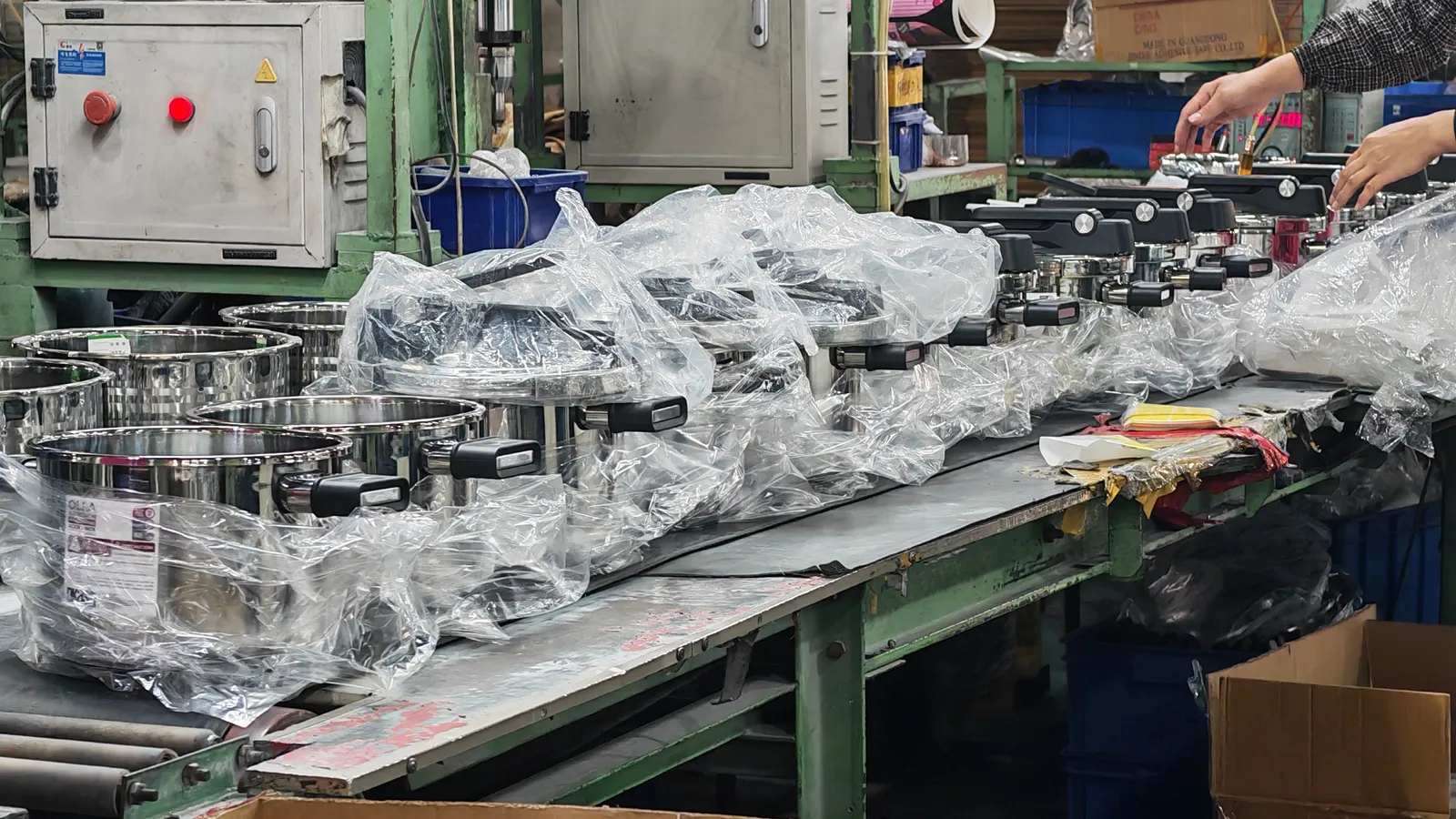
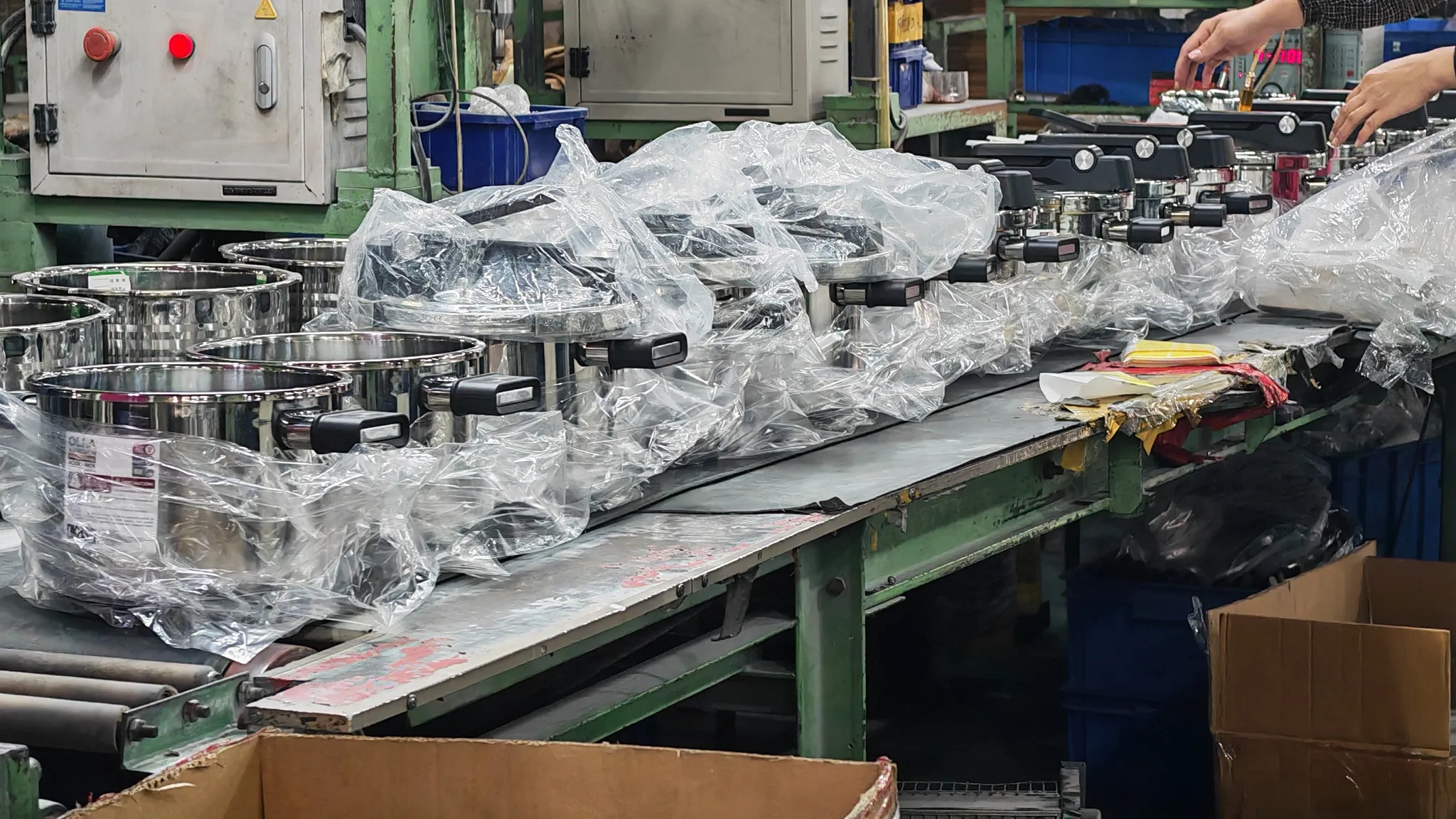
The point where a mixed load becomes physical: bagged bodies, open cartons, and a count that has to survive the next four handlings.
Marking makes the plan work at the other end. Every carton needs its SKU code, its position in the sequence ("carton 12 of 96"), the PO line, and a mark that tells one SKU from another at a glance — a coloured label per SKU is the cheapest version. A warehouse that must open cartons to identify them will not count your load correctly. Photograph the load before the doors close; it is the only evidence if the count is disputed.
Then the physical handling, which is where mixed loads actually fail:
- Glass lids and enamelled bodies never go in the bottom layer, and never at the door end, which takes the most handling.
- Heavy cartons never sit on light ones, however convenient the stack looks at the factory.
- Void space gets filled, not left: air lets a stack move, and movement breaks handles and scuffs polished bodies. The securing practice is published as the IMO/ILO/UNECE CTU Code.
- Wood dunnage and wooden pallets need ISPM 15 treatment and the mark to prove it, or the load can be held, treated or refused at the border — the standard is published by the IPPC.
The receiving side needs one artefact: a count sheet by SKU and layer that matches the carton marks. Without it, a mixed load arrives as a pile of cartons with numbers on them. The packing end of that chain — how cartons are closed, marked and staged — is described in packing and finishing capability.
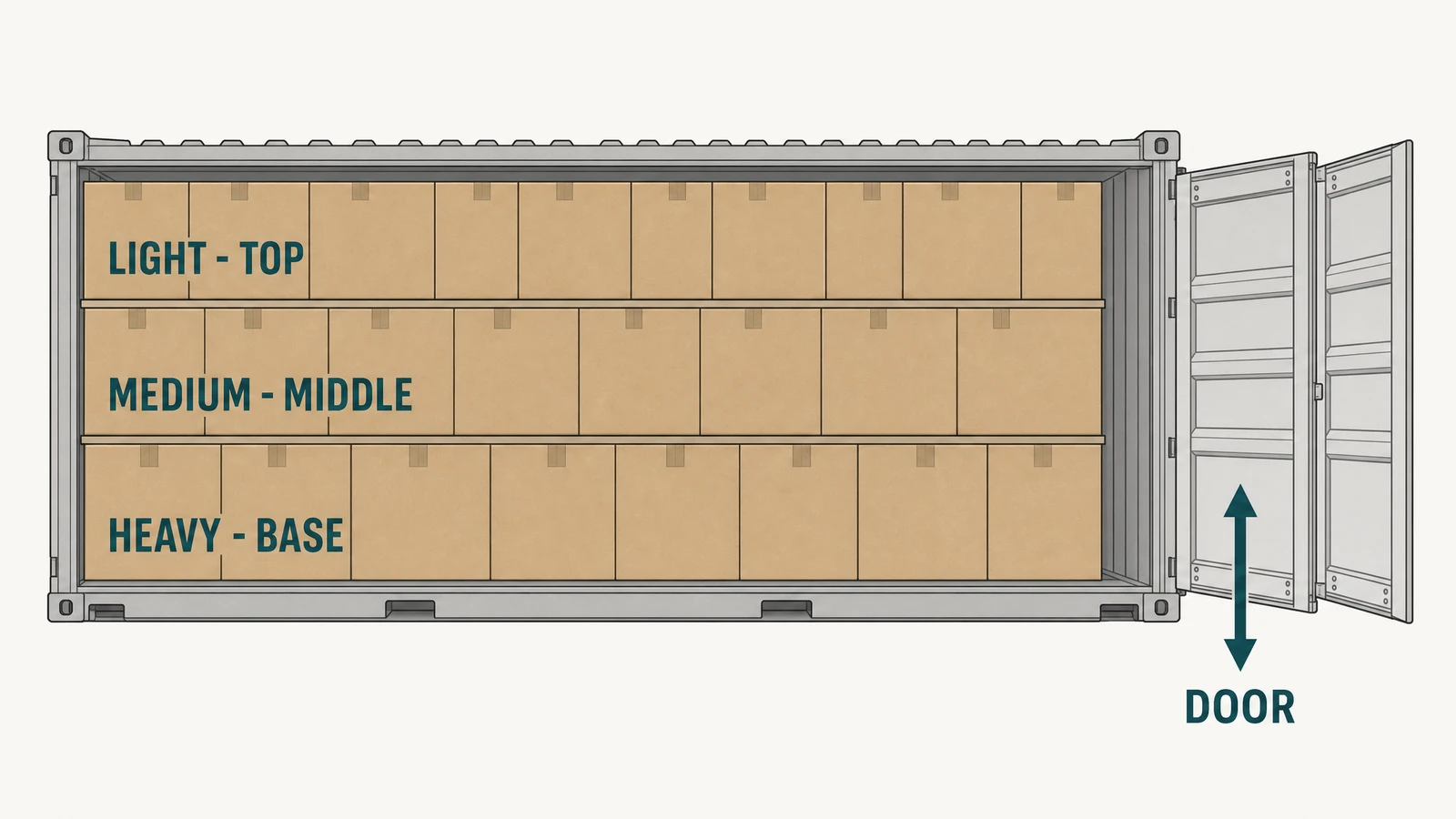
Illustrative render — heavy at the base, medium in the middle, light on top; the door end holds whatever has to come off first.
A checklist you can run on your own order book
Eight checks, in the order a buyer meets them. If any one of them has no answer, the load is not ready to book.
- Which structure is this? One factory, a forwarder consolidation, or LCL. Write it down, because it decides who owns the packing list.
- What is the density of each SKU's carton? Weight ÷ outside volume. Above about 460 kg/m³ the weight ceiling binds before the cube fills; below about 350 it never does.
- What is the combined carton volume? Sum it, then compare with 70–80% of the quoted cube, not with the quote.
- What is the combined gross weight? Including pallets, dunnage and cartons. Compare with payload, not with gross mass.
- How many minimums are you actually placing? One per model, plus one per colourway, plus one per printed carton size.
- Does the SKU split exist on paper? If the packing list does not have a line per SKU, the customs declaration and the VGM are both guesses.
- What is the drop sequence? Then invert it into a load sequence and write it into the loading instruction.
- How will the warehouse count it? If the answer is "by carton", add SKU marks before the container is packed, not after.
The order matters: density before volume, volume before weight, weight before minimums, and minimums before documents. Buyers who start with the minimums usually end up with a load that cannot be documented.
If this is your first container and the arithmetic is new, the first-order cost build-up in how to start a cookware wholesale business works through the rest of the landed cost around it.
What we can and cannot tell you about our own loads
We do not publish a mixed-container minimum, and any number named before your cartons are known is a guess that lands on your freight bill.
This page is method, not a rate card, so it is worth being plain about what we can put in writing. The line covers four categories and roughly 38 SKUs — pressure cookers, water kettles, saucepans and casseroles, and steamers. Sampling runs 7–10 days and production runs 30–50 working days after confirmation. Pricing is quote-based, so no price for any SKU is published.
Everything else about a mixed load — how many SKUs, at what quantity each, packed in which carton — is answered per enquiry, against the assortment you are actually planning and the market you are importing into, because those two inputs are what decide it.
That conversation starts from an assortment plan rather than a product list, which is how importer and distributor programmes are scoped. Bring the SKUs, the cartons and the market; the container maths follows.
Common questions
Can you mix different cookware products in one container?
Yes, provided the mix is planned by density and by carton strength rather than by category. A workable load usually combines three weight classes: heavy, thick-walled items such as pressure cookers at the base, mid-weight saucepans and casseroles in the middle, and bulky light items such as kettles or steamers at the top. The constraint is not which products may sit together; it is whether combined carton weight stays under the payload while the cartons still tessellate. Two dense SKUs hit the weight ceiling with cube to spare; two bulky SKUs leave you paying for air.
How many cartons fit in a 40ft container?
It depends on carton size, carton weight and whether you load loose or palletised. The method: divide the usable cube by the carton's outside volume, then check the result against the payload. A 40 ft high cube quotes about 76 m³, but a floor-loaded plan typically uses 70-80% of that after stacking height, door clearance and pattern gaps. As an example, a 500 x 400 x 300 mm carton of 0.06 m³ gives 960 cartons at eight layers on a 12.03 m internal length — 57.6 m³ and 12.5 tonnes at 13 kg each. Run the numbers on your own carton before you accept a unit count.
Is a mixed container cheaper than LCL shipping?
It depends on how full the container is and on the LCL minimum, so compare both quotes on the same cargo rather than a rule of thumb. LCL is charged by volume or weight with a minimum charge, and it adds a consolidation and deconsolidation leg at each end, which is where most carton damage happens. A mixed FCL spreads one container rate across every unit in it, so the saving grows as the load fills. The break-even is the point where the FCL rate divided by your unit count drops below the LCL charge for the same cubic metres — a calculation to run on your own volume, not a ratio to assume.
What documents do I need for a mixed container of cookware?
At minimum: a commercial invoice and a packing list with one line per SKU, each line carrying carton count, gross and net weight, and carton dimensions; the correct customs heading per product family, which for stainless cookware is heading 7323 but moves to 8516 if the load includes electric kettles; an origin declaration; and a verified gross mass before the container is loaded. Food-contact paperwork travels per product family, not per container, so a mixed load needs one set per family rather than a single certificate covering everything.
Written by
Potobelo Editorial Team
Sourcing and engineering staff at Potobelo, a stainless steel cookware brand built on 30 years of Zoombo manufacturing in Guangdong, China. We write from inside the plant that makes the product, not from reviewing it.