
Cookware for HoReCa: What Hotels and Restaurants Actually Buy
For importers, distributors and brand owners who sell cookware into hotels, restaurants, cafés and contract catering. This piece separates the four buying environments behind the word HoReCa, sets out what each one actually orders, and reduces the decision to four failure modes and the twelve specification lines that prevent them.
 Potobelo Editorial Team16 min read
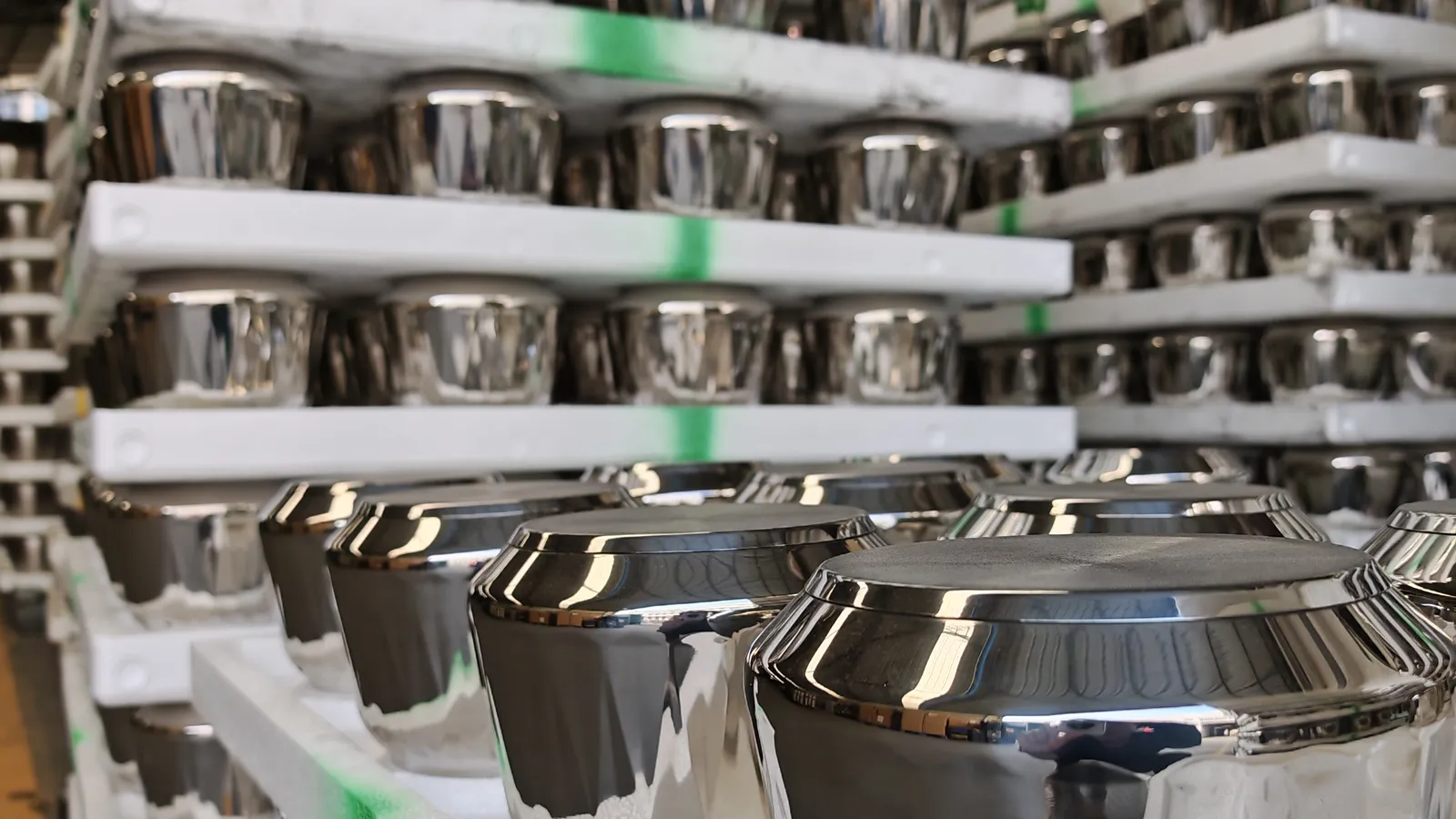
HoReCa stands for hotel, restaurant and café-catering, and procurement usually treats it as one channel with one requirement: something durable, in volume, at a wholesale price. That description is accurate and useless. A hotel banquet kitchen, a twelve-table restaurant, a café counter and a contract caterer running hospital sites are four operating environments, and the cookware each orders differs in shape, size, finish and tolerances — which is why a HoReCa supplier who quotes one specification to all four has answered one brief and mispriced the other three.
The cost arrives at the second reorder, not at the quotation: what was over-specified is still in service, and what was under-specified has been written off.
HoReCa is four buyers, not one channel
HoReCa covers four operating environments — hotel, restaurant, café and quick service, and catering or institutional — each buying cookware on a different clock and against a different failure.
The hotel buys in three layers: breakfast and room service, an à la carte restaurant, and a banquet or conference operation. The banquet layer shapes the order — food held in vessels for hours, produced in batches across a defined menu — and the buffet cookware it serves from is a separate buy. Orders follow a written standard, often annual or half-yearly, set at group level rather than by the property.
The restaurant — independent, or a small group without a central kitchen — buys on replacement demand. Restaurant cookware is a hand tool: it is picked up, thrown in a sink, stacked wet and put back on a burner. The failure mode here is abuse and thermal cycling, not long-dwell corrosion, and the buying cycle is short and irregular.
The café and quick-service operator buys small diameters, low volumes and a surface the customer can see. Kettles, milk pans and small saucepans sit on induction hobs in front of guests, so finish and handle comfort outweigh gauge.
The contract caterer — hospitals, schools, staff canteens, events, transport — buys for movement: filled, lidded, loaded, driven, held, served, then washed in a tunnel machine. Lids, stacking geometry, handle clearance and weight matter more than the base does.
Environment | What dominates the order | What fails first | Buying clock |
|---|---|---|---|
Hotel (banquet, breakfast) | Large stock pots, braising pans, tiered steamers, buffet service | Chloride pitting on holding vessels; rim deformation on lids | Annual or half-yearly, against a group standard |
Restaurant (à la carte line) | Sauté and frying pans, saucepans, small stock pots | Domed base, loosened handle, burnt and re-seasoned interior | Replacement demand, irregular |
Café / quick service | Small saucepans, milk pans, stovetop kettles | Exterior finish wear; handle heat transfer | Short cycles, appearance-led |
Catering / institutional | Deep pots with lids, steamers, stacking vessels | Lid fit, handle failure under load, base damage in transit | Tender cycles, contract-length |
The practical result is that HoReCa ordering is narrow and deep — the commonest misunderstanding between a factory and a channel buyer. A plant organized around a retail assortment, forty SKUs and eight finishes, quotes a HoReCa buyer a range they cannot use. What the buyer needs is six shapes, three or four diameters, one or two finishes, and a specification stable enough to reorder against for five years.
What a HoReCa supplier is actually asked to stock
The working HoReCa range is six shapes across three or four diameters — the restaurant pots and pans a line actually replaces. Everything else is either a specialty order or a different product family.
Stock pots and boiling pots. The batch vessel. A restaurant line works from 8 to 15 liters; a hotel banquet or commissary kitchen runs 20 to 50 liters, often in multiples. Capacity is what buyers quote; diameter decides whether the pot clears the burner grate and the shelf it lives on.
Saucepans. Single long handle, 1.5 to 4 liters, used for sauces, reductions, sides and reheating. This is the most-replaced item on a line because it is also the most abused: emptied into a sink, left on a warm holding plate, scrubbed.
Sauté and frying pans. 24 to 32 cm, the workhorse of the pass. The decision here is wall geometry — sloped for tossing and reduction, straight for searing and braising — plus base thickness and whether the pan must survive induction to oven.
Woks. The seventh shape, and one this range does not cover: different geometry, different burner furniture — round or flat bottom, a ring that has to sit on the burner — so not a frying pan in a larger size. Woks sit with the parent company, outside this site's scope; source them separately.
Braising pans and rondeaus. Wide, low, twin-handled, hob to oven. A banquet kitchen and a braise-heavy restaurant both run these hard; the lid becomes part of the vessel, not an accessory.
Tiered steamers. Two or three tiers with perforated inserts, used across Asian menus, vegetable and dumpling production, and institutional catering where steaming is the volume method.
Stovetop kettles. Breakfast and front-of-house: spout behavior, handle heat and how the body reads on a buffet table matter more than volume.
The saucepans and casseroles range covers the saucepan and the batch-pot end of that list — ten single-handle saucepans and ten deep twin-handled casseroles — while steamers and kettles cover two more. Frying pans and wide braising pans are separate families, ordered by the sizes you run, not by a capacity off a catalog page.
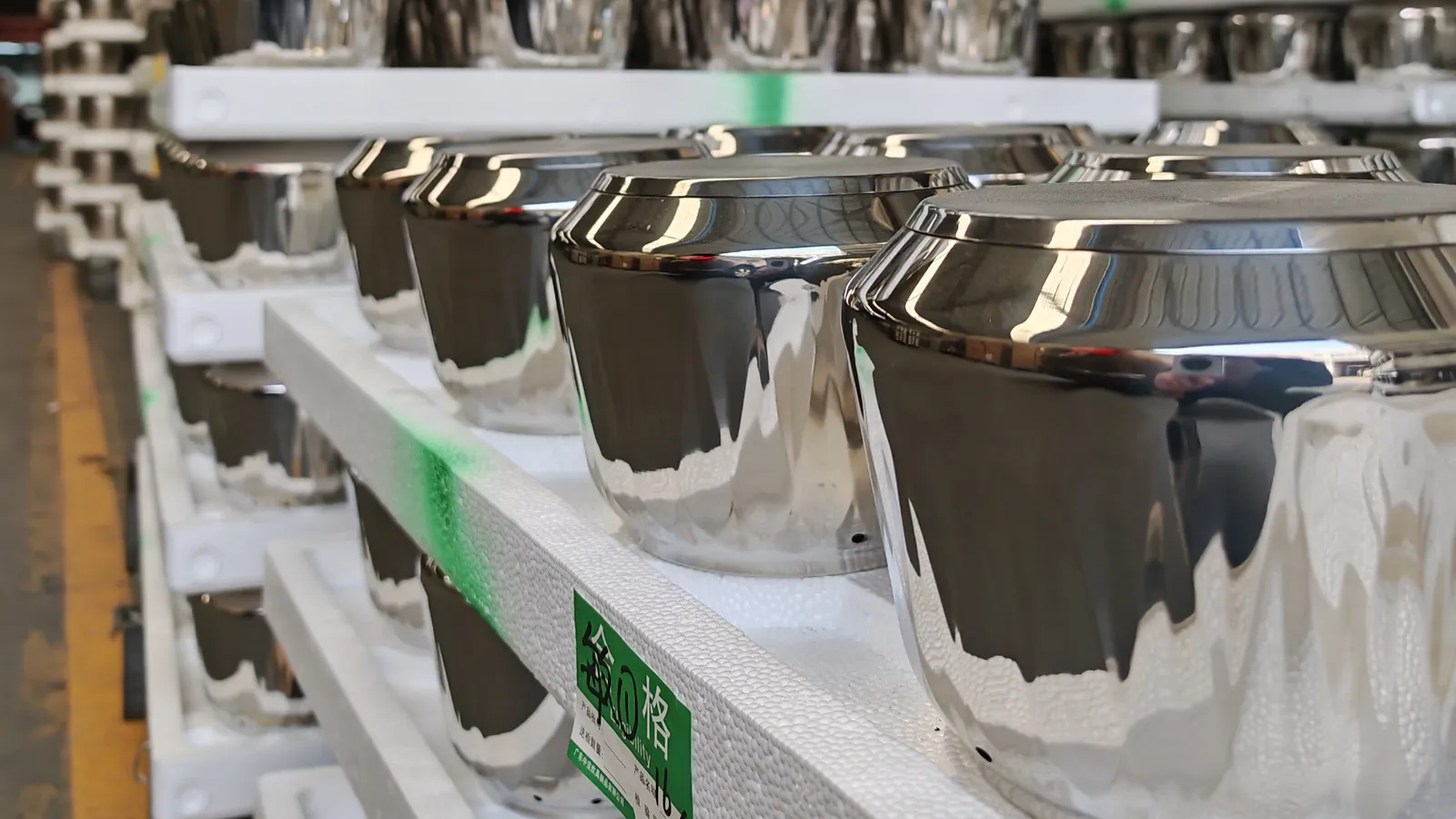
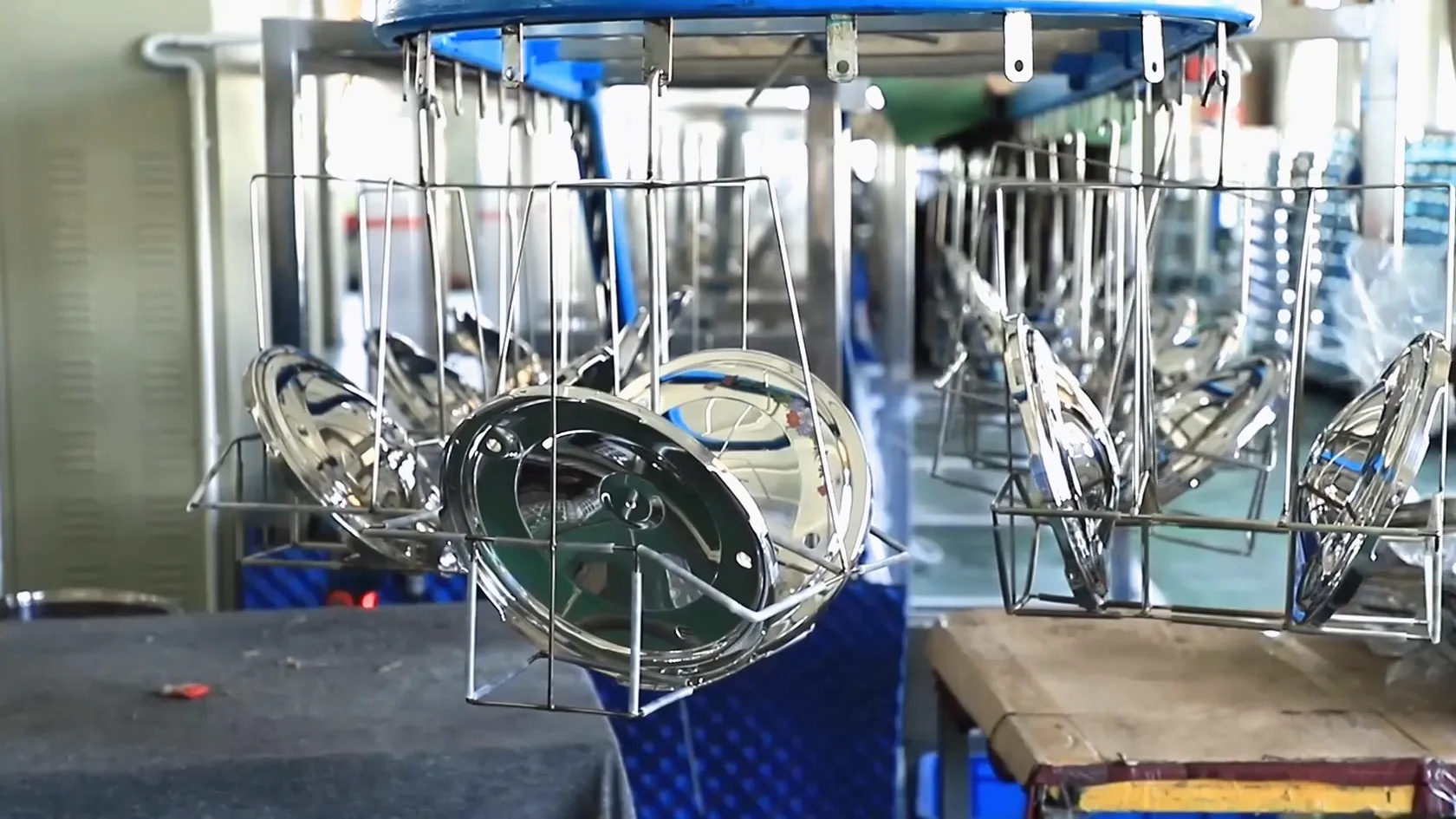
Bodies racked between stages. The differences buyers specify — gauge, base, rim — are set before this point and cannot be inspected from the outside afterwards.
Not on that list at all: hotel pans, GN containers, chafing dishes and sheet pans. They belong to hotelware — thin-gauge, rectangular, formed on different tooling, sold by another set of suppliers. A factory quoting them without the tooling is quoting a product it will outsource; better to say where the range stops than discover it during a tender.
Shape | Where it dominates | The spec that decides the reorder |
|---|---|---|
Stock pot, 8–50 L | Hotel banquet, commissary, caterer | Base construction, rim flatness, handle load rating |
Saucepan, 1.5–4 L | Restaurant line, café | Handle attachment, base flatness after thermal cycling |
Sauté / fry pan, 24–32 cm | Restaurant line, hotel à la carte | Wall geometry, gauge, oven-safe handle |
Braising pan / rondeau | Hotel banquet, braise-led menus | Lid fit, twin-handle fixing, warp resistance |
Steamer, 2–3 tier | Asian menus, institutional | Insert fit, stacking stability, vent design |
Stovetop kettle | Breakfast, café front of house | Spout, handle heat, exterior finish |
The two container systems your pots have to fit
Your pots are not containers, but they live in a room built around containers, and that is a compatibility question with two different answers depending on the market.
The metric system is Gastronorm, standardised in Europe as EN 631-1 on a 530 by 325 mm module — the GN 1/1 catering container, with fractional sizes and depths from 20 mm to 200 mm. Bains-marie, combi ovens, blast chillers, rack trolleys and serving displays across Europe, the Middle East and much of Asia follow that module.
North America runs a different one: the hotel pan, non-metric, with a 12 by 20 inch full size and its own fractions. Both systems are sold under the same informal names — hotel pan, steam-table pan, service pan — and they do not interchange.
A stock pot is not a GN container, but it sits in the same room as the machines. Four questions decide whether a vessel works in a given kitchen, and none appear on a capacity label:
- Does the diameter clear the rack pitch on the combi oven or the holding cabinet?
- Does the overall height — body, lid, handle projection — clear the shelf spacing above it?
- Does the handle foul the rack channel, so the tray will not slide in?
- Will the body sit stable in the dish rack, or rock and trap water against the base?
A factory quotes diameter and capacity; a kitchen works in shelf space. The bridge is a drawing with overall dimensions, not a catalog photo — and a buyer who sends the rack pitch gets a usable answer instead of a range list.
What fails first — and why the failure, not the brand, sets the spec
Commercial cookware rarely wears out. It fails at one of four points, and each point maps to one line on the specification sheet a HoReCa supplier should be asked to stand behind.
1. Chloride pitting. Stainless steel resists corrosion through a passive oxide layer, and that layer is attacked by specific chemical species — the chloride ion being the most common, as the British Stainless Steel Association sets out. In a commercial kitchen the chlorides arrive from salt, sanitizer, detergent residue and the water itself, and where they sit undisturbed against the surface — under a lid, in a holding vessel, in a racked pot that goes back to the shelf wet — the layer breaks down and pits. Pitting is worse in warm, stagnant, concentrated conditions, which describe a banquet holding pan better than a home kitchen.
2. Base flatness. A disc base on an induction hob transfers heat only where it touches. Repeated fast heating, quenching in a sink and stacking on a rack takes the flatness out of the base, and the pot starts to hum, heat unevenly or trip the hob's pan detection. The specification line is a flatness tolerance measured cold plus the base construction: single-skin and composite bases behave differently under the same abuse — set out in 3-ply versus 5-ply stainless steel.
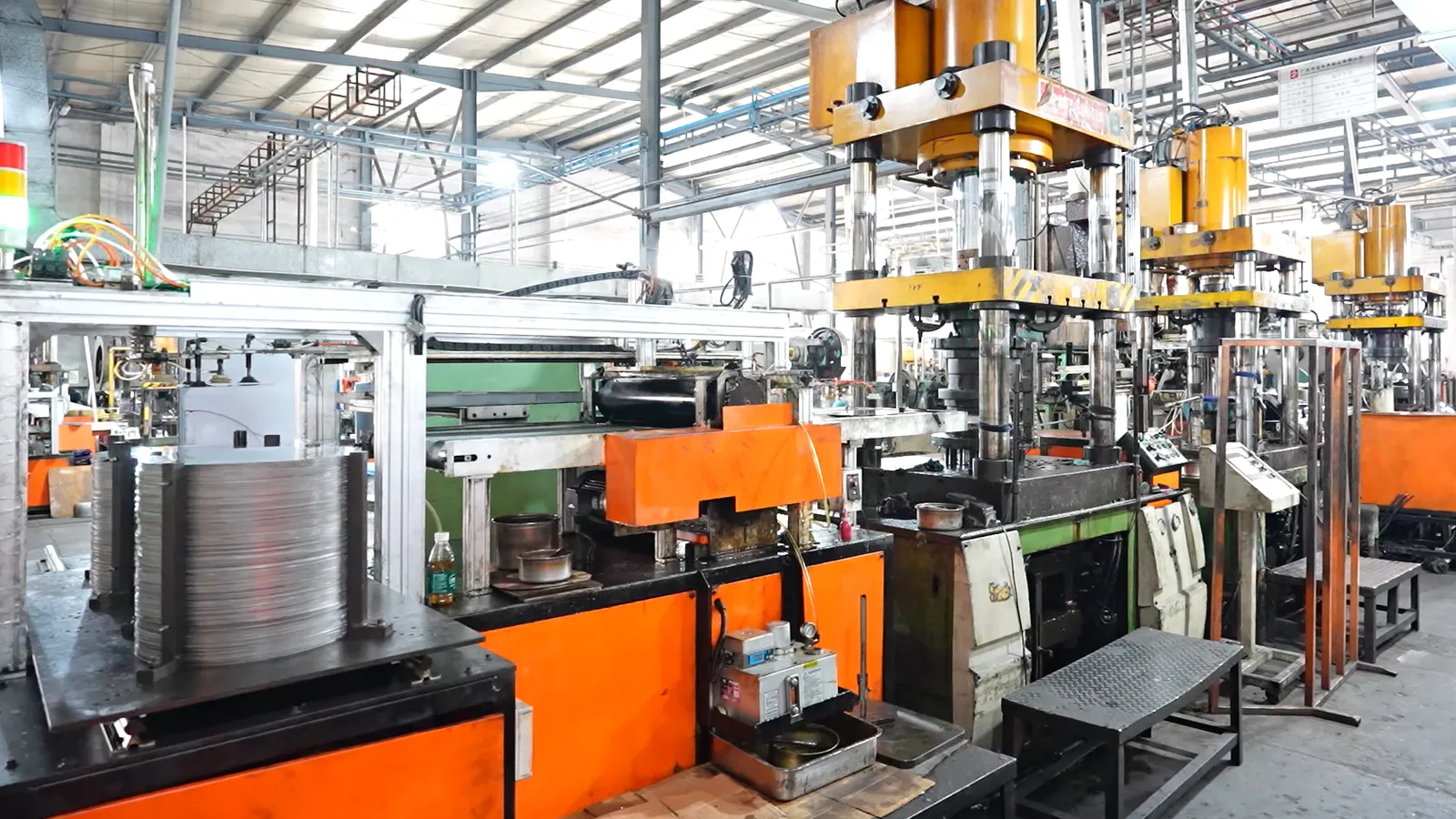
Bodies are drawn here from round blanks. Flatness is a tooling and process outcome, which is why it is also a line you can hold a supplier to.
3. Joints and handle attachments. A rivet or a spot weld creates a crevice, and a crevice is exactly the geometry where chlorides concentrate and stay wet. A handle that loosens after a year becomes a pot that gets sent back — or a batch of forty. What belongs in the spec is the attachment method, whether the fixing penetrates to the food-contact side, and whether the joint cleans.
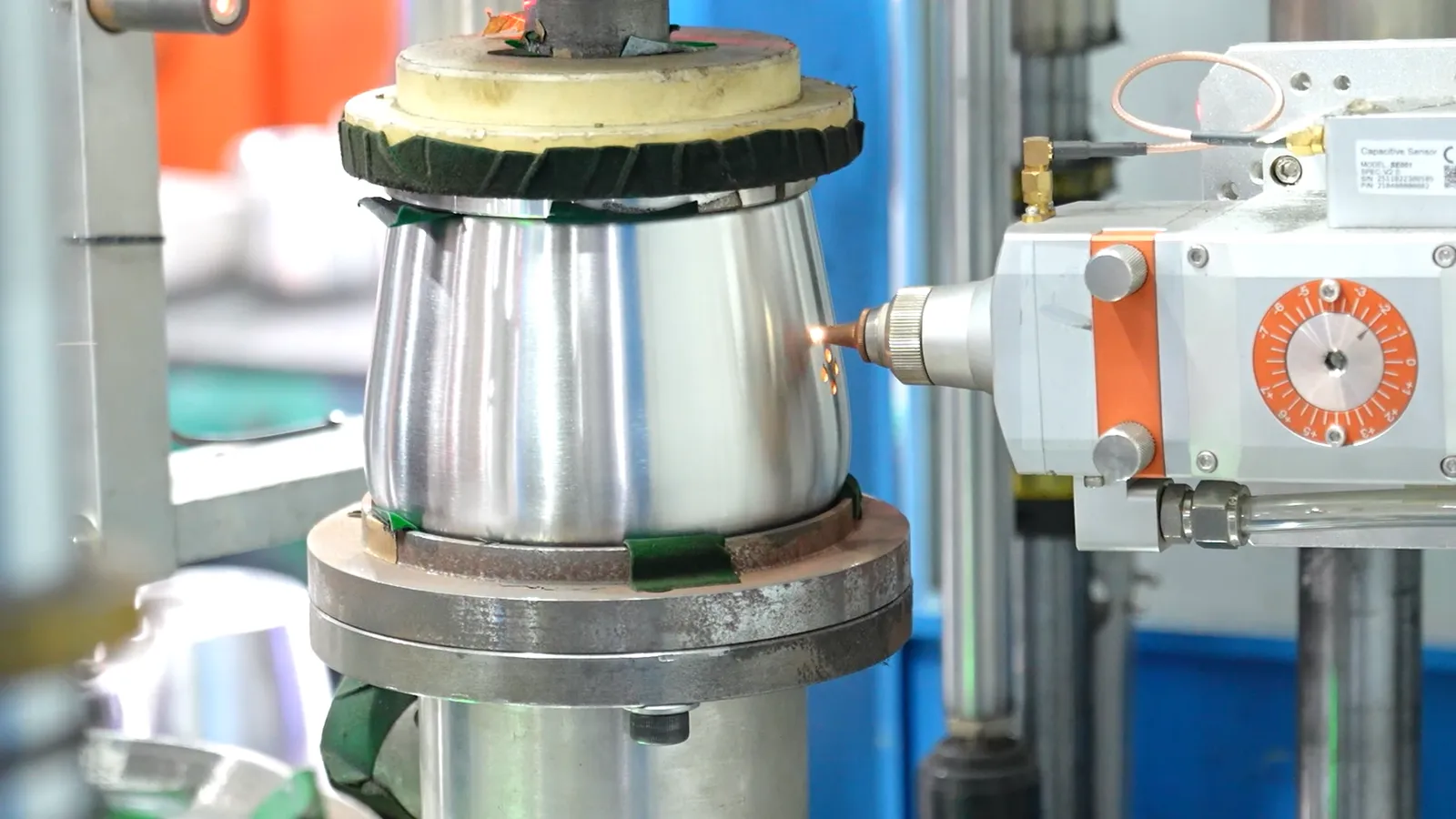
A seam being joined on a rotating fixture. Every joint is a crevice unless the process closes it — which is why the fixing method belongs in the spec, not the brochure.
4. Rim and lid fit. A rim that goes out of flat lets steam escape continuously: longer cooks, more energy, uneven results, and in a pressure cooker a rim that will not seal is a vessel no operator can trust to hold pressure. The line is rim flatness plus lid type, and whether the lid is vented.
Failure | Mechanism | The line to put in the spec |
|---|---|---|
Pitting | Chlorides break down the passive layer where liquid stands | Grade, finish, and a written drying and holding practice |
Domed base | Thermal cycling plus stacking takes flatness out | Cold flatness tolerance; single-skin or composite base |
Loose handle | Crevice at rivet or weld stays wet and corrodes | Fixing method; whether it is exposed to the food side |
Lid will not seat | Rim deformation under load and heat | Rim flatness; lid type and venting |
None of the four shows up in a product photograph; all four show up after thirty wash cycles in your own dish machine.
Material and food contact: what the paperwork can and cannot prove
The question is not whether the steel is "food grade". It is which document you will be holding, in whose name, for which market.
In the European Union, Regulation (EC) No 1935/2004 is a behaviour framework rather than a list of approved grades: materials must be made under good manufacturing practice so that, in normal or foreseeable use, they do not transfer constituents in quantities that could endanger health, change the food's composition, or deteriorate its organoleptic properties. A supplier calling a grade "EU food grade" is really handing over a migration test report for the intended use — the grade is an input to that report, not a substitute.
In the United States, cookware sits explicitly inside the FDA's food-contact scope: the agency's own description covers food packaging and its components, processing equipment, food preparation surfaces and cookware. Authorisation runs through a food contact notification or a food additive regulation. In practice, buyers verify stainless by series and chromium content rather than grade name — which is why a mill certificate or composition report is worth more than a logo on a carton.
For equipment going into North American kitchens there is a third layer buyers often miss: NSF/ANSI 2 sets minimum requirements for the materials, design, fabrication, construction and performance of food equipment. It is a sanitation standard, and in the US the health inspector — not the chef — decides whether a vessel stays in service.
Stated plainly: SS304 and SS201 are both used across the Potobelo line, and in established US and EU food-contact recognition practice, 304 is what a buyer specifies for food-contact cookware, while 201 is usually not what a specifier accepts. The EU framework offers no grade whitelist to appeal to either way; in the US the equivalent evidence is a composition or mill certificate. Pressure cookers we make in 304 only. For the wider question of how grades are named and compared, see food-grade stainless steel cookware.
Two rules keep the paperwork honest: a test report proves the model named on it, at the time it was tested — not the container on the water — and ISO 9001 proves a quality system, not a product. Ask for the entity name on every document, because a report issued to a trading company says nothing about the factory that will run your order. None of this is compliance advice; it is a list of questions for your own authority.
How the channel actually buys: distributors, group purchasing and tenders
The person who signs the HoReCa order is almost never the person who cooks with the pot, and that single fact reorganizes how a supplier should sell.
The channel runs in three layers. At the bottom, a foodservice equipment distributor or dealer holds stock, publishes a catalog, extends credit and delivers, which is why HoReCa supply searches return dealers rather than factories. Above that, dealer groups and group purchasing organizations negotiate pricing and maintain approved-vendor lists, so a product that is not on the list is not ordered regardless of quality. At the top, chain and hotel-group standards are written at head office and applied by every property, turning a small specification error into a multi-site problem.
Three consequences follow.
The customer is often the distributor's brand. A factory selling into this channel is often supplying OEM or private label: the pot carries the distributor's mark, sits in the distributor's catalog, is priced on the distributor's terms. The range has to survive a catalog page — a photograph and six specification fields — before it survives a kitchen. Which is the point of the term: a HoReCa supplier supplies the people who supply HoReCa, usually under their own label rather than ours.
Reorder fidelity beats first-order price. A distributor with forty properties on one specification cannot absorb a batch that is 0.2 mm out on wall thickness, because the complaint arrives from every site at once. Consistency across reorders is the product. If you are still narrowing the field, the capability checks in choosing a stainless steel cookware manufacturer cover what to verify before the first order; the commercial structure is set out in how to start a cookware wholesale business.
The specification has to survive a tender, not a conversation. A tender attaches documents, samples and delivery schedules, and a product that is right but undocumented loses to one that is adequate and complete.
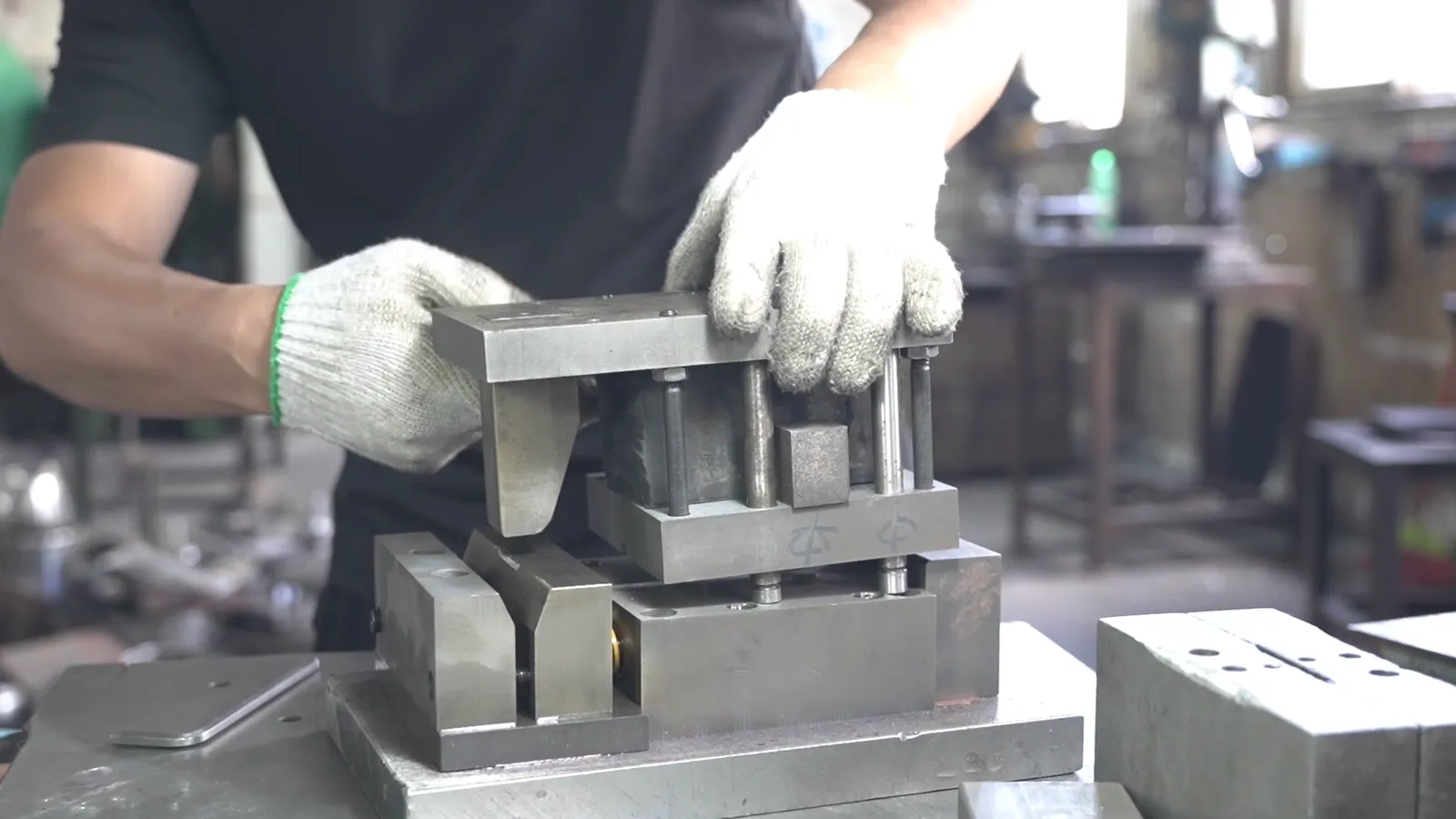
Setting a die. Whoever owns the die, and how long it takes to change, decides whether a multi-site specification holds from one reorder to the next.
The specification sheet: twelve lines that decide the order
A HoReCa order is decided before the first price is quoted, on a page most buyers write afterwards. These are the twelve lines worth writing first — and the opening four you have already met as failure cases.
# | Line | What to write, and why it decides the reorder |
|---|---|---|
1 | Capacity and diameter | Liters hide the footprint; diameter decides burner, shelf and rack fit |
2 | Base construction and total thickness | Single-skin or composite, in mm — this is the heat-spread and warp story |
3 | Base flatness, measured cold | A tolerance, not a promise; it is what induction contact depends on |
4 | Body gauge | Below a certain gauge the pot dents at the rim before it wears out |
5 | Grade, and where each grade is used | Body, lid and base may differ; say which is which |
6 | Surface finish, inside and outside | Mirror and satin behave differently in a tunnel washer and in front of a guest |
7 | Handle attachment | Riveted or welded, exposed to the food side or not — a hygiene question, not a style one |
8 | Lid type and rim flatness | Glass or steel, vented or not, and how flat the rim is allowed to go |
9 | Hob compatibility | Gas, induction and electric; with the flatness figure that makes induction work |
10 | Packing format | Poly bag, printed box or shelf-ready; carton count and pallet pattern |
11 | MOQ, per model | 1,200 pcs per model — ours, per model, not per order, so a three-model order is 3,600 |
12 | Documents for the destination | Which report, issued to which entity, for which market |
Two timing lines belong on the same page, and any HoReCa supplier should put both in writing. Sampling runs 7 to 10 days; production runs 30 to 50 working days from confirmation, so a tender date sets the enquiry date. A first order that cannot fill a container from one model is normal here: mixed container shipping is how a HoReCa range gets started without inflating a single SKU.
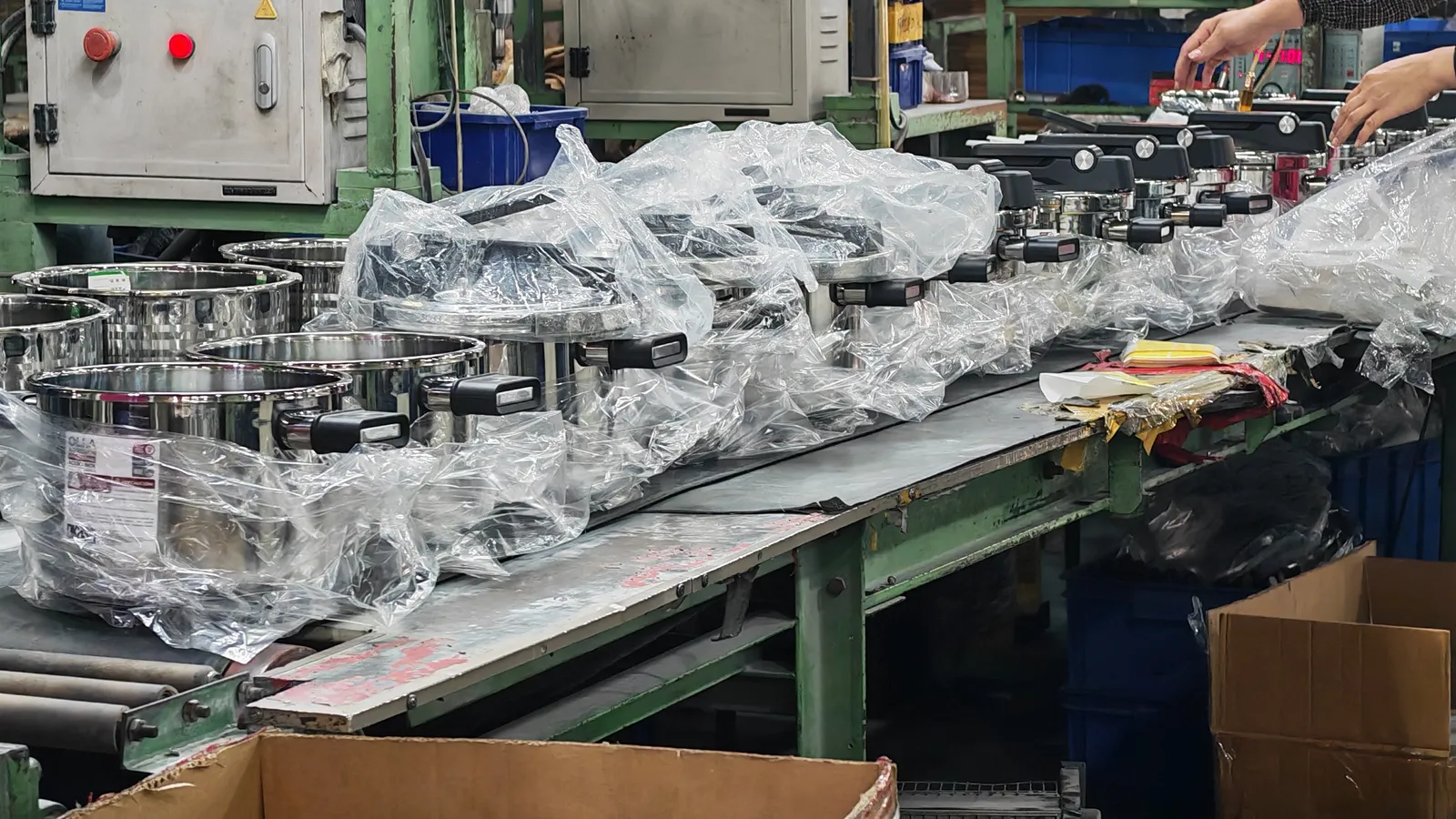
The last line of the specification is written here. Packing format and carton count are the two fields most often left blank, and the two that decide the landed cost.
Then check the first container, not the sample: appearance against the approved reference; dimensions including rim flatness; function, meaning lid seat and induction; material, against a mill certificate or a composition test; and the documents, checking the entity name rather than the logo. A sample proves what the factory can do once. A container proves what it does repeatedly.
The question worth asking any HoReCa supplier is not what the steel is. It is where this pot will fail in my kitchen, and which line on your sheet prevents it. A supplier who cannot answer the first half has not seen your kitchen; one who cannot answer the second is selling a catalog rather than a specification — and that holds whether you are sourcing catering cookware for hospital sites or restaurant cookware wholesale for forty properties.
Common questions
What does HoReCa mean, and why does it matter when sourcing?
HoReCa is an abbreviation of hotel, restaurant and café-catering: the hospitality and food service channel. It matters in sourcing because the four parts do not buy the same way. A hotel orders against a written brand standard on an annual cycle, a single restaurant buys on replacement demand, a café chain buys small diameters on a visibility requirement, and a contract caterer buys for transport and holding. One specification quoted to all four is a correct answer to one of them and an expensive one for the others.
What cookware do hotels and restaurants actually buy?
A narrow range, ordered deep. The HoReCa core list is a stock pot for batch cooking and holding, a single-handle saucepan for sauces and sides, a sauté or frying pan as the line workhorse, a braising pan that goes from hob to oven, a tiered steamer, and a stovetop kettle for breakfast and front-of-house service. Across those six shapes a hotel or restaurant group will typically run three to four diameters. The thin-gauge hotel pans, GN containers and chafing dishes used on a buffet are a separate product family, made on different tooling.
What is the difference between a hotel pan and a GN pan?
Both are rectangular containers built to fill a machine or a serving line, and the two systems are not interchangeable. The metric Gastronorm system is based on a module of 530 by 325 mm, standardised in Europe as EN 631-1, with fractional sizes and depths from 20 mm to 200 mm. The North American hotel pan is non-metric, with a full size of 12 by 20 inches. Bains-marie, combi ovens and racks are built to one system or the other, which is why a supplier quoting containers should say which system the equipment around them takes.
Do HoReCa buyers purchase cookware directly from a factory?
Most do not. Independent restaurants and individual hotels usually buy through a foodservice equipment distributor or dealer, which is why search results for HoReCa supply terms are dominated by local dealers. Chains and hotel groups buy through group purchasing arrangements, approved-vendor lists or a tender, with head office locking the specification and properties ordering against it. For a factory, the effective customer is often the distributor's own brand, supplied as OEM or private label, and the specification has to survive a catalog page, a tender and a multi-site rollout.
Written by
Potobelo Editorial Team
Sourcing and engineering staff at Potobelo, a stainless steel cookware brand built on 30 years of Zoombo manufacturing in Guangdong, China. We write from inside the plant that makes the product, not from reviewing it.