
Composite Bottom Cookware Explained: What 'Impact Bonded' Means
Most "composite bottom" claims describe a shape, not a construction. This is how an impact-bonded base is actually made, how it differs from an encapsulated base and from a fully clad wall, and the lines a buyer has to put on the drawing before that difference survives to mass production.
 Potobelo Editorial Team16 min read
The short answer: a disc, not a clad wall
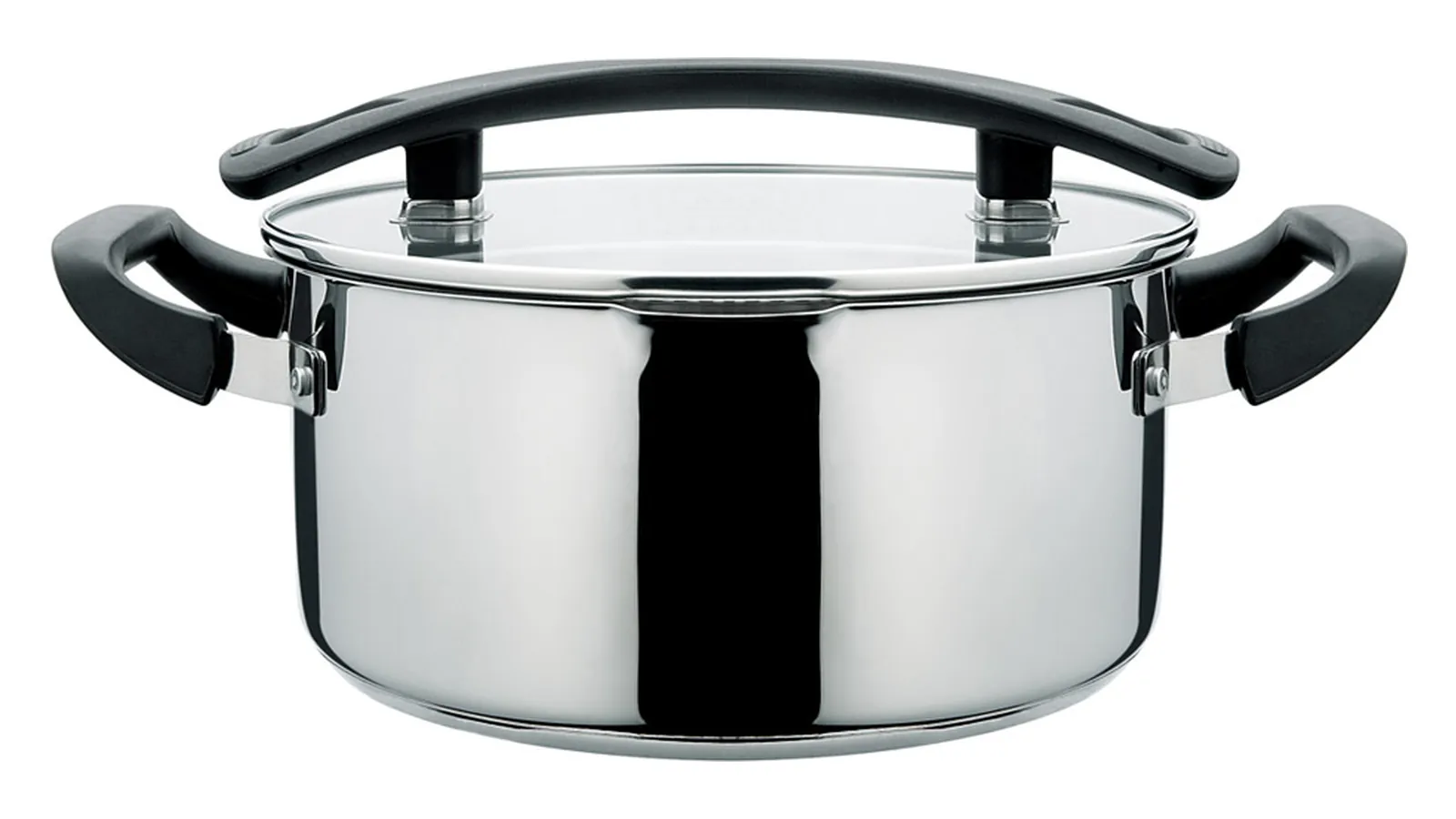
"Impact bonded cookware" describes how the base of a stainless steel pan is built, not how the pan cooks.
A single-wall stainless body — drawn, trimmed, annealed, polished — has an aluminium disc pressed onto its underside under heat and very high load, usually with a magnetic stainless cap on the outside face so the pan can run on induction. The aluminium stays under the base: it does not continue up the wall and does not exist anywhere else in the vessel.
Everything the phrase promises follows from that one geometric fact, and so does everything it leaves out. Heat spreads quickly across the bottom and barely at all up the side. Induction compatibility comes from a cap, not from the body. The joint between disc and body is a discrete interface — the only place in the pan where a bond can fail separately from the metal around it.
For a buyer that settles the specification question faster than any ply count: the base is a part, not a layer. If a factory cannot tell you the disc's alloy, its diameter, its incoming and finished thickness, and how it is centred, then "composite bottom" on the quotation is a description of a shape.
Term on the quotation | What it actually describes | What it does not tell you |
|---|---|---|
Impact bonded base | Aluminium disc joined to the outside of a single-wall body | Anything about the wall, the cap grade or the bond quality |
Composite bottom | A base with more than one metal in it — bonded disc or capsule | Which of the two constructions, or how thick the aluminium is |
Encapsulated base | A disc sealed inside a stainless capsule welded to the body | Whether the disc is centred, or how thick the cap is |
Clad / tri-ply / fully clad | Laminate bonded as sheet before forming, core running to the rim | How the layers are sized; ply count alone grades nothing |
Four constructions, one spectrum
The constructions sit on a single line, and the line is about where the aluminium stops.
At one end is single-ply: one sheet of stainless, no conductive layer at all. It is cheap, it is light, and it is honest about what it does — a hot ring under the burner and a cool edge 10 cm away.
Next is the impact-bonded disc. Aluminium under the base only, capped with magnetic stainless so the pan will run on induction. Heat spreads across the bottom; the wall stays single-layer steel.
Then the encapsulated base, which is the same disc with the aluminium sealed inside a stainless capsule fused to the body. Functionally close to the impact-bonded disc, mechanically different at the rim: there is no exposed aluminium edge for water and dishwasher chemistry to work on, and the capsule clamps the disc instead of relying on the bond alone.
At the far end is fully clad: stainless, aluminium and stainless bonded into one sheet before the pan is formed, so the core runs up the wall as well as across the base. This is what the 3-ply and 5-ply counts refer to — a property of the laminate, not a grade — and the layer-by-layer comparison of 3-ply and 5-ply builds covers that side of the question.
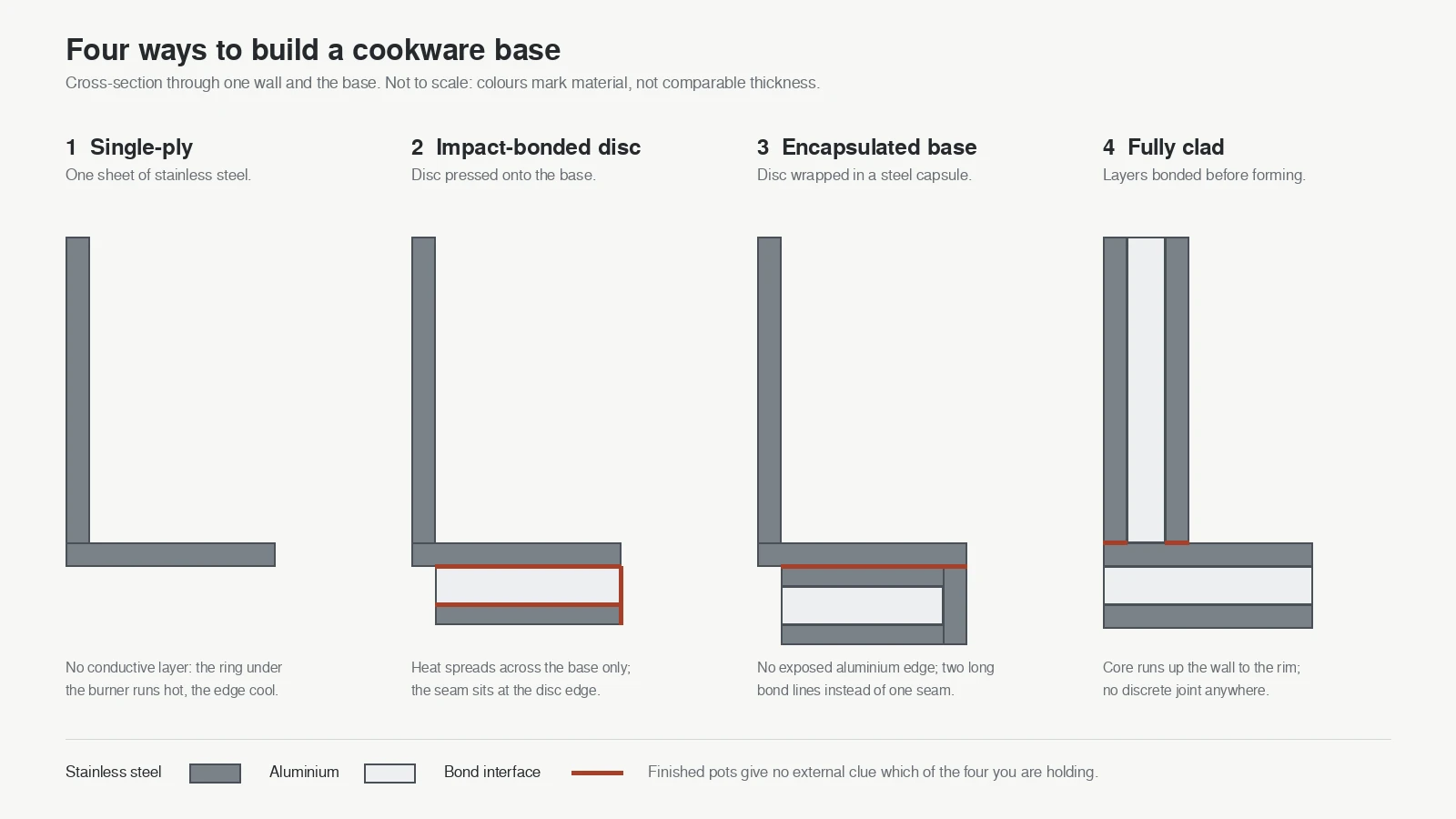
Drawn as sections, the difference stops being a marketing word. Panels 2 to 4 all contain aluminium; only panel 4 carries it into the wall.
Why the base exists at all
Stainless steel is a poor heat conductor — roughly an order of magnitude worse than aluminium. That is not a defect to be engineered out; it is the property that makes it corrosion-resistant and easy to clean. But it means a bare stainless pan does not spread heat sideways: it passes heat straight up from wherever the burner is, which produces a hot ring at the diameter of the burner and a cool rim. Proteins stick and scorch inside that ring.
An aluminium layer fixes the lateral spread, because aluminium moves heat sideways fast enough to even out the base before the food sees it. What it does not fix is the wall. A single-wall stainless side over a hot base is still a poor conductor doing its best, which is where milk scorches at the liquid line and rice sticks above the water. Aluminium and stainless steel behave so differently under heat that the construction question is really about where to put the aluminium and how much to pay for it.
How an impact bonded cookware base is built
The process is short, and every step is a place where a supplier can take cost out without changing the word on the quotation.
1. The body is drawn and finished first. A stainless circle is deep-drawn over one or more stages, annealed between them, trimmed, and the rim rolled. At this point the body has a flat or slightly domed bottom and nothing else.
2. The disc is a separate part with its own supply chain. Aluminium sheet is blanked into circles and cleaned; the magnetic cap that will sit on the outside face is blanked the same way. Each has its own thickness tolerance, alloy and cost before it becomes a pan base.
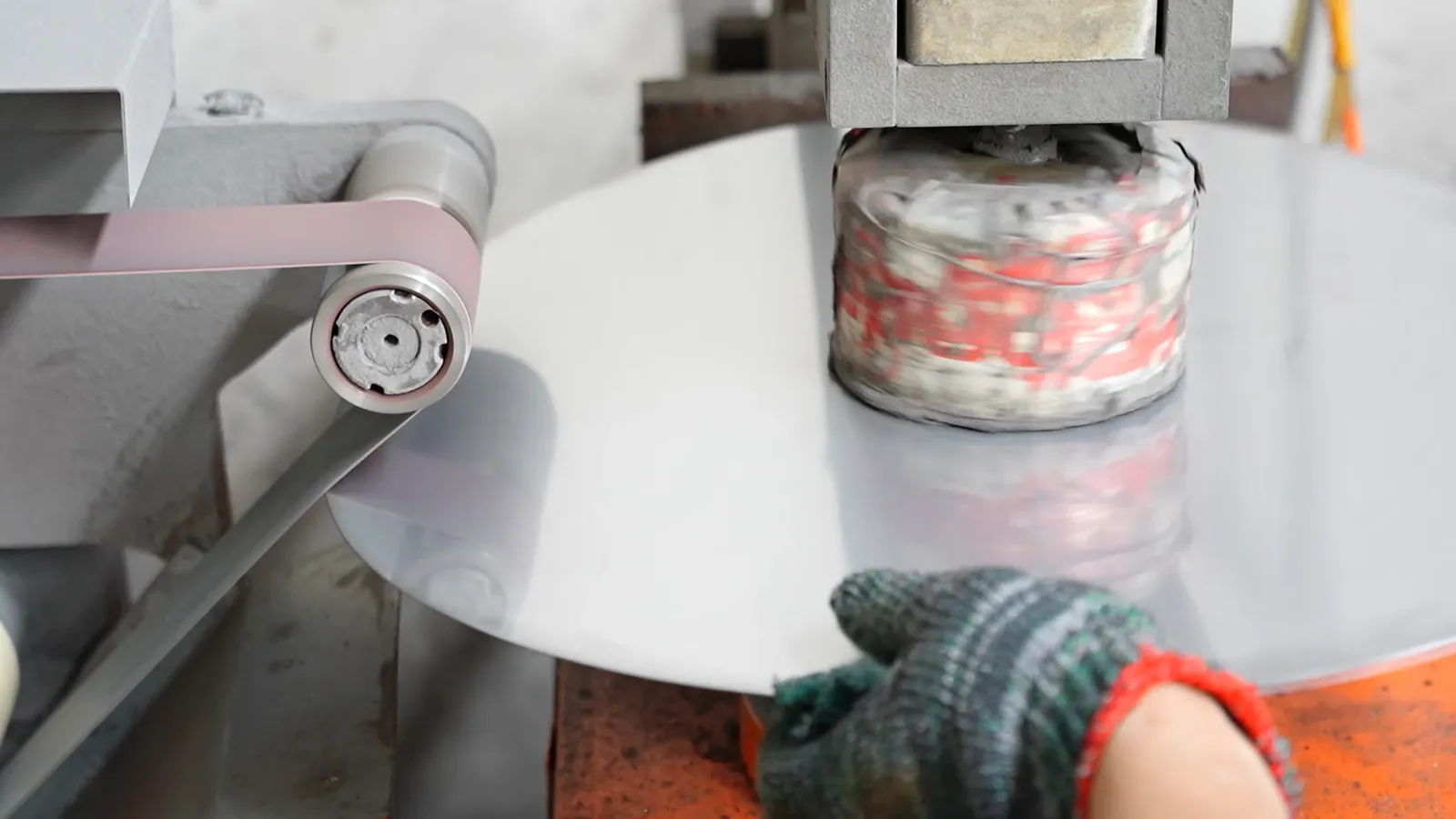
3. Both faces are prepared. Bonding is a metal-to-metal joint, so the aluminium and the steel have to be clean, flat and in full contact before the press closes. Oxide, oil and a domed disc are the three common causes of a bond that looks right and is not.
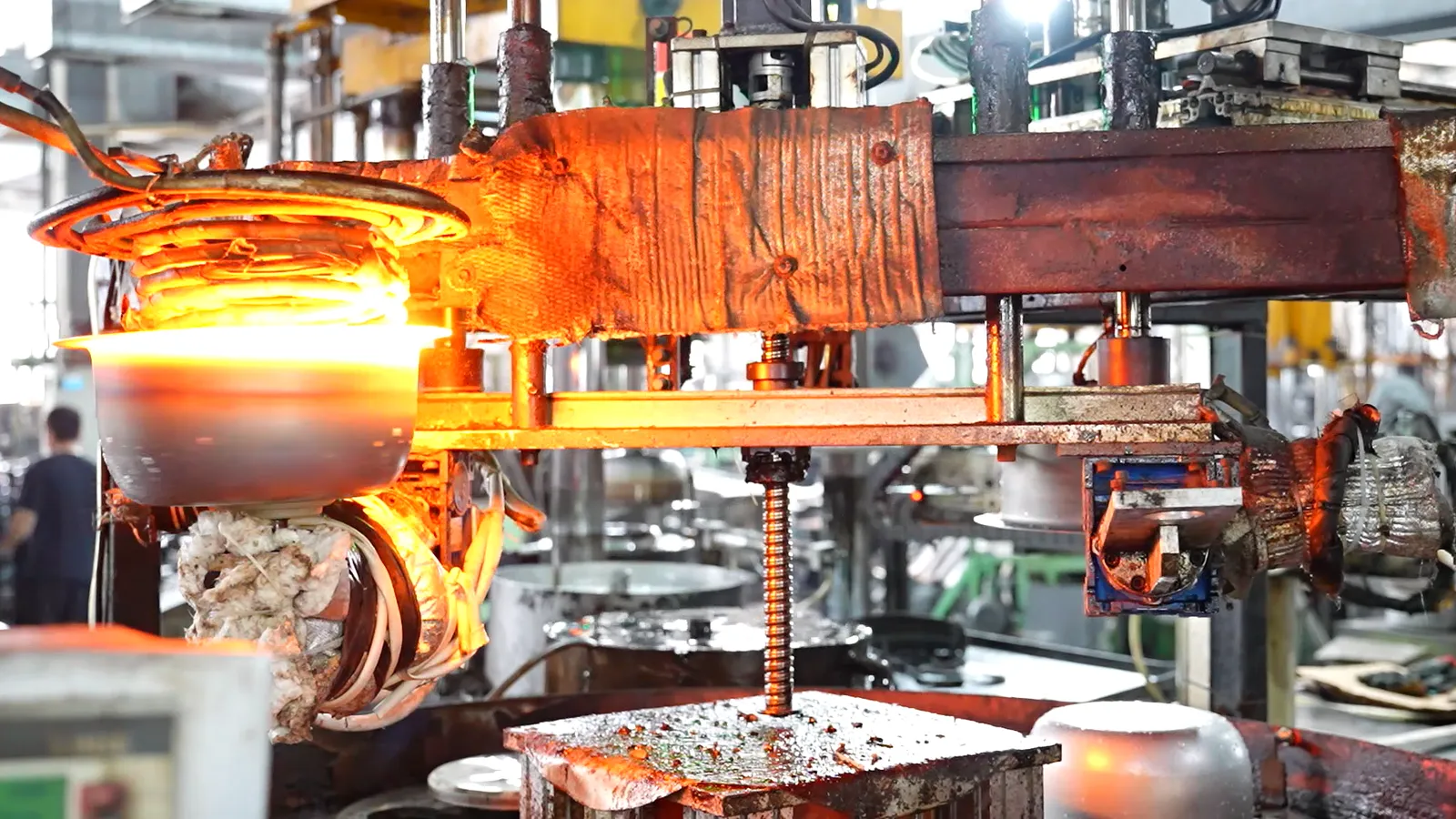
4. The stack is heated. This is the step the induction station in the cover photograph is showing: body and disc brought up to bonding temperature. One published description of the process puts the pre-bond heating at about 400 °C by induction, with the press then applying roughly 5,000 psi through a mould to force the two metals together (US 8,806,737 B2). Exact parameters differ by factory, disc alloy and body thickness; the point is that temperature and pressure are process variables, not constants, and someone has to own them.
5. The press closes the bond. Depending on the line, this is a heavy single-stroke press or an impact / friction-screw press; its job is to hold the stack flat and squeeze it while it is still at temperature. (The brazing route in the next section reaches the same shape without that squeeze, which is why it is treated separately.) What matters downstream is not which machine was used but whether the same machine, tooling and settings ran your approved sample and your production.
6. The base is cooled, trued and finished. The rim of the base is turned to a step, the edge polished, and flatness corrected — a base that has just been through a thermal cycle is not automatically flat. Rushing the flattening step is one of the cheapest ways to ship a pan that rocks on a glass hob.
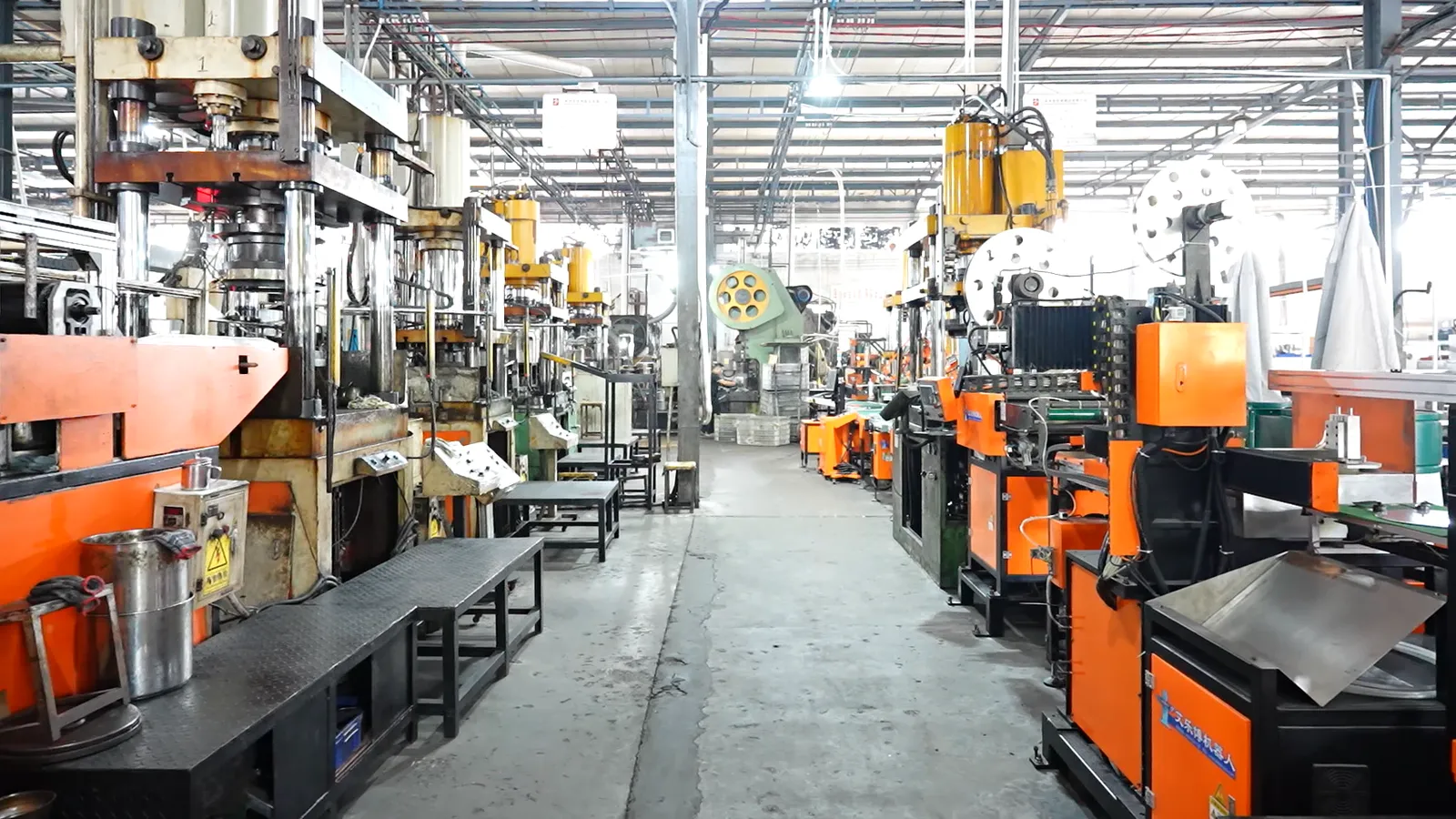
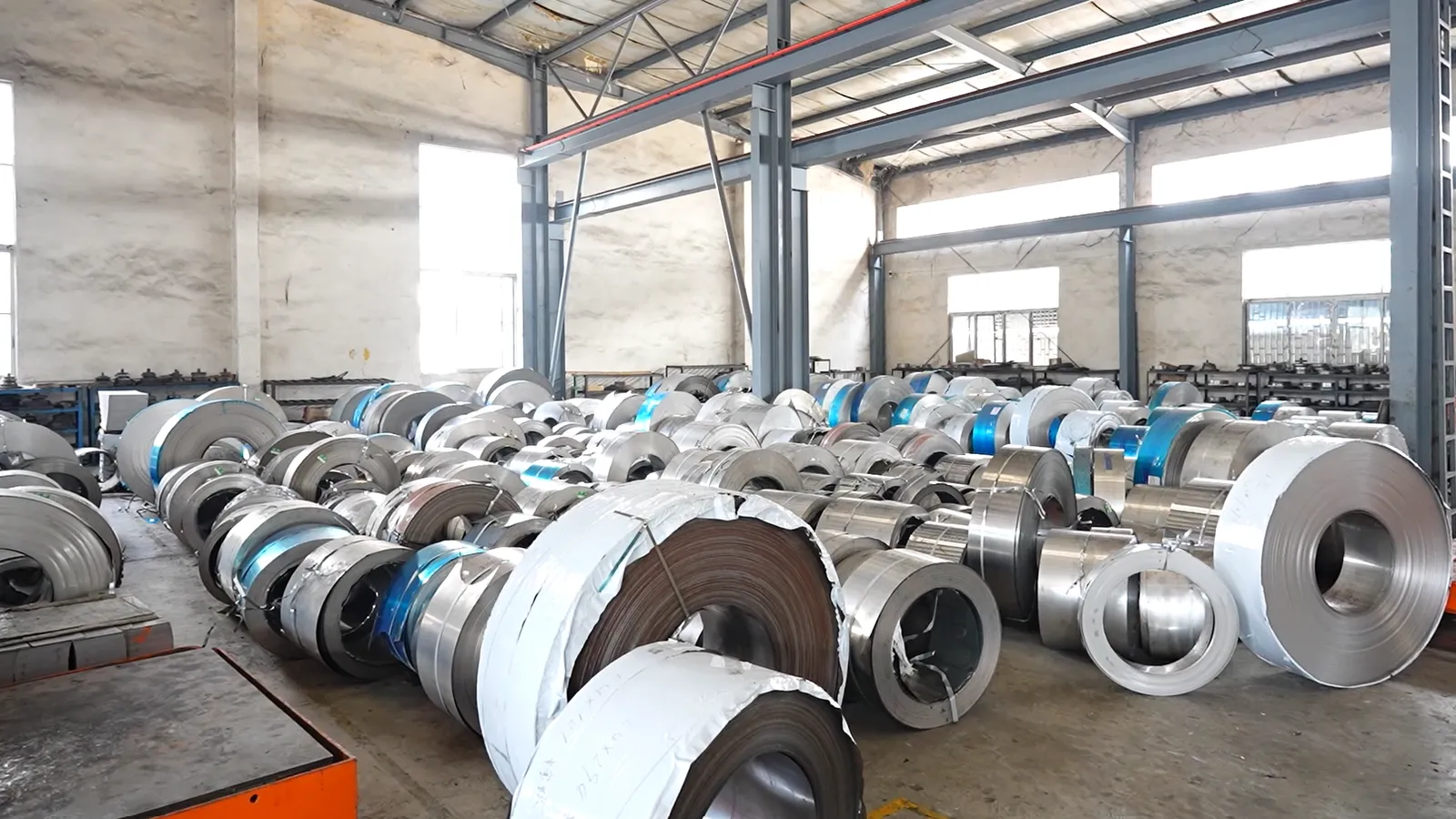
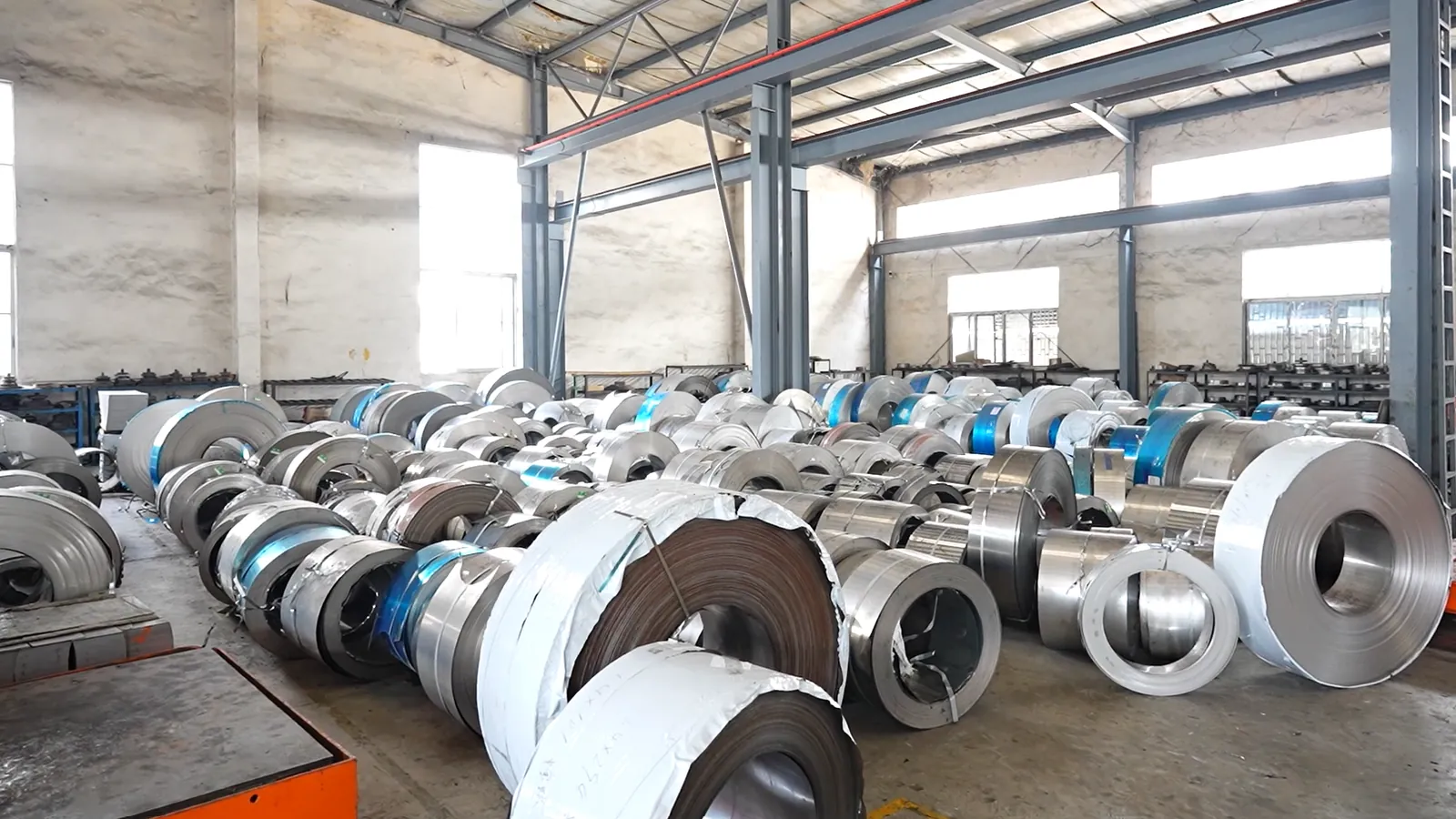
A press hall is the scale evidence here: disc bonding needs a press, a die set, a heating station and a flattening station, set up per model and per base diameter. How stainless steel cookware is made follows the same line from coil to packed carton.
Brazing: the other route to the same shape
The second way to fix a disc is to braze it. Instead of relying on heat and pressure alone, a filler alloy is melted at the interfaces, so the joint is made by a third material rather than by direct metal-to-metal contact.
Brazing is more forgiving on shape and cheaper to tool for small runs, which is why a lot of encapsulated bases are brazed and then welded to the body as a unit. It also introduces a variable that impact bonding does not have: the bond line is now an alloy applied with a flux, and both have to be controlled. Flux residue at the edge, an uneven filler layer, or a joint starved in the middle and rich at the rim will all pass a visual check and show up later as a hot band or a separation.
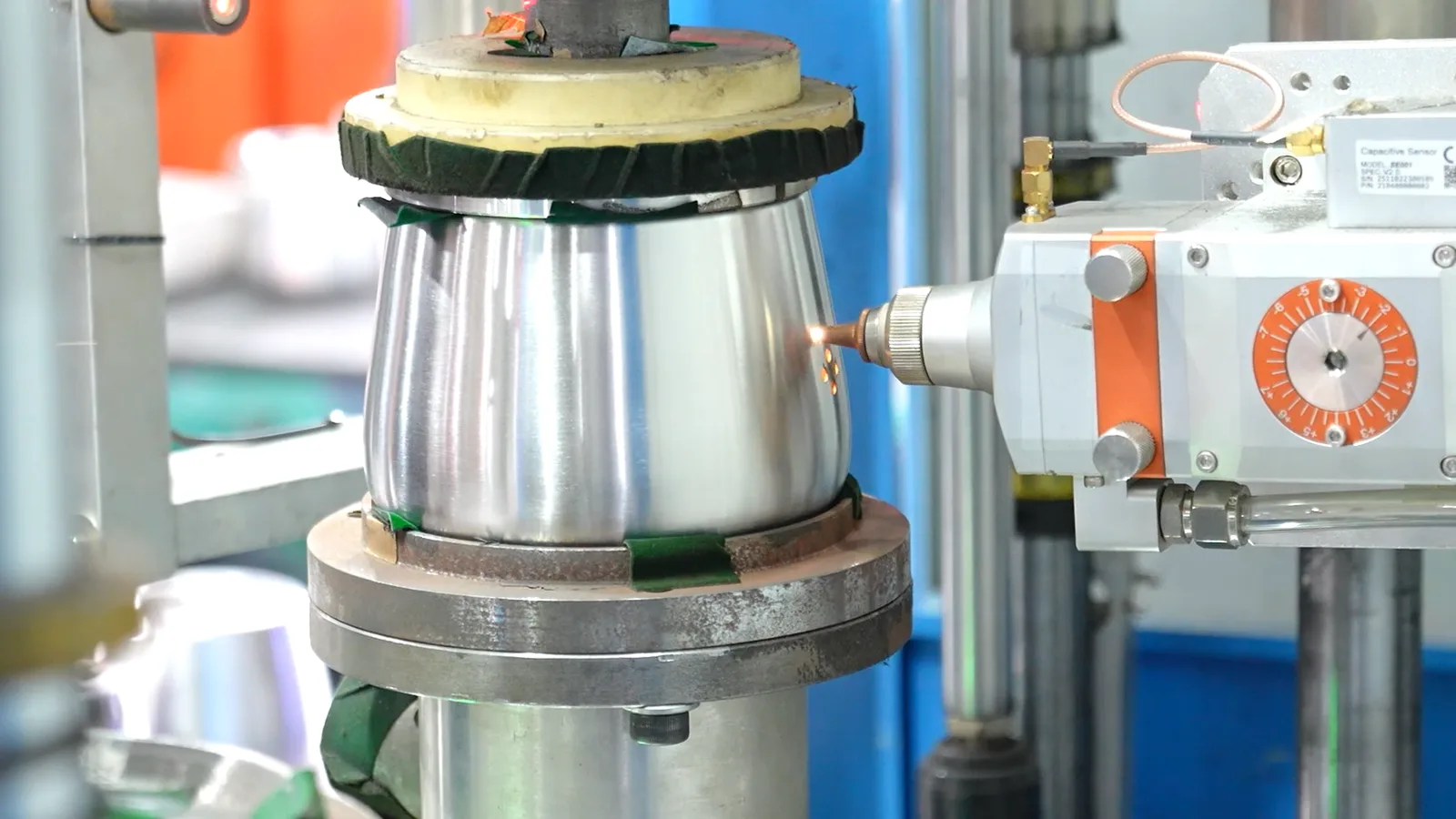
Brazing moves the quality question from "did the press close" to "was the joint filled and cleaned". When a supplier says the base is brazed, the follow-up is what they measure on the bond line, and how often.
What each construction changes for a buyer
Construction | Heat across base | Heat up the wall | Induction | Failure mode you will actually see |
|---|---|---|---|---|
Single-ply | Poor: ring under the burner | Poor | No, unless the body grade is ferritic | Coning and permanent warp |
Impact-bonded disc | Good, if disc diameter and thickness are specified | Poor | Yes, via the cap | Seam corrosion, rattle, delamination at the edge |
Encapsulated base | Good, same variables | Poor | Yes, via the cap | Delamination under the capsule, less exposure at the rim |
Fully clad | Good, and continuous into the wall | Good | Yes, via the outer layer | Blister or rim separation; no seam to start from |
Weight sits in one place. A disc base puts the mass at the bottom and leaves the wall thin: good for stability on a hob, bad for the hand, visible in the carton.
Cost is concentrated in the base. Aluminium plus cap plus blanking plus bonding plus edge machining plus flattening — every one is a line item a supplier can reduce. The two cheapest reductions are a thinner disc and a smaller disc diameter; the second leaves a cold band near the rim that no test catches unless the drawing specified diameter.
The failure mode is a joint, not a material. A clad pan fails, if it fails, on a manufacturing defect in the laminate; a disc pan has a discrete interface, and that is where thermal cycling, moisture at the seam and a marginal bond converge.
Where disc bases fail, and what the claim looks like
Base delamination is the failure this construction is known for, and it is worth being precise about how it presents.
Aluminium expands faster than the steel around it over the same temperature rise, so every heat cycle loads the bond in shear. A sound interface absorbs that for years; a void, an oxide inclusion or a starved brazed joint accumulates damage at the edge first, where the gradient is steepest and, on an unprotected disc, the moisture gets in.
In the field it usually announces itself in this order: a change in the sound when the base is tapped, then a faint rattle, then a visible gap or bulge at the seam, then a base that no longer sits flat. By the time it bulges it is a claim, not a defect report.
Tap, then rattle, then a gap, then a pan that will not sit flat. By the fourth stage the argument is about money, not about metallurgy.
Two things are worth separating before you blame the bond. A pan that rocks is not necessarily delaminated — flatness is a forming and flattening variable and can be wrong from the first day. And a pan that discolours at the seam is not necessarily corroding — heat tint and polymerised oil look alike in a photograph and mean different things.
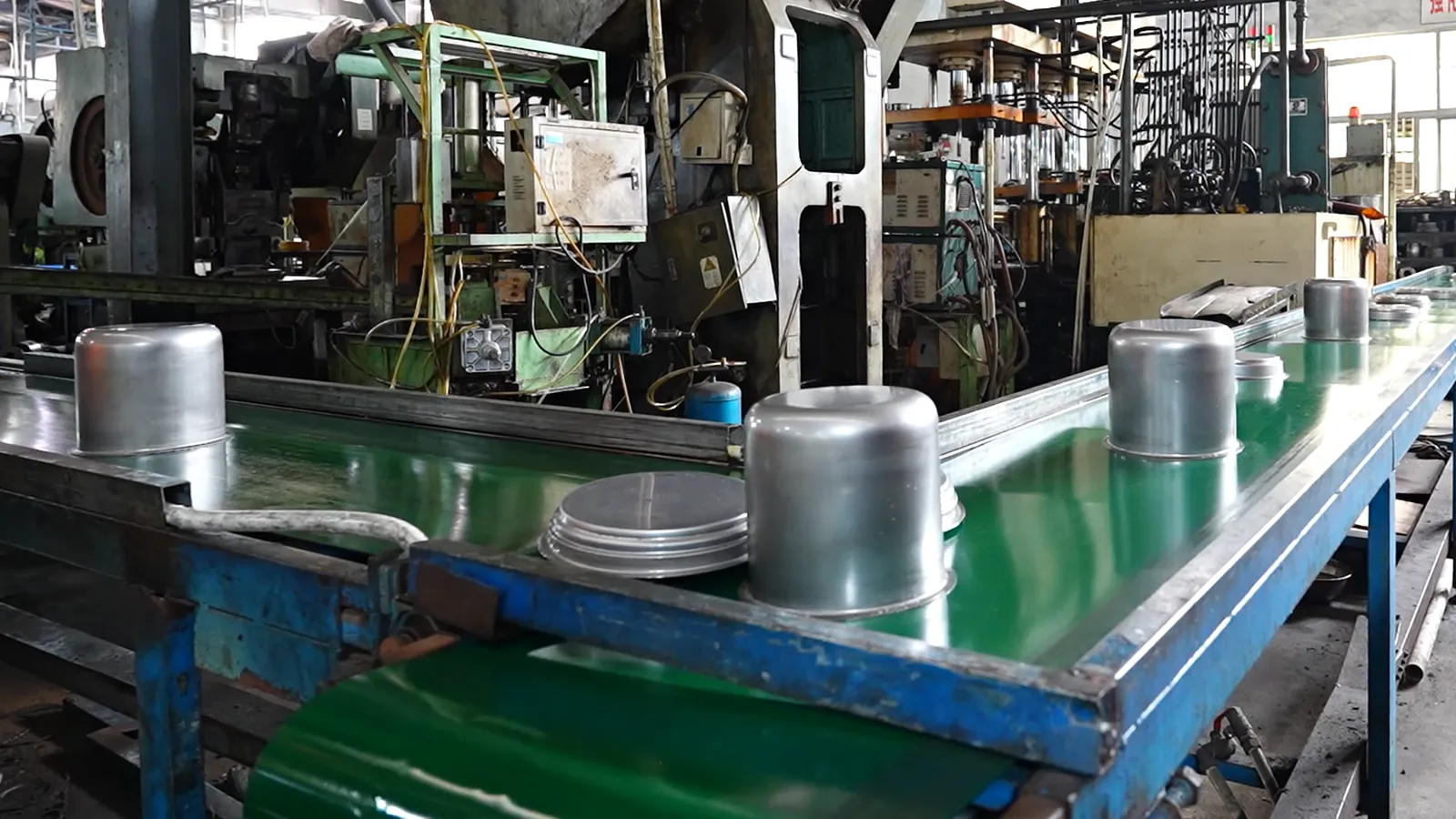
Bodies and discs move through the line in lots, so a bond problem is almost never one pan: the lot, the disc batch and the bonding shift are the traceable units.
Magnet, induction, and a test that proves nothing
The magnet test is the most quoted and least useful check in this category.
A magnet stuck to the outside of a base tells you one thing: the outer face is ferromagnetic, most likely a 430-type ferritic stainless. It does not tell you the disc is centred, that the aluminium is the thickness on the drawing, that the bond is continuous, or that the base is flat. A pan with a 0.4 mm cap and a pan with a 0.8 mm cap hold the magnet equally well and do not heat equally well on the same hob.
That matters most on induction, because the coil does not heat the pan — it induces current in the ferromagnetic cap, and the aluminium only redistributes what the cap absorbed. Coupling depends on cap grade and thickness, on disc diameter relative to the coil, and on how much of the base is touching the glass. What induction hobs ask of a pan goes deeper on coupling; for base specification, the consequence is that induction performance has to be tested as a system, on real appliances, not inferred from a magnet.
A workable check is dull and repeatable: each appliance class your market sells, a defined load of water, and a record of time to boil, the lowest setting at which the hob still detects the pan, noise, and whether the hob cycles. Run it on the first-off, a mid-run sample and the last carton.
The lines to put on the drawing and the PO
A specification that says "composite bottom, induction ready" cannot be accepted or rejected. These fields can:
- Body grade and finished wall thickness — 304, 201 or 18/10, as a grade plus a measured thickness, not a trade name. The grades themselves are a separate decision from the base.
- Disc alloy and diameter — alloy designation (1050 and 3003 are the common choices) and diameter as a percentage of the base diameter. Diameter is the field most often missing and the one that decides whether the rim runs cold.
- Disc thickness, incoming and finished — aluminium is compressible under load, so the number that matters is finished base thickness at agreed measuring points, not the sheet that went in.
- Cap grade, thickness and coverage — 430-type ferritic, with a minimum thickness and a stated coverage of the base area.
- Joining method and process owner — impact bonded or brazed, on which machine, with which tooling, and who signs off the settings.
- Centring tolerance — disc concentricity relative to the body, in millimetres. Off-centre discs are a real defect and an invisible one.
- Base flatness — measurement method, measuring position and acceptance value, taken cold and again after the thermal cycle.
- Step and seam limits — the visible step at the base edge, and limits on any gap, discolouration or polishing at the seam.
- Bond verification and acceptance — destructive section or chisel separation on a sampled unit, with the criterion written down (on a sound impact bond the aluminium tears before the joint does).
- Thermal-cycle protocol — heat source, power, load, peak, hold, cooling method and cycle count, with the post-test checks listed.
- Lot traceability — body lot, disc lot, cap lot and bonding shift recorded against the carton.
Eleven lines. None is exotic, and all are cheaper to agree before tooling than after the first container.
How to verify a bond without owning a lab
Four checks will hold a supplier to a bond specification, and none of them needs a laboratory.
Tap the base. A dull, dead note against a clear ring is a signal, not a verdict. Free, fast, and only useful as a screen.
Cut a section. Two or three units per lot, cut at agreed locations and photographed at magnification: layer continuity, disc centring, interface condition and actual thickness. Destructive, so pair the sample with the process record.
Cycle it and measure. Flatness before, at temperature where the method allows, and after cooling, recording centre rise, rocking and permanent deformation. A single pass mark hides drift; a table of numbers per lot does not.
Try to separate it. A chisel or wedge driven into the interface is the classic destructive check: if the aluminium tears and the joint holds, the bond is sound. If the joint opens cleanly, you have found the failure mode before your customer does.
The European general standard for domestic cookware used on a stove, cooker or hob is DIN EN 12983-1, and it is the document buyers cite when they want a test method that is not the supplier's own. Write acceptance limits before the first sample arrives — the same discipline that stops a sample from drifting away from the mass run applies here, because a base is exactly the kind of feature that gets quietly optimised between the two.
Food contact: what the base does and does not decide
On a disc-base pan the aluminium and cap sit outside the vessel: the food-contact surface is the body's inner stainless, so the base is a thermal component rather than a food-contact layer. That does not make the materials question go away; it moves it.
Under EU Regulation 1935/2004 the framework governs migration from food-contact materials into food. It does not publish a whitelist of approved stainless grades, so "approved grade" is not a status the regulation confers on any particular steel. In the United States the route is through the FDA's food-contact substance framework, where stainless steel is assessed by series and chromium content rather than by a single approved designation. China's GB 4806.9 works on specific release limits for metal migration.
The practical translation: ask for migration test data on the grades actually in the product, for the market you sell into, and treat "food grade" as a claim to be evidenced rather than a category that exists. What makes stainless steel cookware safe covers the grade-specific side.
What to ask on the first call
Five questions sort a supplier faster than a factory tour:
- Which bonding method do you run on this base diameter — impact, friction or brazed — and on which machine?
- What is your finished base thickness at the centre and 10 mm inside the rim, measured, not nominal?
- How do you verify a bond, on what sample size, and what is the acceptance criterion?
- What is your delamination claim rate on comparable programmes, and who owns the claim if it happens?
- Will you put the flatness method and the thermal-cycle protocol in the specification, or only in the quotation?
A factory that can answer the first four and will sign the fifth is a different counterparty from one that answers with the words "composite bottom".
Potobelo specifies a composite, multi-layer base as standard across its stainless range and supplies four product lines — pressure cookers (10 SKUs), water kettles (10), saucepans and casseroles (20) and steamers (8), 48 SKUs across the four — with pressure cookers in 304-grade stainless. Sampling runs 7–10 days, production 30–50 working days, at a minimum of 1,200 pieces per model. If you are specifying a base for a market with an induction-heavy retail mix, that is the conversation to have before tooling.
The base is the cheapest place in a cookware programme to gain performance and the easiest place to lose it silently. Specify the disc, and the phrase stops being a marketing word.
Common questions
What does impact bonded mean on cookware?
Impact bonded describes how the base is attached. A single-wall stainless steel body has an aluminium disc pressed onto its underside under heat and very high pressure, usually with a magnetic stainless cap on the outside face so the pan can run on induction. The aluminium stays under the base and does not continue up the wall. That is the difference from clad cookware, where the aluminium core is bonded into the sheet and runs from the base to the rim.
Is impact bonded cookware as good as fully clad cookware?
It is better for some products and worse for others. An impact-bonded base spreads heat across the bottom about as well as a clad base of similar aluminium thickness, and it costs less because the conductive metal is only under the base. It is weaker where the walls matter: milk, rice and thickening sauces scorch on single-wall stainless because nothing spreads heat up the side. For stockpots and boiling pans the base carries most of the load; for saucepans and saute pans, clad is the more defensible specification.
How can I tell whether a pan has an impact-bonded base?
Look at the rim and at the base edge, not at the label. A disc base shows a step or a seam where the base assembly meets the wall, and the rim shows a single steel thickness. A clad pan shows a fine laminate line at the rim and no step at the base. Weight distribution is the second clue: a disc pan is heavy at the bottom and noticeably light higher up. A magnet is not a test, because it only reads the magnetic cap on the outside of the base.
Does an impact bonded base work on induction hobs?
Yes, provided the outer cap is a ferritic magnetic stainless such as a 430-type grade. The aluminium disc does not respond to the coil itself; it only spreads the heat that the cap absorbs. This is why two pans with the same base thickness can behave differently on the same hob: cap thickness, cap coverage, disc diameter and base flatness all change how much of the coil's field is coupled and how evenly the heat lands. Test detection and heating on the appliances your market actually uses.
Written by
Potobelo Editorial Team
Sourcing and engineering staff at Potobelo, a stainless steel cookware brand built on 30 years of Zoombo manufacturing in Guangdong, China. We write from inside the plant that makes the product, not from reviewing it.